

Airplane Washing Using Water Jet, CFD Simulation ANSYS Fluent Training
Price: $42
This project was performed to simulate aircraft washing using a water jet by ANSYS Fluent software.
Airplane Washing Using Water Jet, CFD Simulation ANSYS Fluent Training
Price: $42
This project was performed to simulate aircraft washing using a water jet by ANSYS Fluent software.
Airplane washing Introduction
Airplane fuselages become contaminated over time due to high-velocity motion, including insect carcasses and bird droppings that combine with engine exhaust to create a carcinogenic layer of contaminant on the fuselage. This Airplane washing is done several times during the year. Airplane windows are also sensitive parts that can be easily scratched, and it is best to cover these parts before starting the washing process.
Problem Description
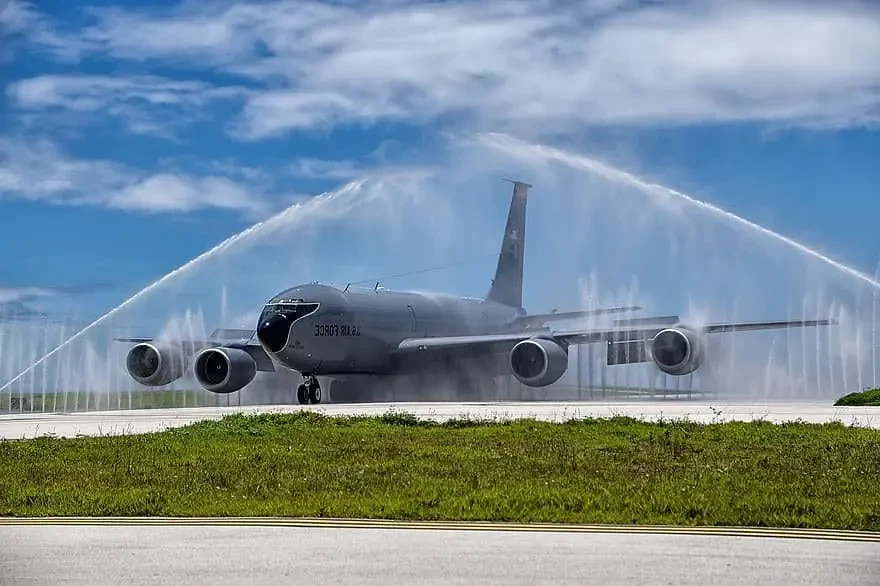
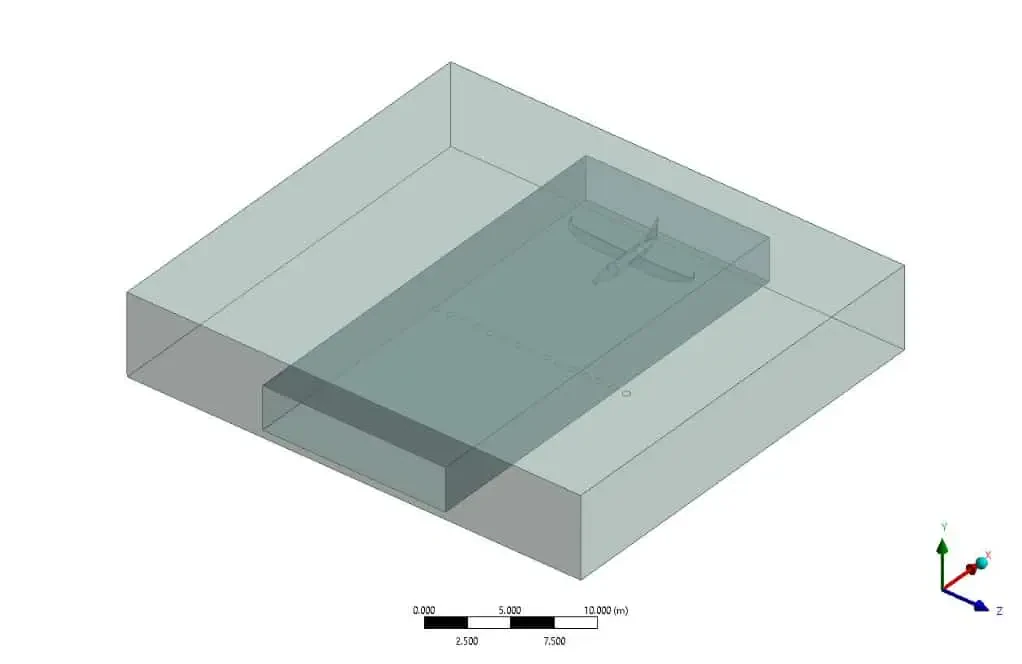
This project was performed to simulate aircraft washing using ANSYS Fluent software. The computational domain of a cube with dimensions of 46 x 8.5 x 17, in which a separate part is provided to move the sub-domain of the aircraft using the sliding mesh model. Water enters the computational domain through holes in the bottom of the slope at a speed of 15 meters per second and air in the opposite direction of the plane at a speed of 2 meters per second from the opposite side to model more realistic conditions.
Geometry & Mesh
The computational domain was designed using Design Modeler software. The computational domain includes a 46 x 8.5 x 17 m cube. The domain in which the plane was located and moving a cube with a cross-section of 13.5 x 3 meters.
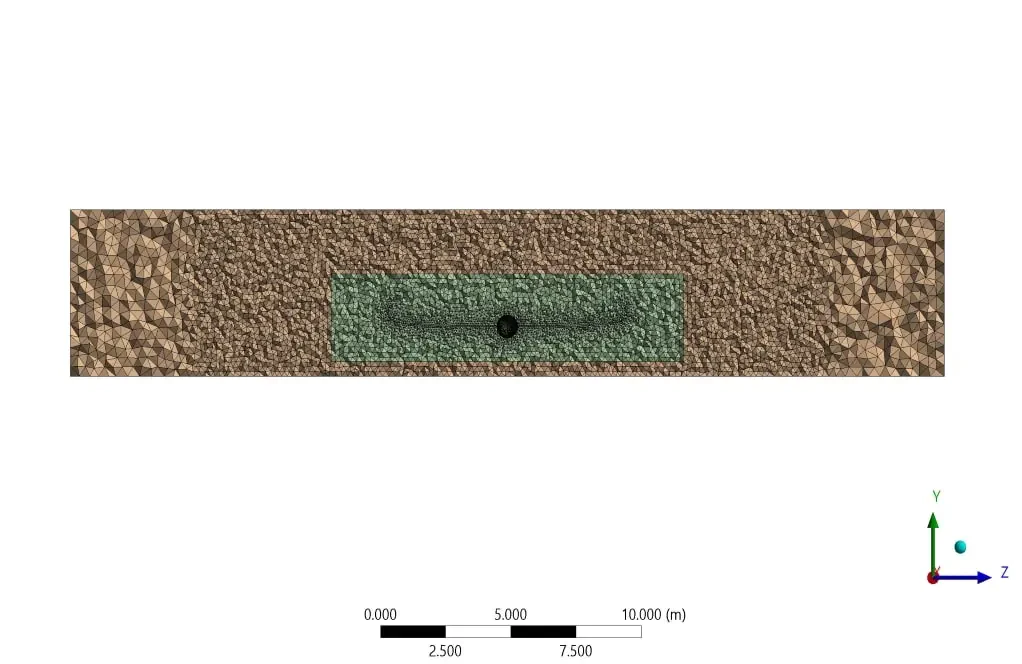
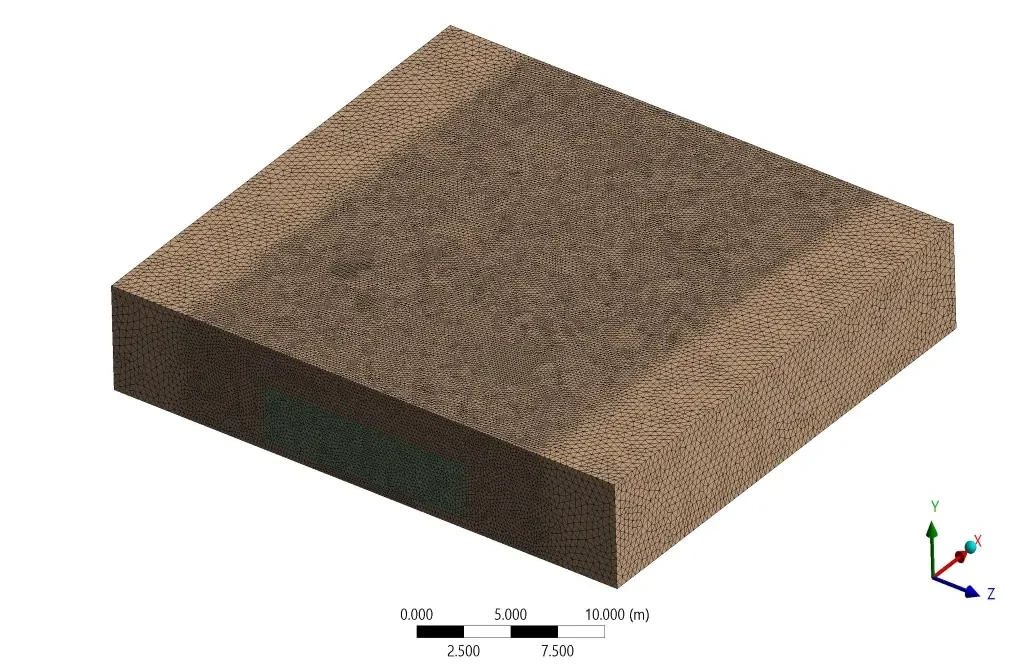
ANSYS Meshing software was used for grid generation, and the type of problem elements was unstructured. Also, the total number of elements was about 4560000.
Solver Setting
In this simulation, the following hypotheses are established:
- A pressure solver was used.
- The problem was solved transient.
- The gravitational effect was considered.
Also, the table below shows the characteristics and values of boundary conditions, along with the models and hypotheses.
| Material Properties | |
| Water | |
| Amount | Fluid properties |
| 998.2 | Density (kg/m3) |
| Air | |
| Amount | Fluid properties |
| 1.225 | Density (kg/m3) |
| Multiphase | |
| Homogeneous model | VOF (volume of fluid) |
| Number of Eulerian phases | 2 (water-air) |
| Interface modeling | sharp |
| Formulation | Explicit |
| Air-water surface tension coefficient | 0.072 N/m |
| Boundary Condition | |
| Type | Velocity inlet |
| Water inlet | 15 m/s |
| Air inlet | 2 m/s |
| Type | Outlet |
| Outlet | Gauge pressure zero |
| Cell zone condition | |
| Fluid | mixture |
| Mesh motion | |
| Moving zone | Translational velocity = 1 m/s |
| Turbulence models | |
| K-e | viscous model |
| Realizable | K-e model |
| Standard wall function | Wall function |
| Solution methods | |
| Simple | pressure velocity coupling |
| Spatial discretization | |
| PRESTO | pressure |
| Second-order upwind | momentum |
| Modified HRIC | Volume fraction |
| First-order upwind | turbulent kinetic energy |
| First-order upwind | turbulent dissipation rate |
| Initialization (Hybrid) | |
Results
In this section, volume fraction and velocity counters are placed in a longitudinal section of the computational range. Observing these images, it is clear that the amount of air injection into the domain increases over time, and when the aircraft reaches that part, the washing process is performed.