

Aorta, Non-Newtonian pulsating blood flow
Price: $42
- The problem numerically simulates a non-Newtonian pulsating blood flow in Aorta using ANSYS Fluent software.
- We design the 3-D model with the Design Modeler software.
- We mesh the model with ICEM software, and the element number equals 457864.
- We perform this simulation as unsteady (Transient).
- We use a UDF to define the pulsating inlet velocity to Aorta.
- We use the Carreau model to define a non-Newtonian fluid.
Aorta, Non-Newtonian pulsating blood flow
Price: $42
- The problem numerically simulates a non-Newtonian pulsating blood flow in Aorta using ANSYS Fluent software.
- We design the 3-D model with the Design Modeler software.
- We mesh the model with ICEM software, and the element number equals 457864.
- We perform this simulation as unsteady (Transient).
- We use a UDF to define the pulsating inlet velocity to Aorta.
- We use the Carreau model to define a non-Newtonian fluid.

Aorta, Non-Newtonian pulsating blood flow, ANSYS Fluent CFD Simulation Training
In this study, a non-Newtonian pulsating blood flow in Aorta has been studied by ANSYS Fluent software. The geometry is a *.stl file that should be repaired before generating the mesh.
This aorta geometry is obtained from a real geometry from a CT-Scan. Some powerful tools can assist us in fixing the geometry, such as Spaceclaim, ICEM CFD, and Design Modeler. We used ICEM CFD to fix the geometry and generate a mesh in this study.
First, the mesh was generated using the octree method with 5 layers of prism meshes with a ratio of 1.2. Second, the Delaunay method has been used to improve the quality of the existing mesh. The final number of mesh is 457864 cells.
Aorta Methodology
UDF defines the pulsatile inlet velocity. A non-Newtonian fluid is a fluid that does not follow Newton's law of viscosity, i.e., constant viscosity independent of stress. In non-Newtonian fluids, viscosity can change when under force to either more liquid or more solid.
In the Carreau Model, viscosity depends upon the shear rate, like in the Power Law Fluid Model. Pierre Carreau first proposed the model. Blood is a non-Newtonian fluid whose behavior follows this model. This model works based on both the shear model and temperature.
In this study, there is no energy equation. Therefore, the temperature was ignored. The following equation shows the viscosity relation with the shear model.

Where µ0, µ∞, n, and λ are zero shear viscosity, infinite shear viscosity, power index, and relaxation time, respectively.
The solver is Transient; the flow is turbulent, and the density is constant and equals 1060 kg/m3. The working fluid (Blood) is non-Newtonian. No-slip condition for the inner surface of the vessel wall.
Here we provide you with the UDF used to define the pulsating inlet velocity to that Aorta.
Aorta Conclusion
The following figures illustrate inlet velocity and pressure drop, respectively. As the figures show, the maximum velocity is at the time of 0.15 (s).
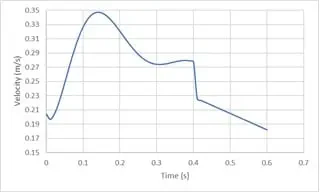
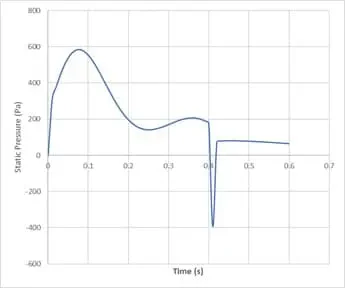
According to the contours, the WSS (wall shear stress) has the maximum value in the Aorta sections whose diameter is less than others. Also, the contours of static pressure show, at the beginning of the pumping of blood, at the entrance of the branches, the pressure is maximum.
When the suction occurs at the time of 0.4 s, it has the most significant impact on the inlet section of the Aorta. To see the pluses and better understand the flow condition, animation files of pressure and shear stress have been attached to this report.