

Badminton Shuttlecock Flight CFD Simulation, Training
Price: Free
In this project, the airflow around a badminton shuttlecock has been investigated.
Badminton Shuttlecock Flight CFD Simulation, Training
Price: Free
In this project, the airflow around a badminton shuttlecock has been investigated.
Badminton Shuttlecock Flight CFD Simulation, ANSYS Fluent Training
The study of the motion of objects in air or other fluids has always been of interest. Due to science's progress in the simulation of such phenomena, engineers have ever tried to do the best possible design in this field. Many of the changes in the appearance of such objects that move in the fluid have been due to this issue. There are many examples in this field that have caused significant changes. The fuselage of aircraft, the type of fins, and their appearance, the shape of the fuselage of cars, the fuselage of ships and submarines, etc., are a few examples of regard.
The importance of this issue is that even the appearance of far fewer virtual objects has been affected. Changes in the formation of the body of the golf ball are one of these cases. The ball used in badminton is no exception and has undergone many changes resulting from such studies.
Project Description
In this project, the airflow around a badminton shuttlecock has been investigated by ANSYS Fluent software. The airflow enters the computational domain with a velocity of 94 m/s and passes on the ball. A Realizable k-epsilon model with standard wall functions is exploited to solve turbulent flow equations.
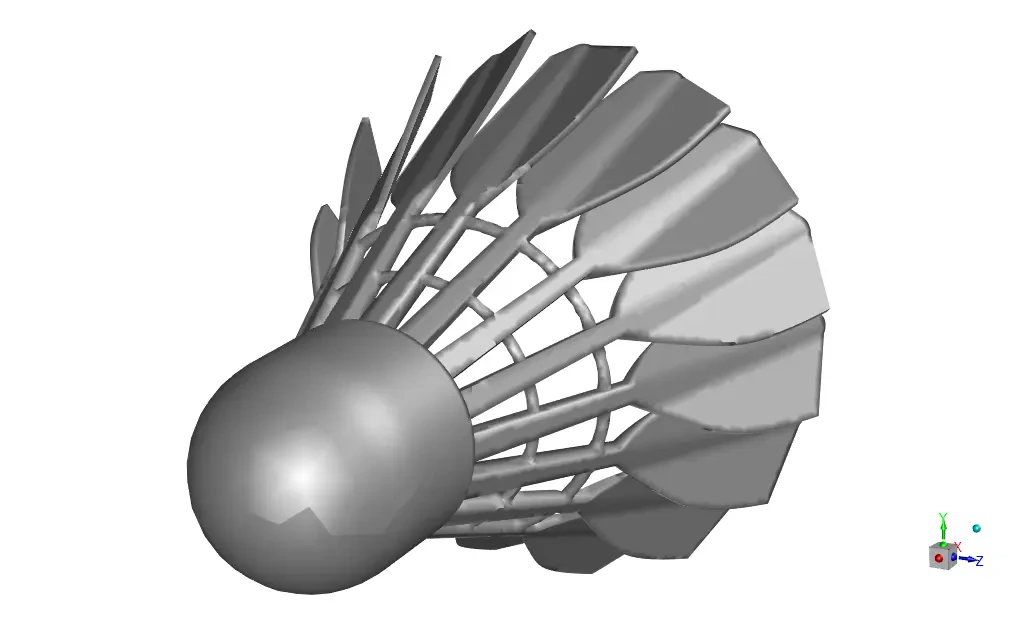
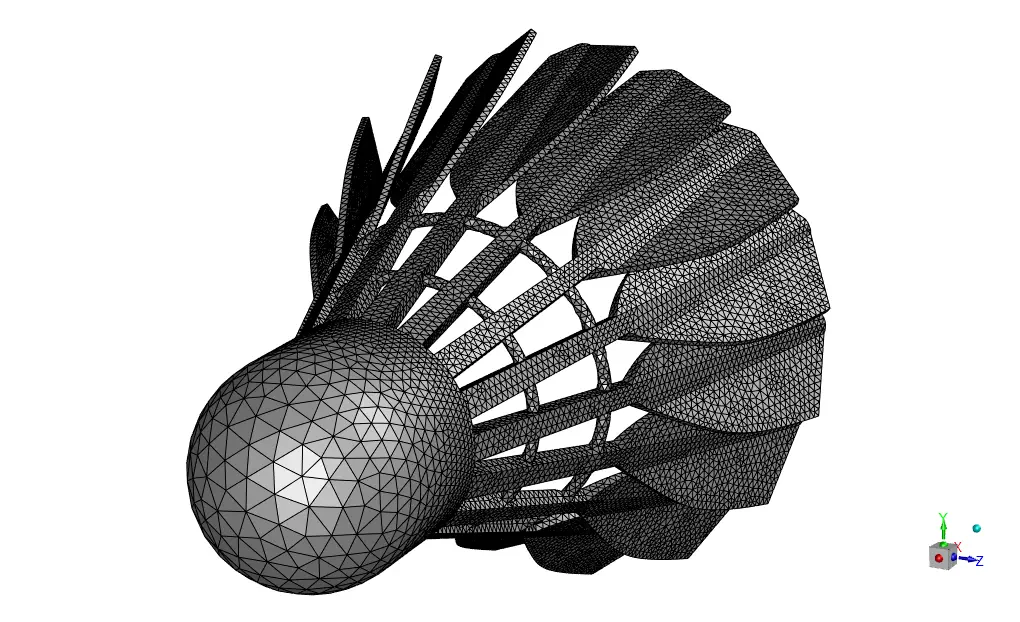
Badminton Shuttlecock Geometry & Mesh
The geometry of this project is designed in ANSYS design modeler and meshed in ANSYS meshing. The mesh type used for this geometry is unstructured, and the element number is 1935891.
Badminton Shuttlecock Flight CFD Simulation Settings
The key assumptions considered in this project are:
- Simulation is done using a pressure-based solver.
- The present simulation and its results are considered to be steady and do not change as a function of time.
- The effect of gravity has not been taken into account.
The applied settings are summarized in the following table.
| Models | ||
| Viscous model | k-epsilon | |
| k-epsilon model | realizable | |
| near wall treatment | standard wall function | |
| Energy | on | |
| Boundary conditions | ||
| Inlet | Velocity inlet | |
| Inlet | 94 m/s | |
| Outlet | Pressure outlet | |
| Gauge pressure | 0 Pa | |
| Walls | Stationary wall | |
| Solution Methods | ||
| Pressure-velocity coupling | coupled | |
| Spatial discretization | Pressure | Second order |
| Momentum | second-order upwind | |
| turbulent kinetic energy | first-order upwind | |
| turbulent dissipation rate | first order upwind | |
| Initialization | ||
| Initialization method | Standard | |
| gauge pressure | 0 Pa | |
| Velocity (x,y,z) | (94,0,0) m/s | |
| Turbulent kinetic energy | 33.135 m2/s2 | |
| Turbulent dissipation rate | 676464.7 m2/s3 | |
Results
Contours of pressure velocity, temperature, etc. are obtained and presented.