Battery Cooling (Thermal Management) by PCM, ANSYS Fluent Training
Price: $39
- The problem numerically simulates the battery cooling by applying phase change material in a storage tank using ANSYS Fluent software.
- We design the 3-D model by the Design Modeler software.
- The present simulation is performed in two steps: without and with phase change material on both sides of the battery.
- We mesh the model with ANSYS Meshing software.
- The mesh type is Structured, and the element number equals 93090 and 276660 for the first and the second cases, respectively.
- We perform this simulation as unsteady (Transient).
- We use the Solidification and Melting model to define phase change materials.
Description
The present problem simulates the cooling process of a battery (battery cooling) by applying phase change material (PCM) using ANSYS Fluent software. We perform this CFD project and investigate it by CFD analysis.
The present simulation is performed in two stages; In the first stage, only one lithium battery is modeled, and in the second stage, two layers of phase change material are used on both sides of the battery.
This work aims to investigate the effectiveness of phase change materials in the cooling process of the battery.
The present model is designed in three dimensions using SOLIDWORKS and then imported into the Design Modeler. We design the geometry in two steps.
The battery designed in the initial modeling has a thickness of 11.3 mm, and its length and width are 335 mm and 167 mm, respectively. In the second model, we add two 12 mm thick layers to both sides of the battery body.
We carry out the model’s meshing using ANSYS Meshing software. The mesh type is Structured. The element number is 93090 and 276660 for the first and the second cases, respectively.
Moreover, due to the nature of the present problem, the transient solver has been enabled.
Battery Cooling Methodology
When the battery starts working, an electric current is established inside it. The current inside the battery can generate heat and increase the temperature of the battery. In this simulation, we define a volumetric heat source in the battery area to determine the amount of heat generation inside the battery.
The heat generated in the battery is equal to R*I², So R is equal to the battery’s internal resistance, and I is equal to the current intensity inside the battery. This modeling assumes that the battery’s internal resistance equals 10 mile-ohms, and the current intensity equals 86 amps.
As a result, the amount of heat generated inside the battery is approximately equal to 120,000 W/m3. In this simulation, the model of solidification and melting is used to define the phase change materials.
To define phase change materials, it should be noted that the maximum temperature at which the solid phase temperature is (solidus temperature) is 307 K, and the minimum temperature at which the liquid phase is dominant (liquidus temperature) is 309 K.
Also, the pure solvent melting heat is defined as 240000 j/kg. Moreover, the laminar model and energy equation are enabled to solve the fluid equations and calculate temperature distribution.
Battery Cooling Conclusion
At the end of the solution process, we obtain two-dimensional and three-dimensional temperature contours in both simulation steps. We compare the temperature contours in both stages at the end of the simulation.
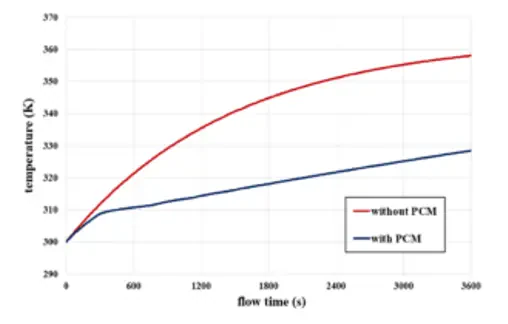
Also, we obtain the diagram of the average temperature changes of the battery in terms of time for the two states with and without phase change material. We present this chart in one hour.
The results show that applying a phase change material coating to the battery body will cool the battery and reduce the temperature growth rate.
Also, two-dimensional and three-dimensional contours related to the volume fraction of liquid from the phase change material are obtained in the second stage of the simulation to show its effect on heat transfer with the battery body.