

Bitumen Melting Inside a Tank, CFD Simulation ANSYS Fluent Training
Price: $10
The present problem simulates bitumen melting inside a bitumen tank using ANSYS Fluent software.
Bitumen Melting Inside a Tank, CFD Simulation ANSYS Fluent Training
Price: $10
The present problem simulates bitumen melting inside a bitumen tank using ANSYS Fluent software.
Bitumen Melting Description
The present simulation is about bitumen melting inside a bitumen tank via ANSYS Fluent. Bitumen is a material that increases in concentration when exposed to cold. In other words, the cold gradually causes the bitumen to freeze inside the tank.
Therefore, hot water flow pipes are used inside these tanks to upper the bitumen temperature inside the tanks and thus prevent it from freezing. In this project, a 2D bitumen tank is designed with periodic conditions.
Inside the tank, several rows of hot water pipes are designed. The bitumen material enters the tank at a low temperature, and its temperature increases when it receives heat from the pipe wall. This simulation uses a solidification and melting model to define phase change materials.
To define bitumen as a phase change material (PCM), the maximum temperature at which the solid phase temperature prevails (solidus temperature) is 340.15 K, the minimum temperature at which the liquid phase dominates (liquidus temperature) is 341.15 K, and the latent heat of pure solvent melting heat is defined as 450367 j.kg-1.
Bitumen flow enters the tank with a speed of 0.1 m.s-1 and a temperature of 343.15 K, and contacts the wall of hot water pipes with a constant temperature of 523.15 K.
Geometry & Mesh
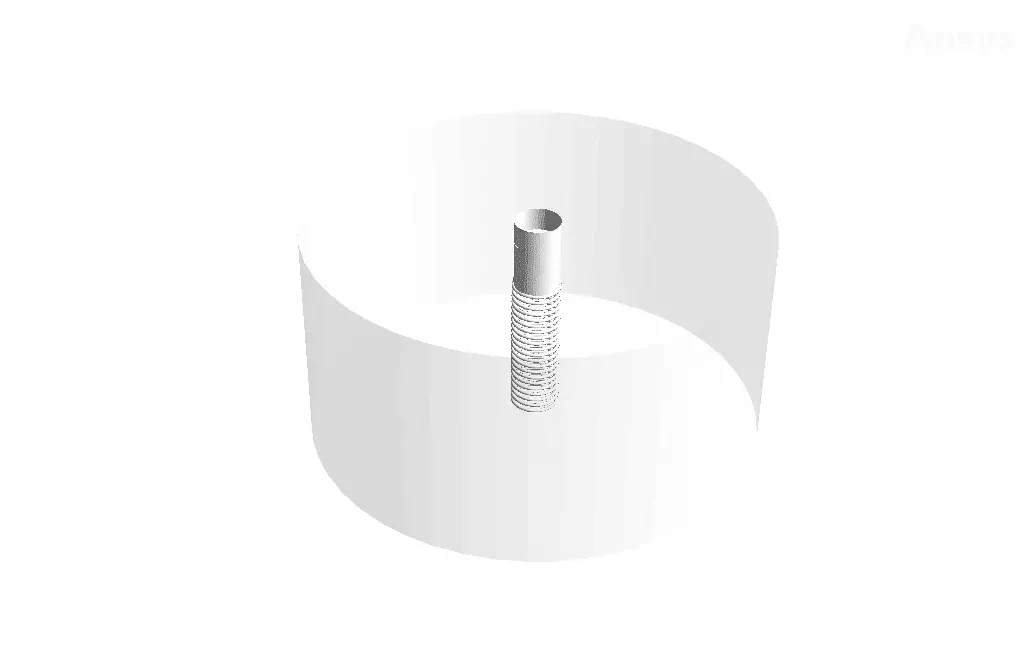
The present geometry is designed in a 2D model via Design Modeler. The computational zone is the interior of a tank with several rows of pipes. This geometry is designed as a 2D plane with periodic conditions and can turn into a 3D cylindrical tank when checking the results.

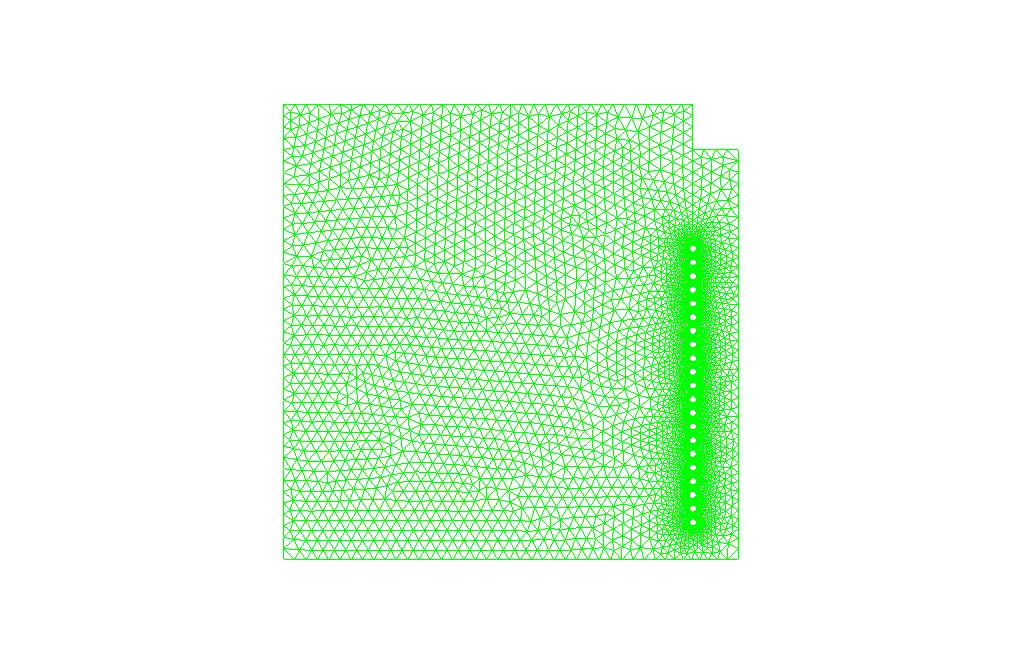
The mesh of the present model has been done via ANSYS Meshing. Mesh is structured, and the number of production cells equals 10541.
Set-up & Solution
Assumptions used in this simulation:
- Pressure-based solver is used.
- The present simulation is unsteady.
- The effect of gravity is ignored.
| Models | ||
| Viscous | k-epsilon | |
| k-epsilon model | RNG | |
| Near-wall treatment | standard wall function | |
| Solidification & Melting Model | On | |
| Energy | On | |
| Boundary conditions | ||
| Inlet | Velocity Inlet | |
| velocity magnitude | 0.1 m.s-1 | |
| temperature | 343.15 K | |
| Inner Wall | Wall | |
| wall motion | stationary wall | |
| thermal condition | coupled | |
| Outer Wall | Wall | |
| wall motion | stationary wall | |
| heat flux | 0 W.m-2 | |
| Tubes’ Wall | Wall | |
| wall motion | stationary wall | |
| temperature | 523.15 K | |
| Outlet | Pressure Outlet | |
| gauge pressure | 0 pascal | |
| Methods | ||
| Pressure-Velocity Coupling | Coupled | |
| pressure | second-order | |
| momentum | first-order upwind | |
| energy | first-order upwind | |
| turbulent kinetic energy | first-order upwind | |
| turbulent dissipation rate | first-order upwind | |
| Initialization | ||
| Initialization methods | Standard | |
| gauge pressure | 0 pascal | |
| velocity (axial & radial) | 0 m.s-1 | |
| temperature | 293.15 K | |
Bitumen Melting Results
After calculation, 2D and 3D contours related to temperature, temperature gradient, pressure, velocity, liquid fraction, and liquid fraction gradient are obtained. The contours show that in the vicinity of the hot pipes, the bitumen rises in temperature. An increase in temperature causes the bitumen to begin to melt. As a result, it prevents the bitumen from freezing.