

Blood Flow in a Coronary Bifurcation, Paper Numerical Validation, ANSYS Fluent
Price: $96
In this project, The effects of non-Newtonian blood, compliant walls, and different bifurcation angles on hemodynamic flow characteristics were evaluated, and the results of this simulation have been investigated.
Blood Flow in a Coronary Bifurcation, Paper Numerical Validation, ANSYS Fluent
Price: $96
In this project, The effects of non-Newtonian blood, compliant walls, and different bifurcation angles on hemodynamic flow characteristics were evaluated, and the results of this simulation have been investigated.
Blood Flow in a Coronary Bifurcation Introduction
The paper "Numerical investigation of blood flow in a deformable coronary bifurcation and non-planar branch" numerically investigates the pulsatile flow of blood in a coronary bifurcation with a non-planar branch. The wall is assumed to be compliant to create a more realistic analysis.
Identification and assessment of hemodynamic characteristics and other flow properties impact the behavior and prevention of cardiovascular diseases. Stenosis is highly dependent on the local hemodynamic characteristics of blood flow. Since coronary artery diseases are associated with a high mortality and morbidity rate, the hemodynamic characteristics of blood flow demand more attention.
For this purpose, The effects of wall compliance and non-Newtonian rheology of blood on flow characteristics have been simulated using Ansys Fluent software.
Blood Flow in a Deformable Coronary Bifurcation Description
The effects of non-Newtonian blood, compliant walls, and different bifurcation angles on hemodynamic flow characteristics were evaluated. Shear-thinning of blood was simulated with the Carreau-Yasuda model. The current research was mainly focused on the flow characteristics in bifurcations since atherosclerosis occurs mainly in bifurcations. Moreover, as the areas with low shear stresses are prone to stenosis, these areas were identified.
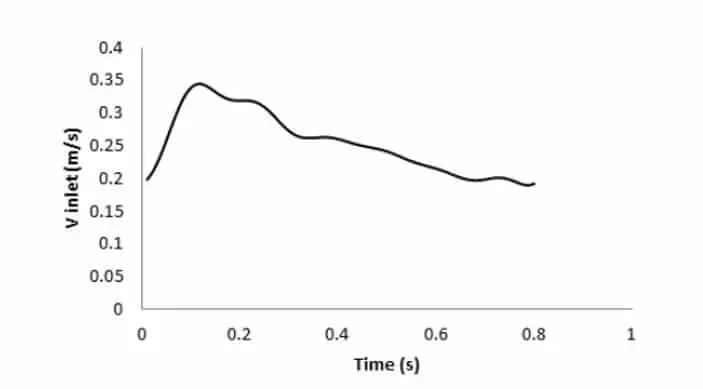
The pulsative velocity of blood at the inlet face is presented in the following figure, while the suitable equation of motion is derivate using MATLAB software and applied in the Fluent by an appropriate UDF.
Geometry & Mesh
Firstly, The geometry of the solution is designed using Gambit software.
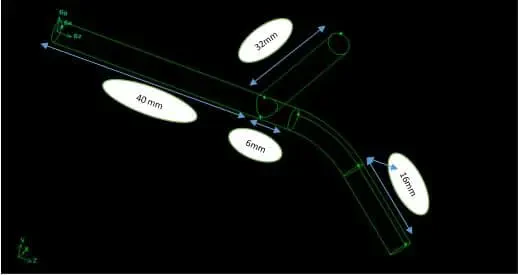
For meshing, the following factors are used:
Start size = 0.25
Growth rate = 1.25
Max. size = 0.5
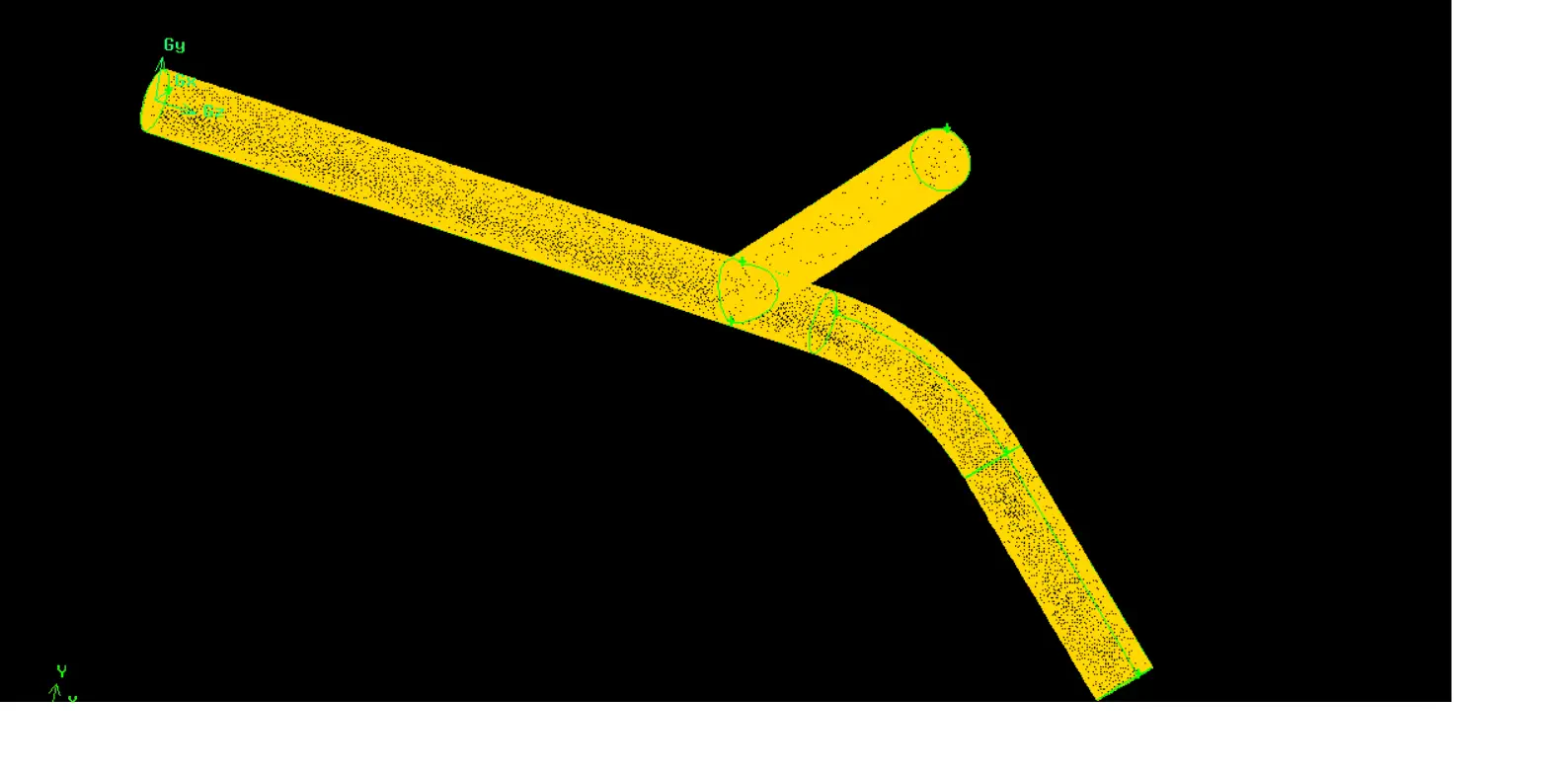
The number of the elements is precisely 397388:
Blood Flow in a Deformable Coronary Bifurcation CFD Simulation
We consider several assumptions to simulate the present model:
- We perform a pressure-based solver.
- The energy equation is off.
- The present model is unsteady.
- The effect of gravity is considered.
The following table represents a summary of the defining steps of the problem and its solution:
| Material Properties | |
| Name | Blood |
| density | 1050 |
| viscosity | Carreau model |
| Boundary Condition | |
| Type | Amount (units) |
| Outlet | |
| Outlet1 | gauge pressure = 0 pa |
| Outlet2 | gauge pressure = 0 pa |
| wall | |
| Vessel-wall | No-slip |
| Velocity-Inlet | |
| inlet | UDF inlet velocity |
| Models | ||
| Energy | off | |
| Turbulence models | ||
| viscous model | laminar | |
| Dynamic Mesh | |||
| Mesh Methods | Smoothing | ||
| Method | Linearly Elastic Solid | ||
| Vessel Wall | Deforming | ||
| Solution methods | |||
| SIMPLE | pressure velocity coupling | ||
| Second-order upwind | pressure | spatial discretization | |
| Second-order upwind | momentum | ||
| Initialization | ||
| Hybrid initialization | initialization method | |
| Run calculation | ||
| Number of Time Steps | 35 | |
| Time Step Size | 0.01 | |
| Max Iterations | 200 |
Results & Discussion
To validate the present numerical simulation results, the diagram in Figure 6 of the article has been used. This diagram shows the wall shear of the walls of Coronary. The X-direction of the diagram shows the distance from the bifurcation. Boundaries of the model. The amount of presented wall shear stress was obtained along Line 3, found in Figure 1 of the article.
A comparison of the results of the current numerical simulation with the results of the numerical work of the article is shown in the image album.