

Blood Vessel (FSI) with the Pulse Velocity, CFD Simulation Ansys Fluent Training
Price: $42
In this project, a Blood Vessel (FSI) with Pulse Velocity has been simulated and the results of this simulation have been investigated.
Blood Vessel (FSI) with the Pulse Velocity, CFD Simulation Ansys Fluent Training
Price: $42
In this project, a Blood Vessel (FSI) with Pulse Velocity has been simulated and the results of this simulation have been investigated.
Blood Vessel Project Description
In this project, which has been done by Ansys Fluent software, a blood vessel is simulated with a wall, where the displacement of the wall is also visible. We have defined the pulse velocity using UDF for the input, and the output is atmospheric pressure. This FSI simulation was performed inside the fluent.
Geometry & Mesh
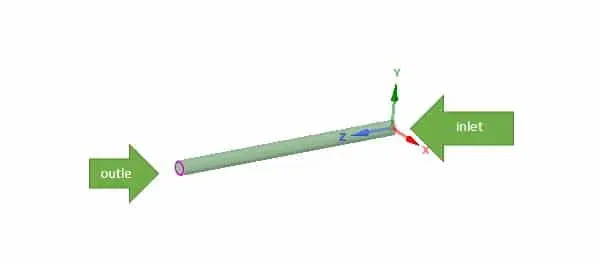
The three-dimensional geometry of this project has been produced with Spaceclaim software The length of the calculation domain is 72 mm, and its height and width are 5 mm.
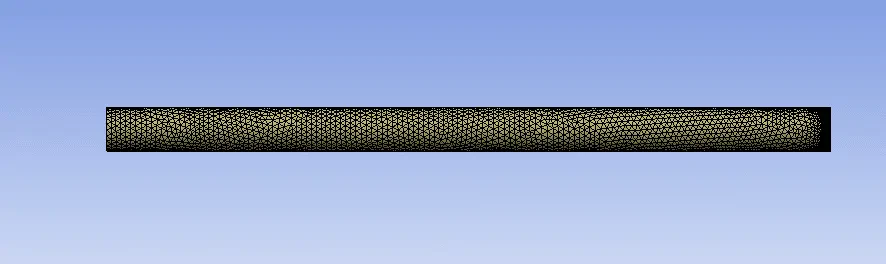
The meshing of this project has been done with Ansys Meshing software, and the type of elements is unstructured. Also, the total number of elements is 55632.
Blood Vessel CFD Simulation
- the pressure-based solver method has been selected.
- The simulation is transient.
- The gravity effect is ignored.
The following tables represent a summary of the defining steps of the problem in this project and its solution:
| Models | ||
| Viscous model | k-w | |
| Model | SST | |
| material | ||
| blood | Density | 1060 kg/m^3 |
| Viscosity | 0.004 kg/(m-s) | |
| vessel | Density | 1500 kg/m^3 |
| Youngs modulus | 1.5e06 pa | |
| Poisson ratio | 0.32 | |
| Boundary conditions | ||
| Inlet | Velocity inlet | |
| Velocity magnitude | UDF | |
| Outlet | Pressure outlet | |
| Gauge pressure | 0 pa | |
| Walls | Intrinsic FSI | |
| Solution Methods | ||
| Pressure-velocity coupling | Coupled | |
| Spatial discretization | Pressure | Second-order |
| Momentum | second-order upwind | |
| Turbulent kinetic energy | first-order upwind | |
| Turbulent dissipation rate | first-order upwind | |
| Initialization | ||
| Initialization method | Standard |
Results
After the simulation, we can observe the velocity and pressure contours inside the vessel, and we can also examine the stresses and displacements created in the vessel wall due to the force exerted by the blood.