

Bluff Body Surface Heating on a Reentry Mission, CFD Simulation, ANSYS Fluent
Price: $14
- The problem numerically simulates a Bluff Body Surface Heating on a Reentry Mission in ANSYS Fluent software.
- The geometry of the model is created using the Design Modeler software.
- The model is meshed in ANSYS Meshing, creating a structured mesh with 672,515 elements.
- The K-ω SST model is used to describe the turbulence of the flow.
Introductions
In this project, we are going to simulate a bluff body reentry problem. The vehicle's Mach number at a reentry mission is so high, and the flow goes to a regime, namely "Hypersonic." In this situation, the shock layer gets close to the wall, so the boundary layer and shock will interact with each other, and the wall temperature will rise dramatically. To solve this issue, engineers design the shape of reentry vehicles, such as a bluff body.
We will simulate the bluff body with two velocities, Mach 2 and Mach 3, and at altitudes of 30 km and 60 km. So, we will study the influence of altitude and velocity on the temperature that the body reaches.
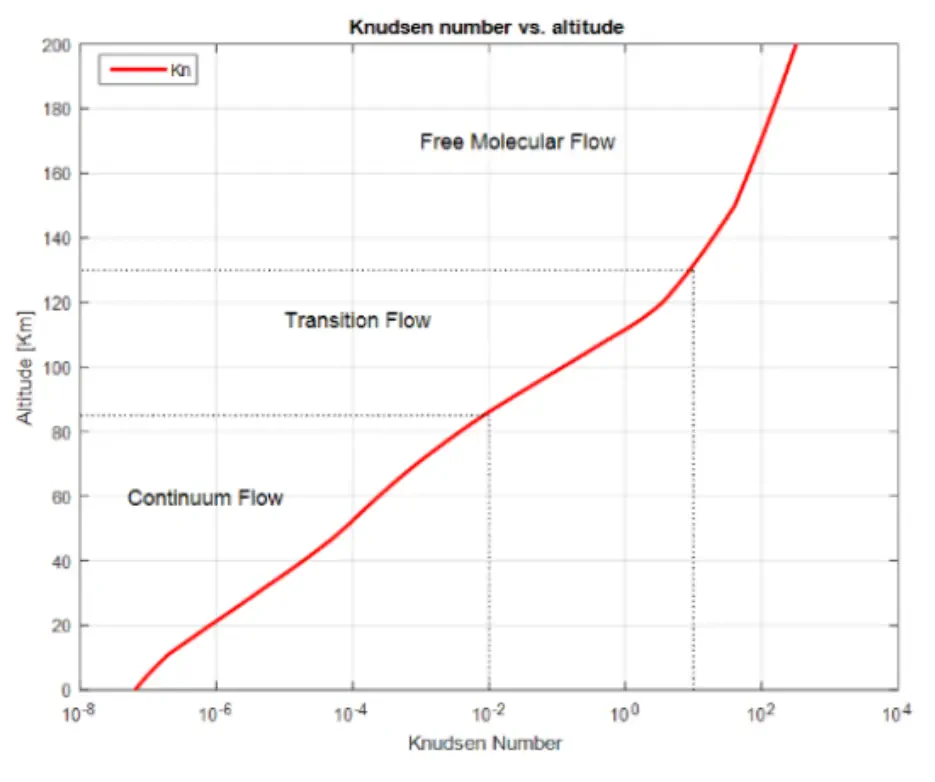
As the below figure shows, till 80 Km, we can model the air as a continuous fluid. So, we can solve Navier Stokes' equation with computational fluid dynamics using Ansys Fluent.
Geometry was designed in Design Modeler, and a structural mesh with 672,515 elements was created in Ansys Meshing.
Methodology (Reentry)
The flow over the bluff body is modeled as a steady state and axisymmetric. Density in the material tab specifies as an ideal gas, and Sutherland is chosen to compute the viscosity of air. K-w SST was chosen for turbulence modeling, and the energy equation was enabled.
Conclusion (Reentry)
As a result, the Mach and temperature contours are reported around the bluff body. In all cases, a bow shock is present in front of the body, and expansion fans can seen behind the corners.
In the table below, the results for the distance of bow shock from the body and the temperature of it are presented. With increasing velocity, shock gets closer to the body, and, of course, the temperature increases. With increasing altitude, the distance of shock increases, and temperature decreases as a consequence of decreased ambient pressure.
case | distance of bow shock from body (m) | Max Temperature of the body (K) |
Mach 2 – Altitude 30Km | 0.613 | 415 |
Mach 2 – Altitude 60Km | 0.648 | 392 |
| Mach 3 – Altitude 60Km | 0.474 | 630 |