

Boiling Phenomenon and Bubble Formation CFD Tutorial
Price: $200
In this project, Boiling Phenomenon to investigate three-volume fraction discretization methods has been simulated and the results of this simulation have been investigated.
Boiling Phenomenon and Bubble Formation CFD Tutorial
Price: $200
In this project, Boiling Phenomenon to investigate three-volume fraction discretization methods has been simulated and the results of this simulation have been investigated.

Boiling Phenomenon and Bubble Formation, Ansys Fluent CFD Simulation Training
Boiling is the fast evaporation of a liquid when heated to its boiling point. The temperature at which the liquid's vapor pressure equals the pressure exerted on the liquid by the surrounding environment. Boiling may be classified into two types: nucleate boiling, in which tiny bubbles of vapor develop at distinct places, and critical heat flux boiling, in which the boiling surface is heated above a specific critical temperature and a film of vapor forms on the surface. Transition boiling is an unstable intermediate form of boiling that has components of both forms. The boiling point of water is 100 °C or 212 °F; however, it is lower at higher altitudes due to reduced air pressure. Boiling Phenomenon and Bubble Formation CFD simulation by ANSYS Fluent is carried out in this product.
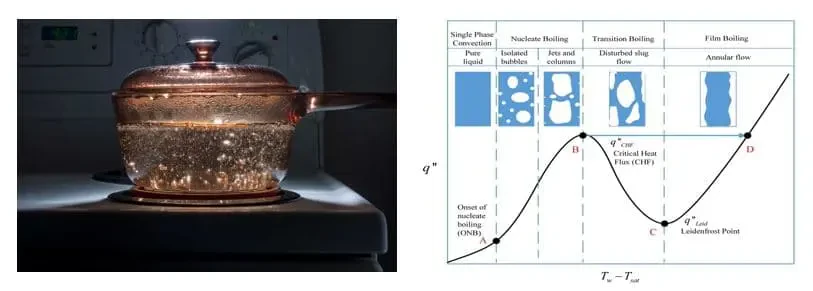
Project Description
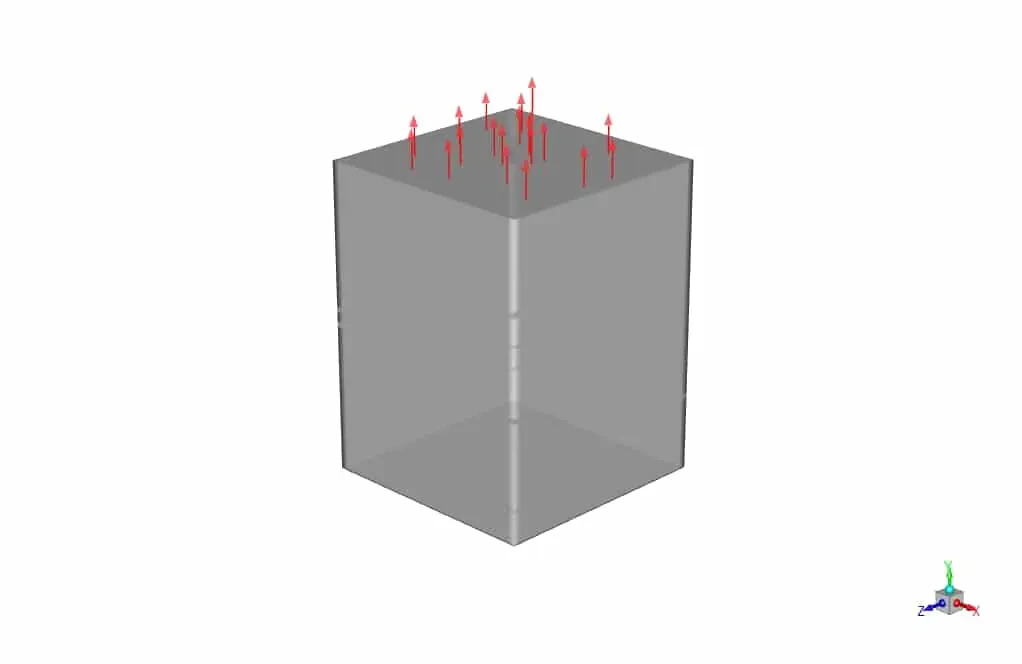
In this simulation, the difference between HRIC-compressive-Geo-reconstruct models and their effect on the output results were discussed by changing the volume fraction discretization. The computational domain is a 15 x 15 cm cube with a 2 x 2 cm heated surface. The change in volume fraction discretization showed no significant change in surface temperature and heat transfer coefficient. Only the Geo-Reconstruct model visually models a more realistic simulation with a higher computational cost.
Geometry & Mesh
The computational domain was designed using Design Modeler software. The computational domain includes a 15 x 15 cube with a 2 x 2 cm heating surface.
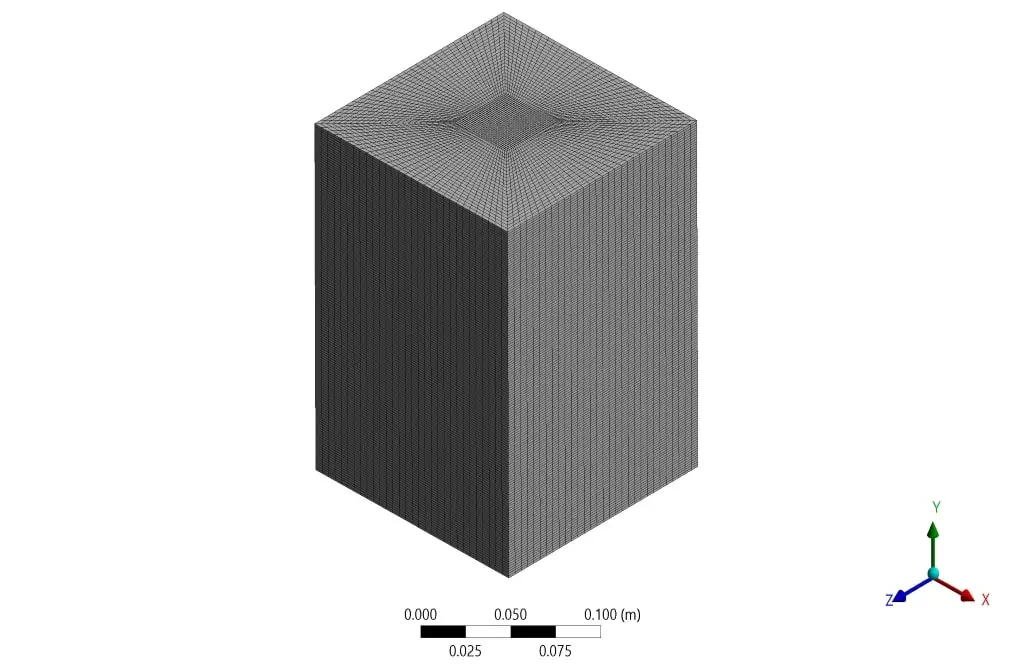
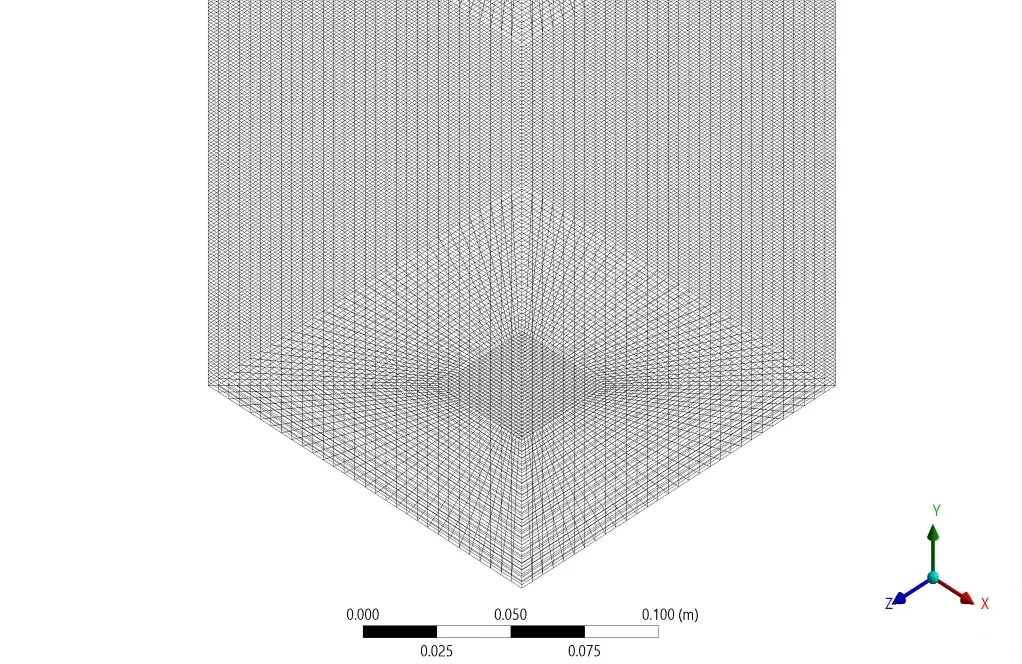
Ansys Meshing software was used for grid generation, and the type of problem elements was structured. Also, the total number of elements was about 570000.
CFD Simulation Solver Setting
In this simulation, the following hypotheses are established:
- A pressure solver was used.
- The problem was solved transient
- An explicit VOF multiphase model was activated.
- Gravitational and capillary effects were considered.
Also, the table below shows the characteristics and values of boundary conditions, along with the models and hypotheses.
| Material Properties | |||
| Water | |||
| Amount | Fluid properties | ||
| 998.2 | Density (kg/m3) | ||
| Water vapor | |||
| Amount | Fluid properties | ||
| 0.5542 | Density (kg/m3) | ||
| Multiphase | |||
| Homogeneous model | VOF (volume of fluid) | ||
| Number of Eulerian phases | 2 (water-water vapor) | ||
| Interface modeling | sharp | ||
| Formulation | Explicit | ||
| Phase interaction | |||
| Evaporation & Condensation | Lee model | ||
| From phase Frequency (1/s) | 10 | ||
| Fluid type | Surface tension coefficient (N/m) | ||
| Water-vapor | 0.06 | ||
| Boundary Condition | |||
| Type | Heat flux (W/m^2) | ||
| Hot wall | 10000 | ||
| Cell zone condition | |||
| Fluid | mixture | ||
| Turbulence models | |||
| K- | viscous model | ||
| Realizable | K- model | ||
| Standard wall function | Wall function | ||
| Solution methods | |||
| Coupled | pressure velocity coupling | ||
| Modified body force weighted | pressure | spatial discretization | |
| First-order upwind | momentum | ||
| First-order upwind | turbulent kinetic energy | ||
| First-order upwind | turbulent dissipation rate | ||
| Volume fraction | Geo-reconstruct Compressive Modified HRIC | ||
| Initialization (Standard) | |||
| 0 (Pa) | gauge pressure | ||
| 373.15 K | Temperature | ||
| 1 | Water volume fraction | ||
Boiling Phenomenon and Bubble Formation Results
The table below clarifies that the average surface temperature at the input of the problem and the heat transfer coefficient in these three discretization models do not change much. In the simulation with high computational cost, it is suggested that the discretization methods of compressive and modified HRIC Be have a lower computational cost. But for near-reality simulation, it is better to use the Geo-reconstruct model, which has a higher computational cost.
| Discretization method | Surface temperature (K) | Heat transfer coefficient (W/m^2.K) |
| compressive | 385.835 | 102.398 |
| Modified HRIC | 385.688 | 102.547 |
| Geo-reconstruct | 387.96463 | 101.76327 |
The grid elements need to be finer near the hot surface to increase the simulation accuracy. The distance of the first cell is essential in boiling studies, but this is very effective in increasing the computational costs in 3D simulations.