

Bubbles Motion under the Water with/without Shear Stress CFD Simulation, ANSYS Fluent Training
Price: $20
In this project, bubble motion under the water on a plate with/without shear stress has been simulated and the results have been investigated.
Bubbles Motion under the Water with/without Shear Stress CFD Simulation, ANSYS Fluent Training
Price: $20
In this project, bubble motion under the water on a plate with/without shear stress has been simulated and the results have been investigated.

Bubbles Motion Project Description
In this project, numerical simulation of bubbles motion under the water on a plate with and without shear stress has been done using Ansys Fluent software. The VOF model has been used to simulate and solve the two-phase flow field equations. The purpose of this project is to consider the effect of surface tension in simulations where the free surface in phase is investigated. The two modes in this project are simulated and compared. The difference between the two simulated modes is the presence and absence of surface tension. The initial size of the bubbles is assumed to be 2e-04 m.
Geometry & Mesh
The 2D geometry of the present model is generated using SpaceClaim software. The length of the computational area is 50 mm and its height is 65 mm.
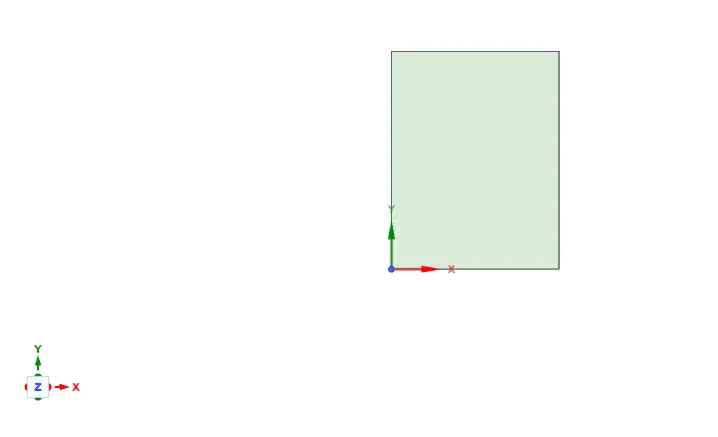
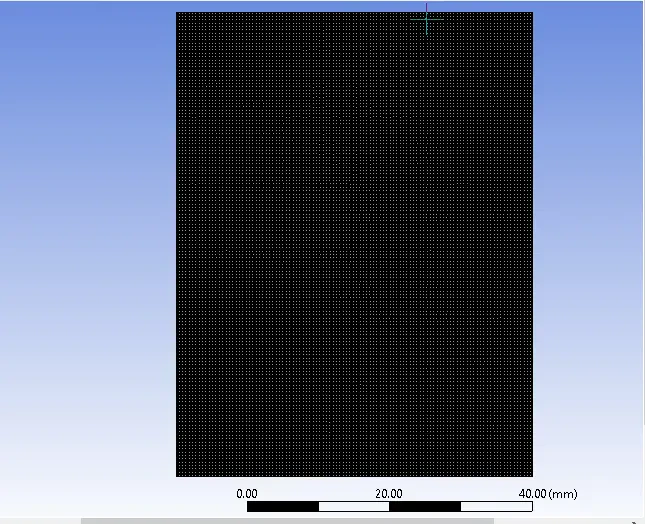
The meshing of the present model has been done using ANSYS Meshing software. The mesh type is structured in all of the computational domains, and the element number is equal to 81250.
CFD Simulation Settings
We consider several assumptions to simulate the present model:
- Due to the incompressibility of the flow, the pressure-based solver method has been selected.
- The simulation is transient.
- The gravity effect is considered equal to -9.81 m.s-2 on Y-axis
The following tables represent a summary of the defining steps of the problem in this project and its solution:
| Models | ||
| Multiphase | ||
| Homogeneous model | Volume of fluid | |
| Number of Eulerian phases | 2(air& water) | |
| Interface modeling | Sharp Interfacial | |
| Formulation | explicit | |
| Body force formulation | Implicit body force | |
| Viscous | Laminar | |
| Material Properties | |
| Air | |
| Density | 1.225 |
| viscosity | 1.7894e-05 |
| water-liquid | |
| Density | 998.2 |
| viscosity | 0.001003 |
| Methods | ||
| Pressure-Velocity Coupling | SIMPLE | |
| Pressure | PRESTO! | |
| Momentum | Second-order upwind | |
| Volume fraction | Compressive | |
| Initialization | ||
| Initialization methods | Standard | |
| Patch | Phase | Phase2 |
| Variable | Volume Fraction | |
| Registers to patch | Region_0 | |
| Value | 1 | |
| Run calculation | ||
| Time advancement | Type | adaptive |
| Parameters | ||
| Initial time step size | 0.0002 | |
| Settings | Minimum time step size | 0.0002 |
| Maximum time step size | 0.0002 | |
| Time step size | 1900 | |
Bubbles Motion Results
Given the shape of the bubbles, it is clear how much error can occur in the simulation if surface tension is not taken into account. But if surface tension is not taken into account, the bubble will collapse due to water pressure.