

Solar Collector with FMHPA CFD Simulation Training
Price: $24
The present problem simulates Collector with FMHPA using ANSYS Fluent software.
Solar Collector with FMHPA CFD Simulation Training
Price: $24
The present problem simulates Collector with FMHPA using ANSYS Fluent software.
Solar Collector with FMHPA, CFD Simulation Training by ANSYS Fluent
The present simulation is about a Solar Collector with FMHPA CFD Simulation via ANSYS Fluent. In this project, a collector is designed, located inside a computational zone with a parabolic cross-section. This parabolic zone is considered the surrounding air environment, responsible for radiation heat transfer from the sun.
The outer part of the collector is modeled as a cylinder. Its outer layer is glass, which acts as a solar heat absorber.
There are flat micro-heat pipe arrays (FMHPA) inside these glass layers. This system consists of several rows of pipes with a square cross-section and micro dimensions. The system's working fluid enters these pipes. After receiving the heat caused by radiation, the temperature rises and turns into hot vapor; Hence, this part is also called the evaporation zone.
The high-temperature working fluid is then transferred to the outside of the system and exposed to the heat exchanger airflow used at the end of the collector. In this part, the fluid loses its heat and becomes condensed; Hence, this part is also called the condensation zone.
Between the layers of cylindrical glass and these micro-pipe arrays, there is a gap space in which the air inside is responsible for sucking the hot air from the solar radiation towards the micro-pipes. This modeling uses radiation and solar ray tracing models to apply for heat transfer due to solar radiation.
In the settings of this section, the geographical coordinates of the angle of solar radiation relative to the collector, along with the longitude and latitude of the location of the collector and the time and date of the solar radiation, are determined.
Geometry & Mesh
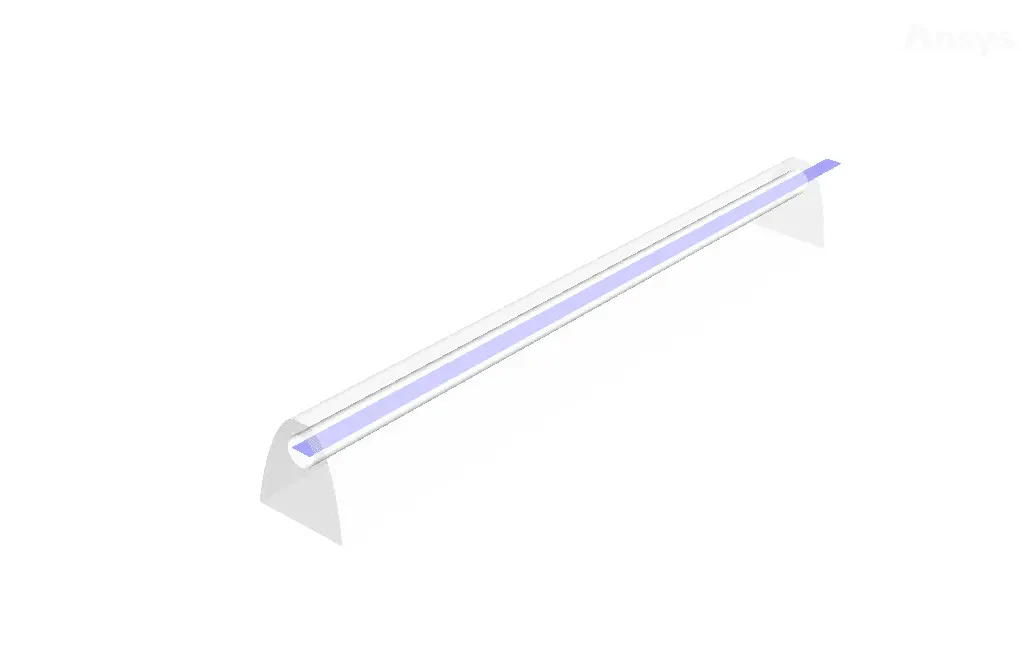
The present geometry is designed in a 3D model via Design Modeler. The computational zone is related to the space of an outdoor air environment. Inside this ambient space, a cylindrical collector is modeled. The outer layer of this collector is radiant heat-absorbing glass layers.
Then an air-gap layer is placed. Finally, FMPHA consisting of several rows of micro-sized pipes is modeled. The first part of this system is called the evaporation zone, and the last part is called the condensation zone.
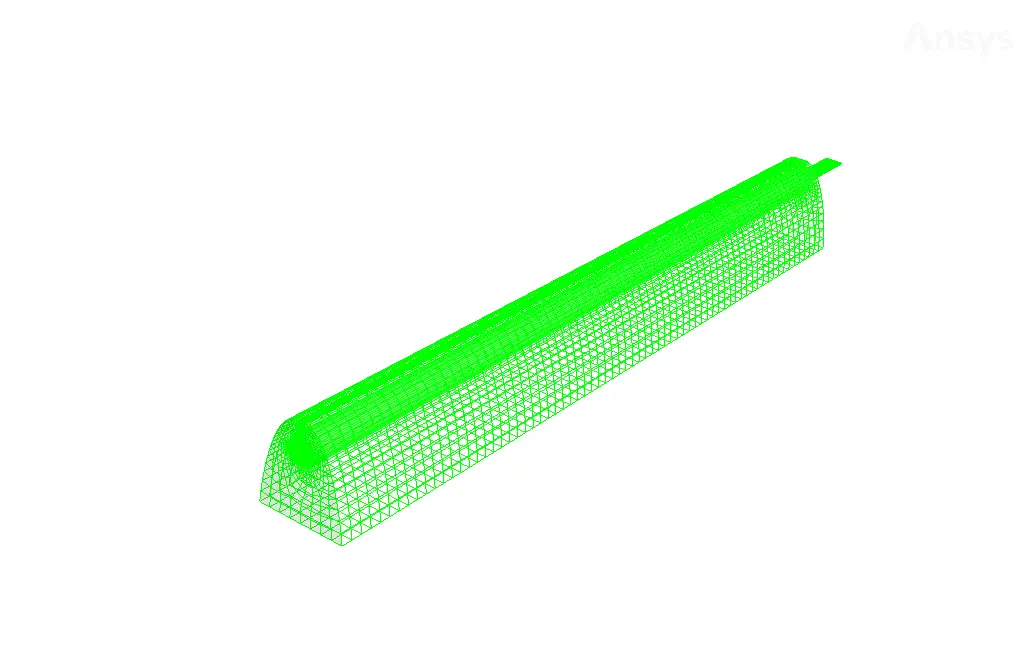
The mesh of the present model has been done via ANSYS Meshing. Mesh is structured, and the number of production cells equals 153680.
Assumptions used in this simulation:
- Pressure-based solver is used.
- The present simulation is unsteady.
- The effect of gravity on the model is considered, and the gravitational acceleration is defined as 9.81 m.s-2.
| Models | ||
| Viscous | k-epsilon | |
| k-epsilon model | standard | |
| near-wall treatment | Menter-Lechner | |
| Radiation Model | Solar Ray Tracing | |
| direct solar irradiation | solar calculator | |
| diffuse solar irradiation | solar calculator | |
| Energy | On | |
| Boundary conditions | ||
| Inlet | Mass Flow Inlet | |
| mass flow rate | 0.01088 kg.s-1 | |
| temperature | 126.2 C | |
| participate in solar ray tracing | active | |
| Outlets | Pressure Outlet | |
| gauge pressure | 0 Pascal | |
| participate in solar ray tracing | active | |
| Inner Walls | Wall | |
| wall motion | stationary wall | |
| thermal condition | coupled | |
| BC type | opaque | |
| participate in solar ray tracing | active | |
| Outer walls | Wall | |
| wall motion | stationary wall | |
| heat flux | 0 W.m-2 | |
| BC type | opaque | |
| participate in solar ray tracing | active | |
| Methods | ||
| Pressure-Velocity Coupling | Coupled | |
| pressure | Second-order | |
| momentum | Second-order upwind | |
| energy | Second-order upwind | |
| turbulent kinetic energy | First-order upwind | |
| turbulent dissipation rate | First-order upwind | |
| Initialization | ||
| Initialization methods | Hybrid | |
Collector with FMHPA Results
After calculation, 2D and 3D contours related to temperature, pressure, and velocity are obtained. The contours show that the working fluid in the initial part of the FMHPA (evaporation zone) receives heat, and the temperature rises.
This heat is transmitted to the FMHPA through the absorbent glass layer of the solar radiation and the air-gap space. Then, the high-temperature working fluid loses heat at the end of the FMHPA (condensation zone), and the temperature decreases.