

Combustion in the Presence of EHD, CFD Simulation
Price: $54
The present simulation is about combustion in the presence of EHD via ANSYS Fluent, and the results of this simulation have been analyzed.
Combustion in the Presence of EHD, CFD Simulation
Price: $54
The present simulation is about combustion in the presence of EHD via ANSYS Fluent, and the results of this simulation have been analyzed.
Combustion in the Presence of EHD, CFD Simulation ANSYS Fluent Training
The present simulation is about combustion in the presence of EHD via ANSYS Fluent. In this project, a simple combustion chamber is designed. Airflow and fuel enter the cylindrical combustion chamber axially.
So that C10H22 enters the chamber as fuel from the central part and airflow around it. This project has been done in two steps. First, simple combustion between air and fuel is investigated. Then the same combustion is performed in the presence of an electrohydrodynamic (EHD).
Applying EHD to the fluid causes the fluid to become charged. The motion of ionized particles or molecules and their interaction with the electric field and surrounding fluid are studied. To define the combustion reaction, the Species Transport model must be used.
C10H22 and O2 are defined as reactants, CO2 and H2O as products in this reaction, C10H22, and O2 are defined as reactants, and CO2 and H2O are as products. Airflow with a temperature of 447 K and a velocity of 5 m / s and fuel with a temperature of 300 K and a velocity of 0.01 m / s enter the combustion chamber.
The EHD model is used to apply the electric field's effect on the combustion chamber's performance. 40 A / m2 is applied to the inlet and outlet boundaries of the combustion chamber. The positive charge is defined on the input boundary, and the negative charge is defined on the output boundary.
Defined combustion reaction:

Geometry & Mesh
The present geometry is designed in a 3D model via Design Modeler. The computational zone of the interior is a horizontal cylindrical combustion chamber. Fuel enters the chamber through a narrow inner tube, and airflow enters the chamber from around this tube.
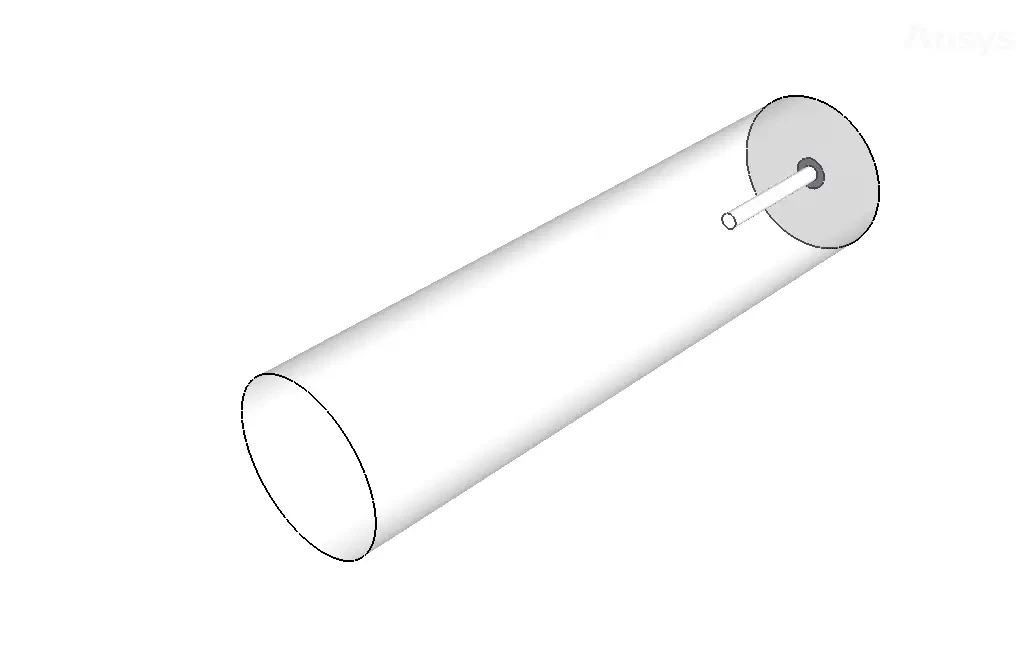
The mesh of the present model has been done via ANSYS Meshing. Mesh is done unstructured, and the number of production cells equals 1000658.

Set-up & Solution
Assumptions used in this simulation:
- Pressure-based solver is used.
- The present simulation is steady.
- The effect of gravity on the model is ignored.
| Models | ||
| Viscous | k-epsilon | |
| k-epsilon model | standard | |
| near wall treatment | standard wall function | |
| Species | Species Transport | |
| number of volumetric species | 5 (C10H22, O2,CO2, H2O, N2) | |
| reactions | volumetric | |
| Energy | On | |
| Potential/Li-ion Battery | On | |
| Boundary conditions | ||
| Inlet-Air | Velocity Inlet | |
| velocity magnitude | 5 m.s-1 | |
| temperature | 447 K | |
| O2 mass fraction | 0.21 | |
| C10H22, H2O, CO2 mass fraction | 0 | |
| current density | -40 A.m-2 | |
| Inlet-Fuel | Velocity Inlet | |
| velocity magnitude | 0.01 m.s-1 | |
| temperature | 300 K | |
| C10H22 mass fraction | 1 | |
| O2, H2O, CO2 mass fraction | 0 | |
| current density | 0 A.m-2 | |
| Outlet | Pressure Outlet | |
| gauge pressure | 0 Pascal | |
| current density | 40 A.m-2 | |
| Inner Wall | Wall | |
| wall motion | stationary wall | |
| thermal condition | coupled | |
| Outer Wall | Wall | |
| wall motion | stationary wall | |
| heat flux | 0 W.m-2 | |
| current density | 0 A.m-2 | |
| Methods | ||
| Pressure-Velocity Coupling | Coupled | |
| pressure | second order | |
| momentum | second order upwind | |
| turbulent kinetic energy | first order upwind | |
| turbulent dissipation rate | first order upwind | |
| species’ mass fraction | second order upwind | |
| energy | second order upwind | |
| Initialization | ||
| Initialization methods | Standard | |
| gauge pressure | 0 Pascal | |
| O2 mass fraction | 0.21 | |
| C10H22, H2O, CO2 mass fraction | 0 | |
| velocity | 5 m.s-1 | |
| temperature | 447 K | |
| Potential | 0 | |
Combustion in the Presence of EHD Results
After calculation, 2D and 3D contours related to temperature, velocity, pressure, and mass fraction of species (CO2, C10H22, O2, N2, and H2O) are obtained. These results are displayed in two modes (in the absence of EHD and the presence of EHD) so that the effect of the electric field can be studied by comparing the results.
The contours show that when EHD is applied to the combustion chamber, more heat is applied to the species, resulting in higher product temperatures. Increasing the temperature of the reactive species causes the combustion reaction to occur more rapidly. Also, by examining the behavior of reaction products, it can result that the combustion reaction in the presence of EHD will be of higher quality.