Cooling of Airfoil Surface by Lateral Hole Air Inlets
Price: $16
- The problem numerically simulates Cooling of Airfoil Surface by Lateral Hole Air Inlets using ANSYS Fluent software.
- We design the 3-D model by the Design Modeler software.
- We Mesh the model by ANSYS Meshing software, and the element number equals 582263.
- The Energy Equation is activated to define the cooling process.
Cooling of Airfoil Surface by Lateral Hole Air Inlets, ANSYS Fluent Tutorial
The present problem simulates the movement of heated airflow over the surface of an airfoil and Cooling of Airfoil Surface using lateral air inlets with ANSYS Fluent software. We perform this CFD project and investigate it by CFD analysis.
In the field of jet engines, surface cooling of airfoils has become one of the most important issues in mechanical engineering and aerospace.
The present model is designed in three dimensions using Design Modeler software. The meshing of this present model has been generated by Ansys Meshing software. The total cell number is 582263.
Cooling Methodology
In this project, the movement of heated airflow over the surface of an airfoil and the surface cooling of the mentioned airfoil using lateral hole air inlets is simulated by ANSYS Fluent software.
The heated air enters the computational domain with a velocity and temperature of 15 m/s in the X direction and 600 K, respectively. Two lateral air inlets are responsible for the surface cooling of the blade or airfoil.
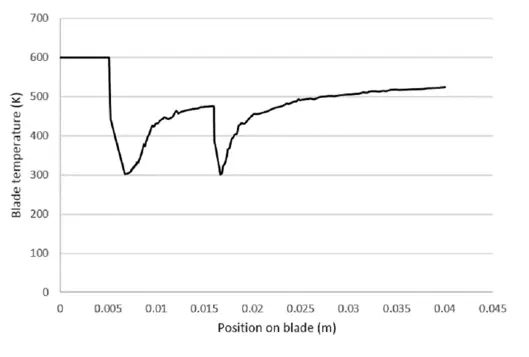
The air also enters through these cooling inlets with a velocity and temperature of 6.59 m/s and 300 K. Standard k-epsilon model is exploited to solve turbulent flow equations, and the Energy equation is activated to calculate the temperature distribution inside the computational domain.
Cooling Conclusion
At the end of the solution process, we obtain two-dimensional contours related to pressure, velocity, and temperature. For instance, the temperature reduction near the airfoil's surface is evident due to the injection of cold airflow.
Furthermore, it can be observed in temperature contour and changes of blade temperature in terms of blade position diagram that the lateral inlets have effectively done their job and lowered the temperature of the blade's surface, as the free stream has a temperature of 600 K and the blade's final temperature is less than 520 K.