Cooling Process of a Hot Rotating Steel Structure
Price: $8
In this project, the unsteady cooling process of a hot rotating steel structure is investigated.
Cooling Process of a Hot Rotating Steel Structure
Price: $8
In this project, the unsteady cooling process of a hot rotating steel structure is investigated.

Cooling Process of a Hot Rotating Steel Structure, CFD Simulation Training by ANSYS Fluent
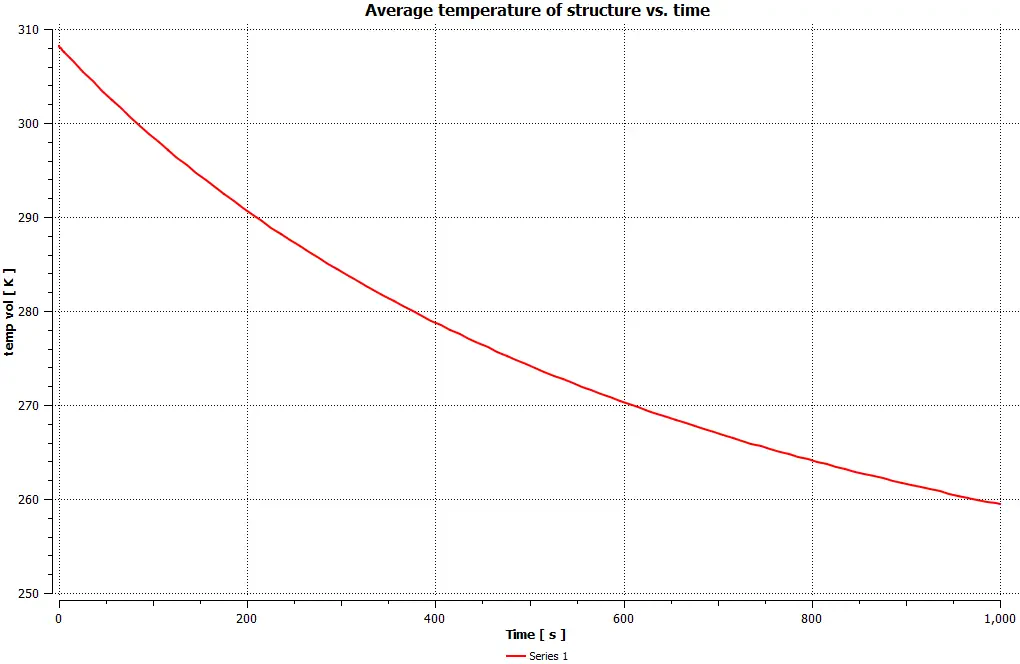
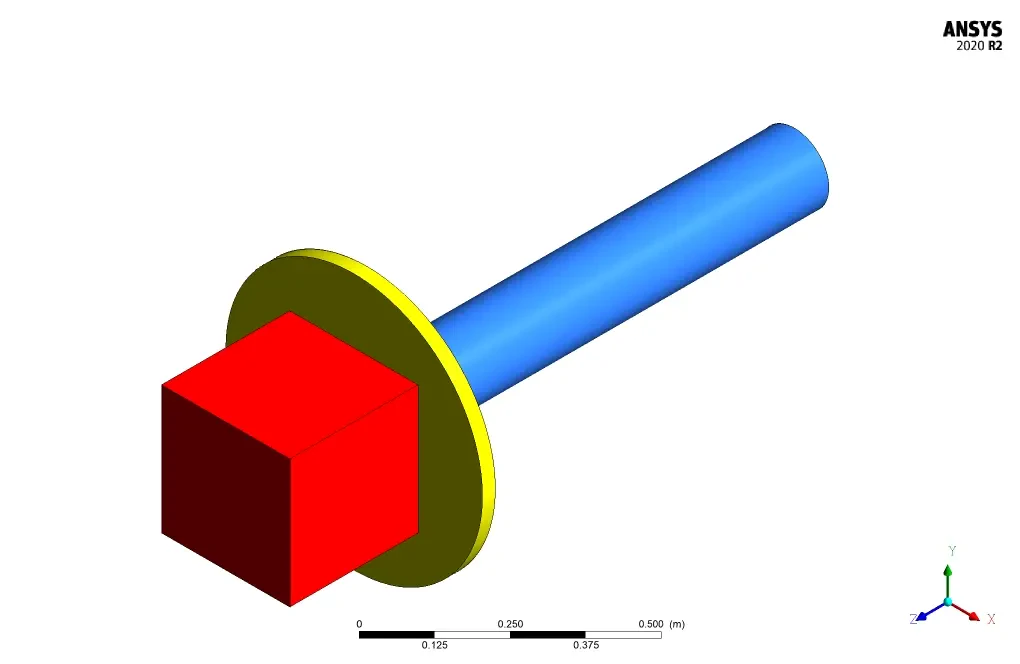
In this project, the unsteady cooling process of a hot steel structure is investigated by ANSYS Fluent software. In the exact model, the structure is rotating around Z-axis. The actual simulation involving rotation and resulting forced convection requires extreme computational resources. However, in this simulation, the structure is assumed to be rigid, and heat transfer boundary conditions on each surface are modified in such a manner as to mimic the forced convection effects in rotation. In this project, the only energy equation is solved. Free stream convection heat transfer coefficients of red, yellow, and blue sections are considered equal to 80, 90, and 73 w/K.m2, respectively. The free stream flow temperature is assumed to be 243K. The volume average temperature of the whole structure at the start of the simulation and after 1000s is equal to 308.15K and 259.44K, respectively.
Geometry & Mesh
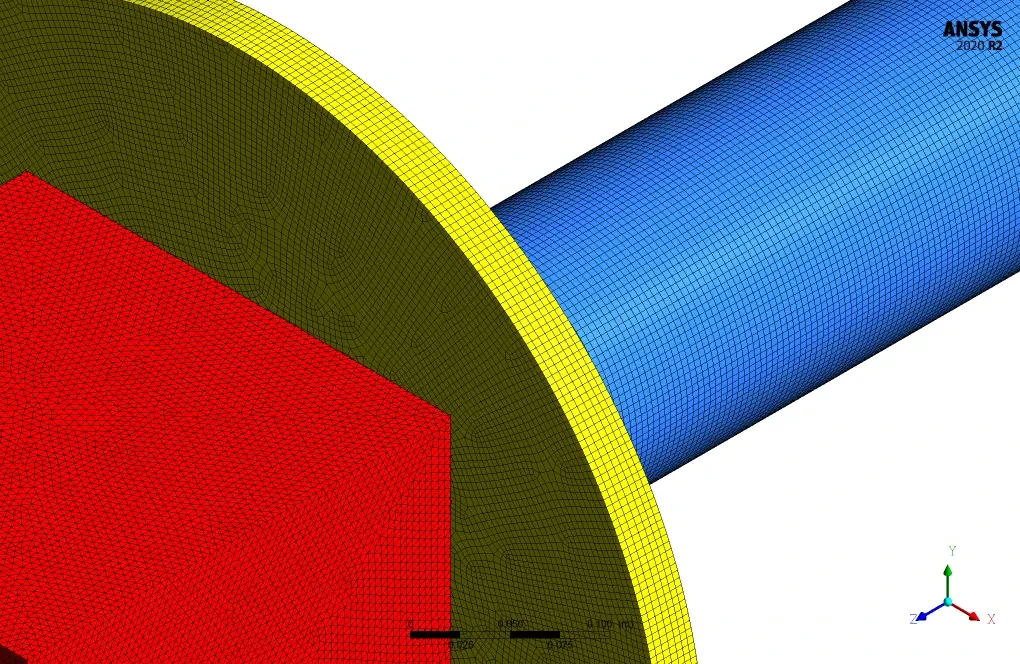
This project's 3D geometry is modeled in Design Modeler, and the computational grid is generated using Ansys Meshing software. The mesh type in structured and the element number is 600405.
Cooling CFD Simulation Settings
Critical assumptions of this simulation are:
- Solver type is assumed to be Pressure-Based.
- Time formulation is Transient.
- The gravity effect is ignored.
The applied settings are recapitulated in the following table.
| models | ||
| Viscous | Laminar (is then deactivated in Controls) | |
| Energy | On | |
| Material properties | ||
| Steel | Definition type | Fluent database |
| Density | 8030 kg/m3 | |
| Specific heat | 502.48 j/kg.K | |
| Thermal conductivity | 16.27 W/m.K | |
| Cell zone conditions | ||
| Zone name | Fluid | |
| Material name | Steel | |
| Boundary conditions | ||
| Tube | Type | Convection |
| Heat transfer coefficient | 73 W/m2.K | |
| Free stream temperature | -30 C | |
| Table | Type | Convection |
| Heat transfer coefficient | 90 W/m2.K | |
| Free stream temperature | -30 C | |
| Type | Convection | |
| Box | Heat transfer coefficient | 80 W/m2.K |
| Free stream temperature | -30 C | |
| Type | Convection | |
| Solver configuration | ||
| Pressure velocity coupling | Scheme | PISO |
| Spatial discretization | Gradient | Least square cell-based |
| Pressure | Standard | |
| Momentum | First order Upwind | |
| Energy | First order Upwind | |
| Initialization | Gauge pressure | 0 Pa |
| X velocity | 0 m/s | |
| Y velocity | 0 m/s | |
| Z velocity | 0 m/s | |
| Temperature | 35 C | |
Results & Discussion
Contours of temperature at different simulation times are extracted and presented .
As shown in the chart below, which shows the volume average temperature of the structure as moving further in time, the cooling down rate is very high at the beginning, but as time passes temperature of the structure begins to reach a steady-state which has not yet occurred so far (1000s).