

Dehumidifier With VOF Model, CFD Simulation ANSYS Fluent Training
Price: $28
The present simulation is about a Dehumidifier with VOF Model via ANSYS Fluent, and the results of this simulation have been analyzed.
Dehumidifier With VOF Model, CFD Simulation ANSYS Fluent Training
Price: $28
The present simulation is about a Dehumidifier with VOF Model via ANSYS Fluent, and the results of this simulation have been analyzed.
Dehumidifier With VOF Model Description
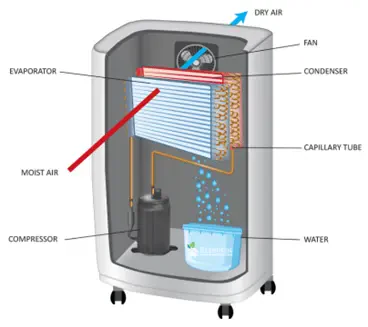
The present simulation is about a dehumidifier via ANSYS Fluent. A dehumidifier is an air conditioning device that reduces and maintains the level of humidity in the air. This device is used to increase the health and thermal comfort of the people in the environment, eliminate the musty odor, and prevent mildew growth by removing water from humid air.
This project investigates a humidification-dehumidification system with a phase change process. These systems consist of two sections the evaporator and the condenser.
First, the airflow inside the copper pipes is heated and compressed by the compressor and goes to the condenser section. In this section, the air inside the pipes is reduced by temperature due to blowing the fan, and condensation occurs.
The resulting liquid then goes to the evaporator section to evaporate again when it receives heat and turns into a gas phase. This heat is taken from the humid air blown into the pipes. Receiving heat from humid air causes dry air to be obtained. In this study, water vapor is considered humid air. Therefore, a multi-phase model must be defined, consisting of water and vapor.
Then the mass transfer between vapor and water is defined in evaporation-condensation type so that steam becomes liquid water by decreasing the temperature to below saturation temperature.
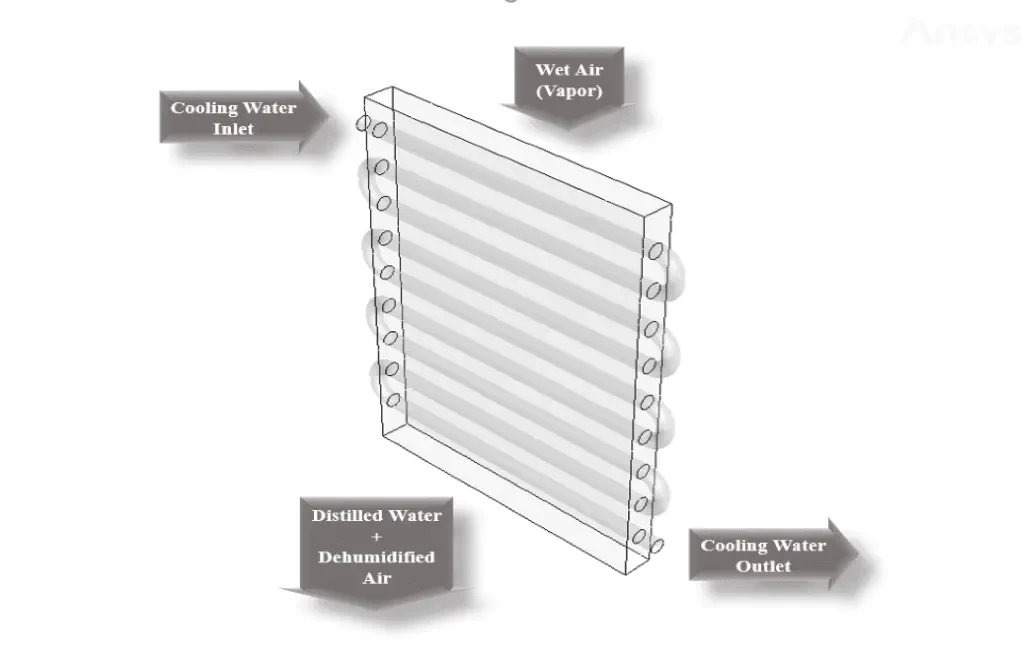
The amount of water resulting from the phase change between vapor and water indicates the amount of dehumidification. Since the two phases of water and vapor are entirely separate from each other, the volume of fluid (VOF) model is used. So, a chamber is designed with spiral tubes, So that the pipes have a flow of cold water and the chamber contains water vapor.
The vapor enters the chamber with a saturation temperature of 373.15 K and velocity of 0.05 m/s and contacts the surface of a pipe with water flow at a temperature of 358.15 K and a velocity of 0.01 m/s.
Geometry & Mesh
The present geometry is designed in a 3D model via Design Modeler. The computational zone is the interior of a dehumidifier. This dehumidifier consists of a chamber with spiral tubes. Steam flows inside the chamber, and cold-water flows inside the spiral pipes.
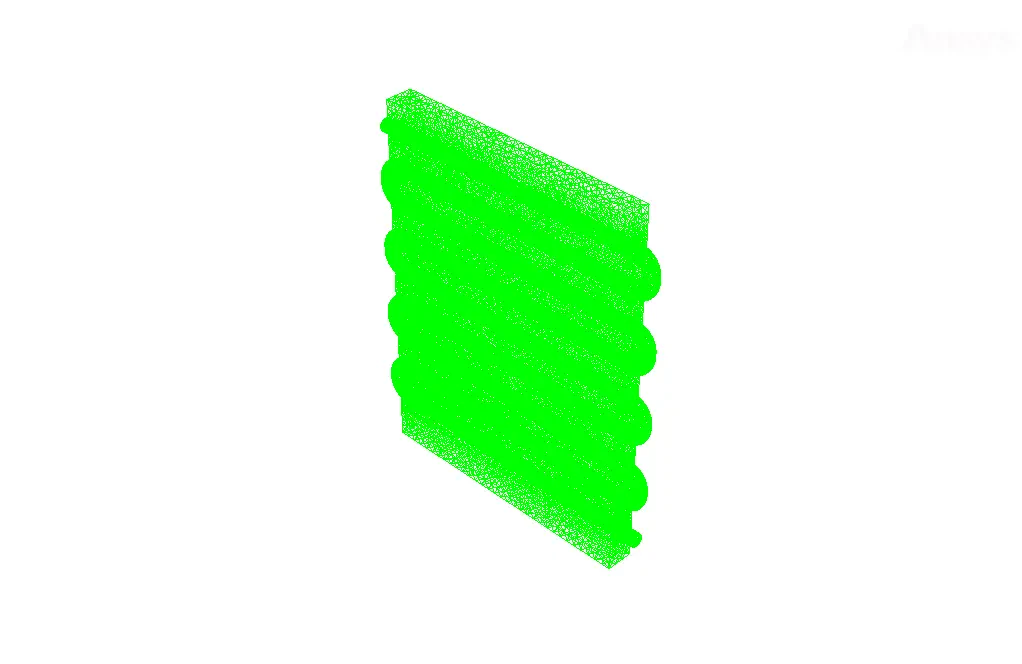
The mesh of the present model has been done via ANSYS Meshing. Mesh is done unstructured, and the number of production cells is equal to 1522772.
Set-up & Solution
Assumptions used in this simulation :
- Pressure-based solver is used.
- The present simulation is steady.
- The effect of gravity on the model is considered, and the gravitational acceleration is defined as 9.81 m/s2.
| Models | ||
| Viscous | k-epsilon | |
| k-epsilon model | realizable | |
| Near-wall treatment | standard wall function | |
| Multiphase | VOF | |
| number of eulerian phases | 2 (water & vapor) | |
| interface modeling | sharp | |
| mass transfer mechanism | evaporation-condensation | |
| Energy | On | |
| Boundary conditions | ||
| Inlet-Wet Air | Velocity Inlet | |
| velocity magnitude | 0.05 m.s-1 | |
| temperature | 373.15 K | |
| volume fraction of water | 0 | |
| volume fraction of vapor | 1 | |
| Inlet-Cool Water | Velocity Inlet | |
| velocity magnitude | 0.01 m.s-1 | |
| temperature | 358.15 K | |
| volume fraction of water | 1 | |
| volume fraction of vapor | 0 | |
| Outlet-Dry Air | Pressure Outlet | |
| gauge pressure | 0 Pascal | |
| Outlet-Cool Water | ||
| gauge pressure | 0 Pascal | |
| Inner Wall | Wall | |
| wall motion | stationary wall | |
| thermal condition | coupled | |
| Outer Wall | Wall | |
| wall motion | stationary wall | |
| heat flux | 0 W.m-2 | |
| Methods | ||
| Pressure-Velocity Coupling | Coupled | |
| pressure | PRESTO | |
| momentum | First-order upwind | |
| turbulent kinetic energy | First-order upwind | |
| turbulent dissipation rate | First-order upwind | |
| volume fraction | modified HRIC | |
| energy | First-order upwind | |
| Initialization | ||
| Initialization methods | Standard | |
| gauge pressure | 0 Pascal | |
| volume fraction of vapor in chamber | 1 | |
| volume fraction of vapor in tube (patch) | 0 | |
| velocity | 0 m.s-1 | |
| temperature in chamber | 373.15 K | |
| temperature in tube (patch) | 358.15 K | |