Diaphragm Pump CFD Simulation, ANSYS Fluent Training
Price: $63
- The problem numerically simulates the Diaphragm Pump using ANSYS Fluent software.
- We design the 2-D model with the Design Modeler software.
- We mesh the model with ANSYS Meshing software; the element number equals 222,986.
- We perform this simulation as unsteady (Transient).
- We use the Dynamic Mesh Model to define deforming and moving zones.
- We use the user-defined function (UDF) to define the reciprocating motion.

Description
This project is related to the numerical simulation of the Diaphragm Pump using ANSYS Fluent software. A pump is a mechanical device for moving and transferring all liquids from one place to another. The pump takes mechanical energy from an external source, such as a motor, and transfers it to the fluid passing through it. As a result, the energy of the fluid increases after leaving the pump.
The energy transfer to the pump fluid is done in two dynamic and displacement methods. Therefore, pumps are divided into positive displacement pumps and dynamic or non-positive displacement pumps. Positive displacement pumps are divided into two groups: rotary (such as gear, lobe, and vane) and reciprocating (piston and diaphragm).
A diaphragm pump is one of the pumps to increase the hydraulic power of a fluid. Diaphragm pumps use a composite membrane, which flexes up-down over a water flow.
The pump membrane has an up-and-down reciprocating motion. When the membrane moves up, the liquid flow is sucked from the intake valve, and when the membrane moves down, the liquid flow is pushed towards the outlet valve.
In this project, we simulated the water flow inside a diaphragm pump. We aim to model the reciprocating motion of the membrane inside the pump. The gears' reciprocating motion momentarily changes the fluid's behavior in the pump. So, the mesh of the computing domain deforms over time.
We modeled the geometry of the project using Design Modeler software. The geometry is related to a diaphragm pump. The computational domain includes the internal space of the pump with a moving membrane. Then we meshed the model with ANSYS Meshing software. The model mesh is unstructured, and the number of cells equals 222,986.
Diaphragm Pump Methodology
In this project, the Dynamic Mesh Model was used. We generally use a dynamic mesh whenever we have a moving boundary or a deforming zone.
Here, a wall creates a wave motion. So this causes the mesh to deform over time. Therefore, we define a user-defined function (UDF) to define the wavy motion of the wall. To apply the wave motion to the wall, we must use the Grid Motion UDF.
According to the reciprocating motion of the membrane as a rigid body, the mesh zone near the moving membrane is deformed. So, for this zone, we use the Deforming option.
Due to the nature of this modeling, fluid behavior is time-dependent. Hence, we use the unsteady (Transient) solver.
Diaphragm Pump Conclusion
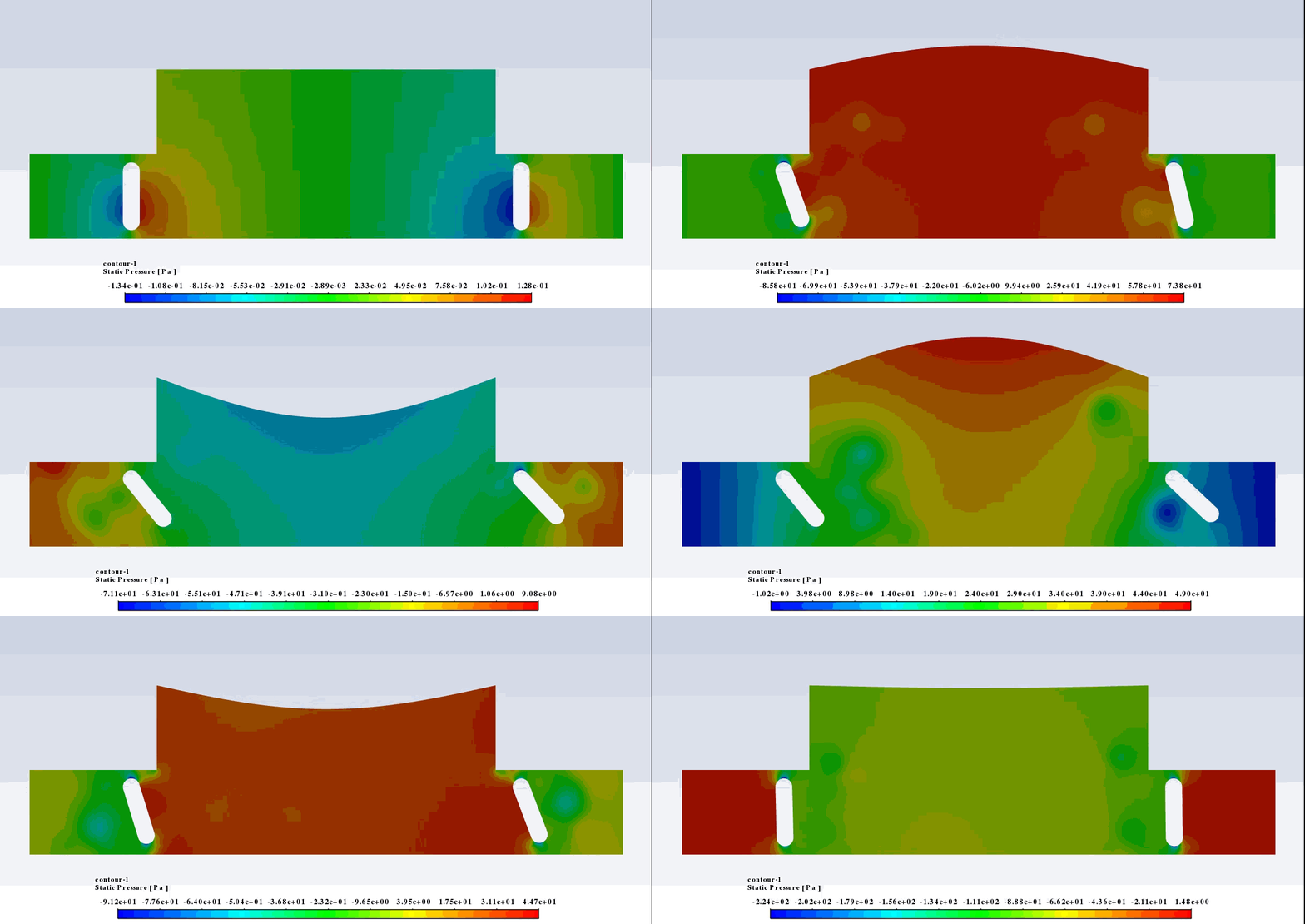
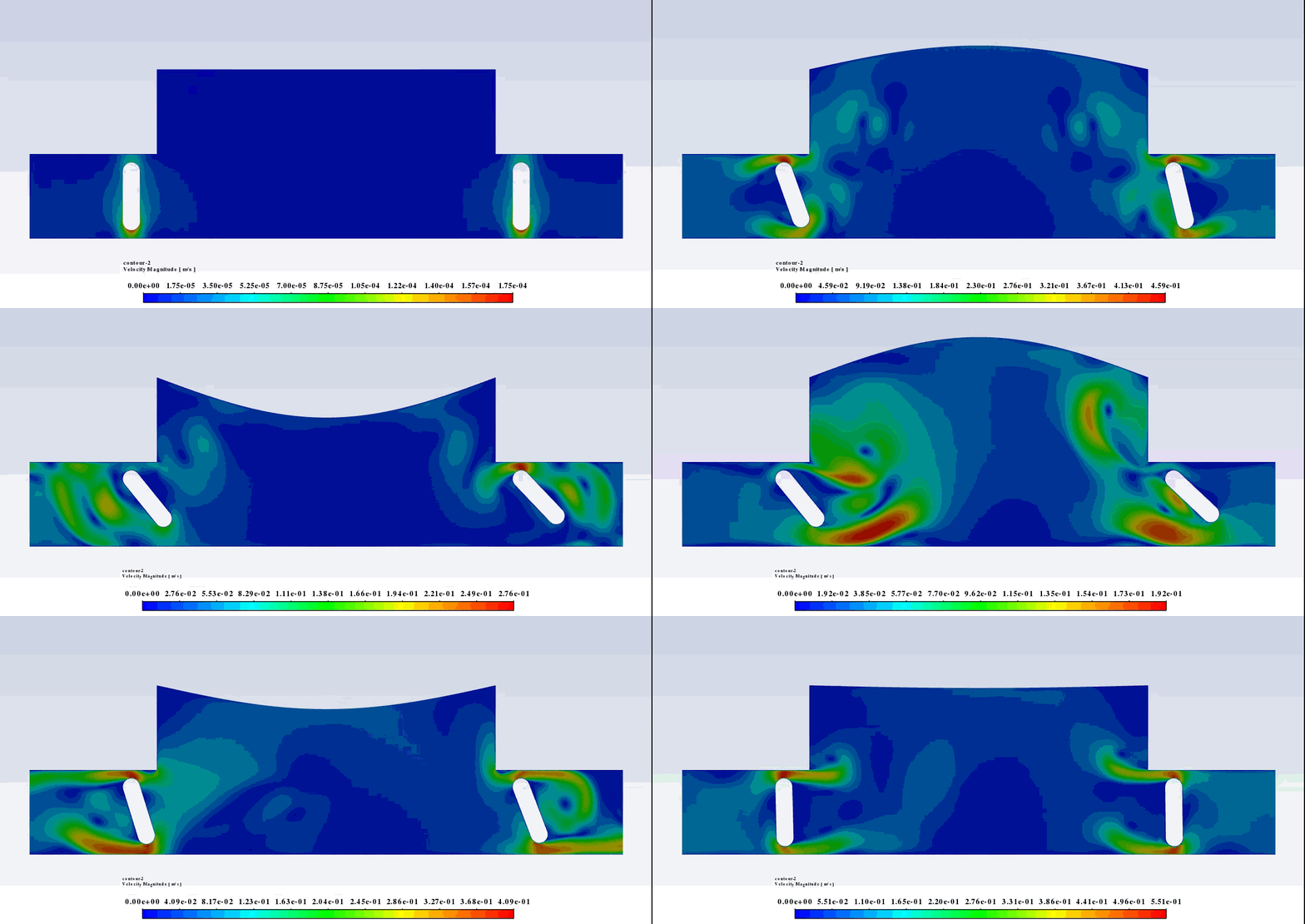
After the solution, we obtained pressure and velocity contours. Because the membrane moves over time, we obtained the animation of the velocity and pressure contours.
The results show that the pressure and velocity constantly change under the influence of the reciprocating motion of the non-stationary membrane. The reciprocating motion causes suction from the intake valve and compression to the outlet valve.