

Double Pipe Heat Exchanger with Dish-Shaped Strip Inserts, ANSYS Fluent
Price: $8
The heat transfer inside a double pipe heat exchanger with dish-shaped strip inserts is investigated in this project.
Double Pipe Heat Exchanger with Dish-Shaped Strip Inserts, ANSYS Fluent
Price: $8
The heat transfer inside a double pipe heat exchanger with dish-shaped strip inserts is investigated in this project.
Introduction
A heat exchanger is a system used to transfer heat between two or more fluids. Heat exchangers are used in both cooling and heating processes. A solid wall may separate the fluids to prevent mixing, or they may be in direct contact. They are widely used in space heating, refrigeration, air conditioning, power stations, chemical plants, petrochemical plants, petroleum refineries, natural-gas processing, and sewage treatment. The classic example of a heat exchanger is found in an internal combustion engine. (Double Pipe Heat Exchanger with Dish-Shaped Strip Inserts)
A circulating fluid known as engine coolant flows through radiator coils and air flows past the coils, which cools the coolant and heats the incoming air. Another example is the heat sink, a passive heat exchanger that transfers the heat generated by an electronic or a mechanical device to a fluid medium, often air or a liquid coolant.
Double Pipe Heat Exchanger with Dish-Shaped Strip Inserts Project Description
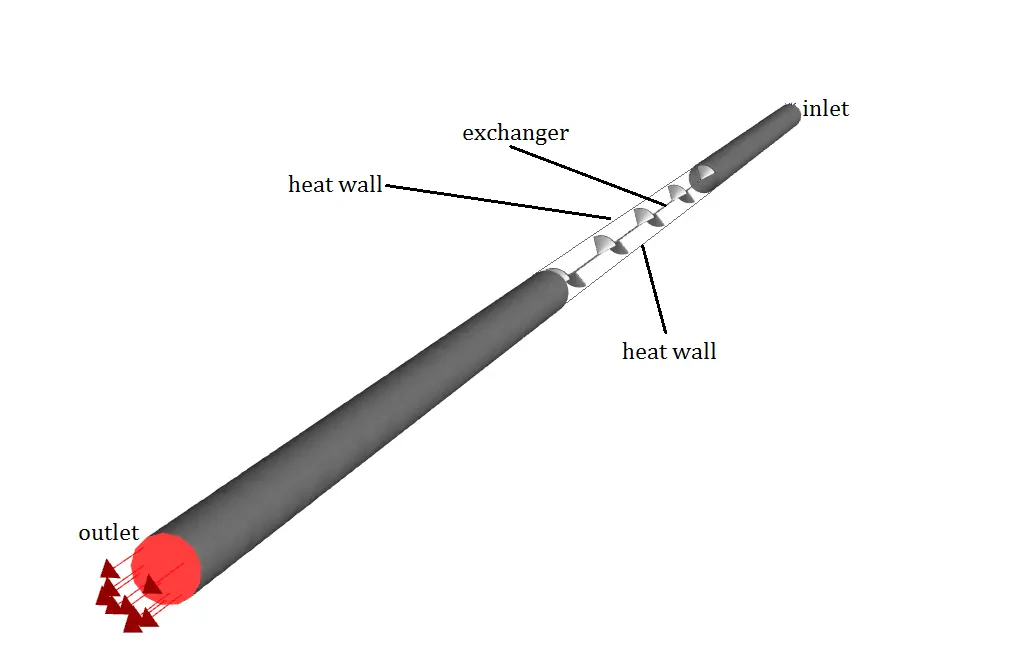
The heat transfer inside a double pipe heat exchanger with dish-shaped strip inserts is investigated in this project by ANSYS Fluent software. The double heat exchanger consists of several baffles (dish-shaped strip) with a heated wall. The water flow enters the pipe with an initial temperature of 293K and a velocity equal to 1.537972m/s. Also, the heated wall is exposed to a heat flux of 200000W/m2. The energy equation is activated to obtain temperature distribution inside the computational domain, and the RNG k-epsilon model is exploited to solve turbulent flow equations.
Double Pipe Heat Exchanger Geometry & Mesh
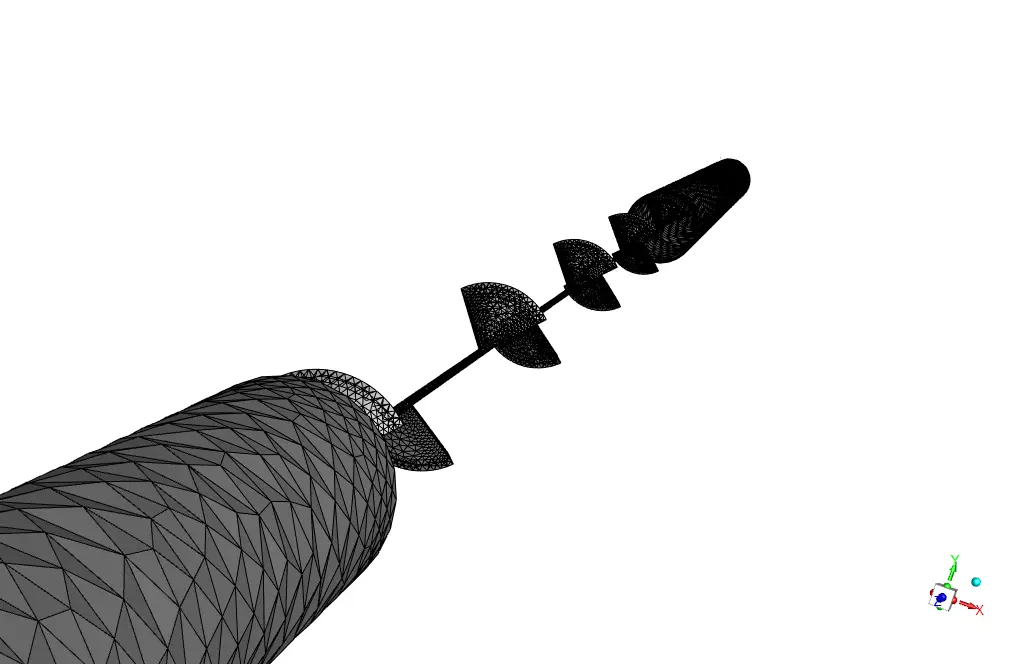
This project's geometry is designed in ANSYS Design Modeler and consists of dish-shaped strips and a heating wall. The geometry has then meshed in ANSYS Meshing software, and the mesh type used for this geometry is unstructured, and the element number is 649800.
CFD Simulation Settings
The critical assumptions considered in this project are:
- Simulation is done using a pressure-based solver.
- The present simulation and its results are considered steady and do not change as a function of time.
- The effect of gravity has not been taken into account.
The applied settings are summarized in the following table.
| Models | ||
| Viscous model | k-epsilon | |
| k-epsilon model | RNG | |
| near wall treatment | standard wall function | |
| Energy | on | |
| Boundary conditions | ||
| Inlet | Velocity inlet | |
| Inlet | 1.537972 m/s | |
| Temperature | 293 K | |
| Outlet | Pressure outlet | |
| Gauge pressure | 0 Pa | |
| Walls | Stationary wall | |
| exchanger | Heat flux | 0 W/m2 |
| Heat wall | Heat flux | 200000 W/m2 |
| wall | Heat flux | 0 W/m2 |
| Solution Methods | ||
| Pressure-velocity coupling | SIMPLE | |
| Spatial discretization | Pressure | Second order |
| Momentum | second order upwind | |
| Energy | second order upwind | |
| turbulent kinetic energy | second order upwind | |
| turbulent dissipation rate | second order upwind | |
| Initialization | ||
| Initialization method | Standard | |
| gauge pressure | 0 Pa | |
| Velocity (x,y,z) | (1.537972,0,0) m/s | |
| temperature | 293 K | |
| Turbulent kinetic energy | 0. 0003548039 m2/s2 | |
| Turbulent dissipation rate | 0.0007634331 m2/s3 | |
Results
After the CFD simulation process, contours of pressure, velocity, temperature, etc., are obtained and presented.