

Duct Effect on HAWT Performance, CFD Simulation ANSYS Fluent Training
Price: $18
In this project, a horizontal axis wind turbine (HAWT) is modeled in two different cases via Ansys Fluent.
Duct Effect on HAWT Performance, CFD Simulation ANSYS Fluent Training
Price: $18
In this project, a horizontal axis wind turbine (HAWT) is modeled in two different cases via Ansys Fluent.
Duct Effect on HAWT Performance Problem Description
In this project, Duct Effect on HAWT Performance is simulated in two different cases via Ansys Fluent. Once, without implementing any duct, and in another case, a duct is installed. The study aims to investigate the effect of the duct on turbine performance. Plus, the multi-reference frame (MRF) module is used, and the tip-speed ratio is 2.5.
Geometry & Mesh
The 3D geometry is modeled in Ansys Design Modeler software for both cases. Also, the mesh grid is carried out using Ansys Meshing software. Furthermore, an unstructured grid and boundary layer is generated in the first place and then transformed into polyhedron elements to decrease the computational cost. Therefore, 10506896 & 12216335 elements established the fluid domain, respectively.
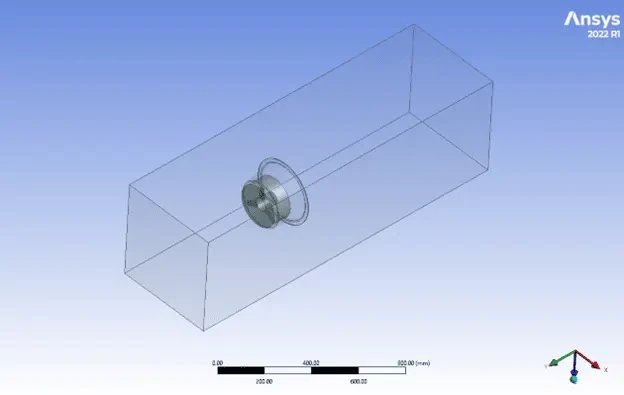
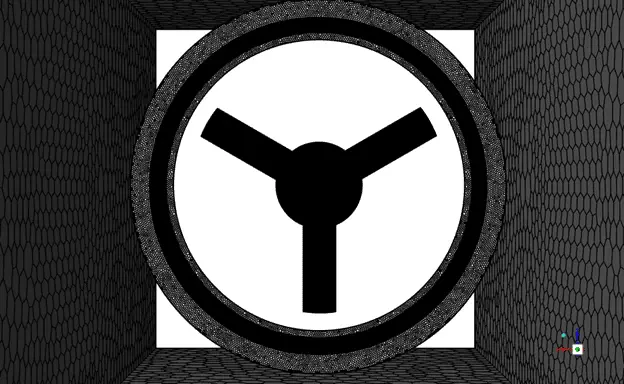
CFD Simulation
Several assumptions have been considered to simulate HAWT, including:
- The simulation is Steady in order to investigate the performance in a working manner.
- The pressure-based solver type was used due to the incompressibility of the working fluid.
- Gravitational acceleration effects were ignored.
The following table represents a summary of the solution:
| Models(Viscous) | ||
| Viscous | K-w | SST |
| Materials | ||
| Fluid | Definition method | Fluent database |
| Material name | Air | |
| Cell zone condition | ||
| Material name | Air | |
| Frame Motion | -2000rpm | |
| Boundary condition | ||
| Inlet | Type | Velocity inlet |
| Velocity magnitude | 5m/s | |
| Turbulent intensity | 5% | |
| Turbulent viscosity ratio | 10 | |
| Outlet | Type | Pressure-outlet |
| Gauge Pressure | 0 | |
| Blade-turbine Nuzzle Hub Tunnel | Type | Wall (Stationary – No-slip condition) |
| Solver configuration | ||
| Pressure-velocity coupling | Scheme | Coupled |
| Spatial Discretization | Gradient | Least squares cell-based |
| Pressure | PRESTO! | |
| Momentum | First-order upwind | |
| Turbulent kinetic energy | First-order upwind | |
| Turbulent dissipation rate | First-order upwind | |
| Initialization | Initialization methods | Standard Initialization |
| Run Calculation | Number of Iterations | 2500 |
Duct Effect on HAWT Performance Results
After the simulation process, 2D & 3D contours are extracted, as shown below. To assess properly, the torque generated by the turbine blade around the y-axis is reported by ANSYS Fluent. The results show a significant increase in torque which equals 63%! or in other words, the performance of wind turbines. To conclude, in tip-speed-ratio of 2.5 is a great effect but should be observed for different working conditions.
| Without Duct | With Duct | |
| Wind Turbine Torque [N.m] | 0.0031304626 | 0.0051037854 |