Dynamic Stability Derivatives for a Flying Wing (RQ-170)
Price: $649
- The problem numerically simulates the dynamic stability derivatives of a flying wing aircraft using ANSYS Fluent
- The Mesh Motion and UDF files are used to define the rotational and oscillatory motion of the wing.
- The 3D geometry of the model was created using ANSYS SpaceClaim
- A high-quality unstructured mesh was generated using ANSYS Meshing
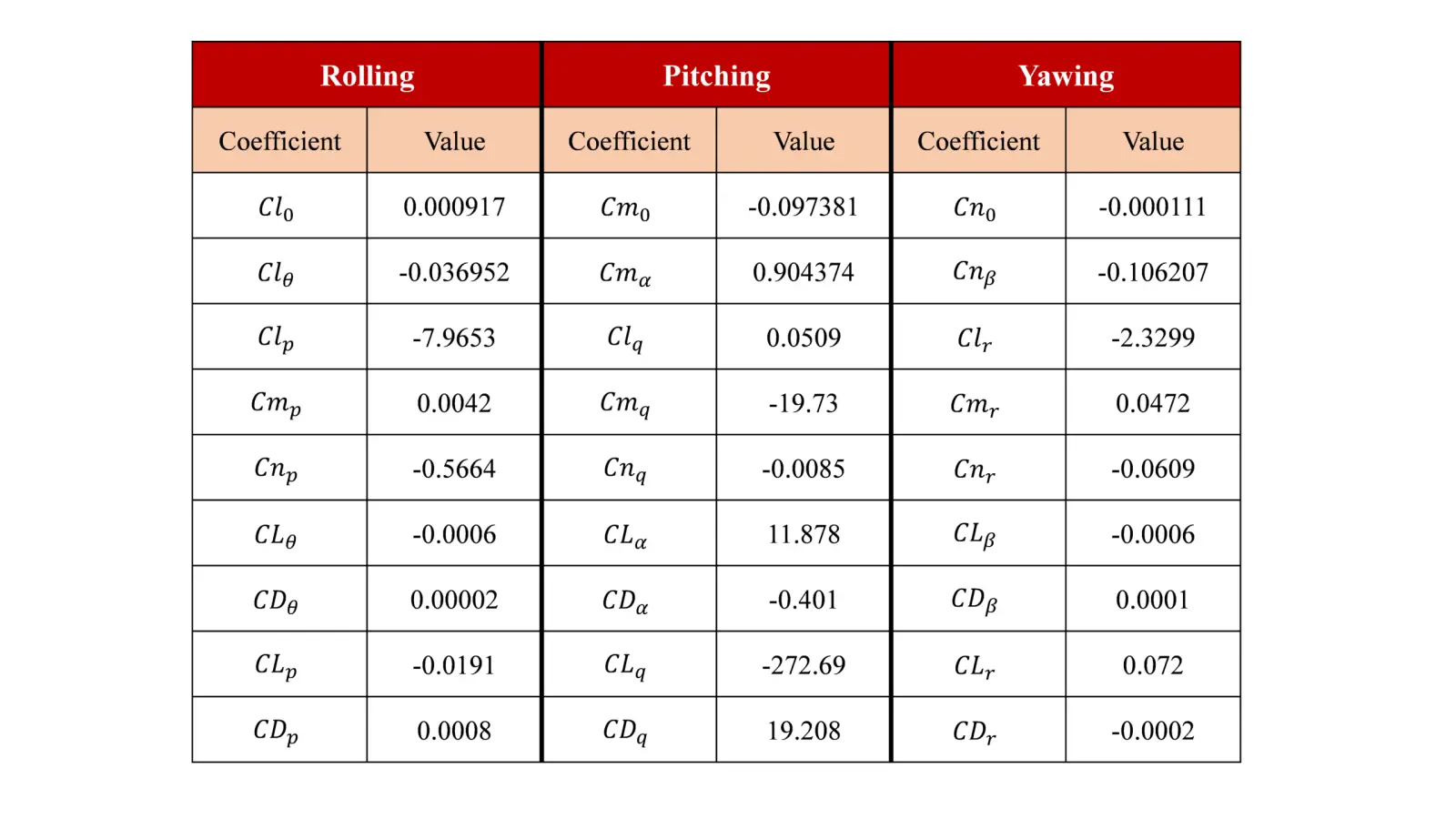
- The corresponding graphs are drawn and the total number of 24 dynamic derivatives coefficients are correctly extracted.
Aircraft Dynamic Stability Derivatives Extraction using CFD.
The determination of an aircraft's dynamic stability and control derivatives is vital for the development of accurate flight models and control system design. These coefficients, which relate aerodynamic moments to angular motion, are traditionally obtained through costly and time-consuming wind tunnel tests. This study proposes a Computational Fluid Dynamics (CFD) approach using forced oscillation techniques to efficiently extract these crucial dynamic stability derivatives for an aircraft operating at a subsonic Mach number.
For more information on dynamic stability derivatives, click here.
Using ANSYS Fluent software, a transient, compressible turbulent flow simulation was performed around a defined aircraft geometry. The computational domain was specifically structured with two fluid zones to facilitate the motion: a stationary outer Fluid zone and a rotating inner Slide-Fluid zone that completely encloses the aircraft. A high-fidelity mesh was used to ensure the accurate resolution of the flow field and its unsteadiness. The investigation focuses on applying a specific cosine oscillation to the aircraft and analyzing the resulting aerodynamic moments to quantify the dynamic stability derivatives.
Methodology
The study utilized a Pressure-Based, Transient CFD simulation in ANSYS Fluent to analyze the unsteady, compressible flow around an aircraft at Mach 0.6 for dynamic derivative extraction. The flow physics were modeled using the Ideal Gas Law, the Energy Equation, and the k−ω SST turbulence model. The key methodology involved a Sliding Mesh technique where an inner fluid zone, containing the aircraft, was forced into a simple harmonic oscillation via a UDF, while the outer domain was set with Pressure-Far-Field boundary conditions. This setup, with fine temporal resolution, was designed to capture the dynamic aerodynamic response necessary for calculating dynamic stability derivatives.
Results and Conclusion
The comprehensive transient CFD simulations successfully generated the necessary time-accurate data to determine the full set of 24 dynamic derivative coefficients for the aircraft. These critical values, representing the aircraft's unsteady stability characteristics, were extracted and are precisely tabulated, with corresponding graphs drawn to visually illustrate their relationship with the oscillation parameters. Furthermore, key visualizations, including various contours of the fluid properties around the aircraft, are presented to provide physical context to the aerodynamic moments.