

Effect of Contact Angle on Droplet Collapse, Ansys Fluent Training
Price: $100
- The problem numerically simulates the Effect of Contact Angle on Droplet Collapse using ANSYS Fluent software.
- We design the 3-D model by the SpaceClaim software.
- We Mesh the model by ANSYS Meshing software, and the element number equals 53440.
- We perform this simulation as unsteady (Transient).
- We use the VOF Multi-Phase model to water droplets in the air.
Description
In this project, the effect of the contact angle on droplet collapse has been simulated, and the results have been investigated using ANSYS Fluent software. We perform this CFD project and investigate it by CFD analysis.
The present model is designed in three dimensions using the SpaceClaim software. The length of the computational area is 5 mm, and its height is 3.5 mm.
This geometry is meshed in Ansys meshing software, and the total number of cells is 53440.
Also, due to the nature of the present problem, the transient solver has been used.
Droplet Methodology
In this project, a numerical simulation of droplet collapse with two different contact angles has been done using Ansys Fluent software.
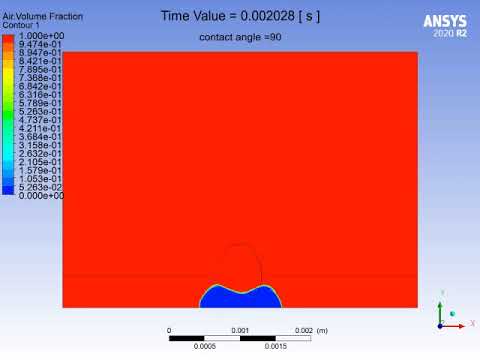
The VOF model has been used to simulate and solve the two-phase flow field equations. This project investigates the collapse of water droplets on the wall at contact angles of 90 degrees and 120 degrees.
Moreover, the laminar viscous model is used to solve the fluid equations.
Droplet Conclusion
At the end of the solution process, two-dimensional contours related to water volume fraction, velocity, and pressure are obtained. This simulation investigates the behavior of water droplets in the two modes of contact angles of 90 and 120 degrees.
According to the animation, it is clear that when the contact angle is 120 degrees, the water drop has more resistance to the momentary turbulence created, But we see more scatter in the 90-degree angle mode. This phenomenon can be important when more drops are on the wall next to each other.