

Ejector Two-Phase Flow CFD Simulation, ANSYS Fluent
Price: $20
In this project, a two-phase flow of vapor and liquid ammonia in a two-phase ejector has been simulated by ANSYS Fluent software.
Ejector Two-Phase Flow CFD Simulation, ANSYS Fluent
Price: $20
In this project, a two-phase flow of vapor and liquid ammonia in a two-phase ejector has been simulated by ANSYS Fluent software.

Ejector CFD Simulation, Two-Phase Flow, ANSYS Fluent Training
In general, an ejector is a system of ducting and nozzles used to direct the flow of a high-pressure fluid in such a way that a lower-pressure fluid is entrained in the jet and carried through a duct to a region of higher pressure. It is a fluid-dynamic pump with no moving parts, except a valve to control inlet flow. A steam ejector is a typical application of the principle used to deliver cold water to a boiler against its pressure, using its own live or exhaust steam, replacing any mechanical pump.
Project Description
In this project, a two-phase flow of vapor and liquid ammonia in a two-phase ejector has been simulated by ANSYS Fluent software. The realizable k-epsilon model is used for flow analysis. The VOF multi-phase model for two phases of liquid ammonia and vapor ammonia has been used to investigate the phase interactions. The energy equation is also activated in this analysis. The liquid ammonia will enter the computational domain through the primary inlet with a pressure of 9MPa and a temperature of 393K. This flow will induce the vapor ammonia to exit the ejector along with liquid ammonia.
Ejector Geometry & Mesh
The geometry of this model is designed and meshed in Gambit®. The mesh type used for this geometry is structured and the element number is 11808.
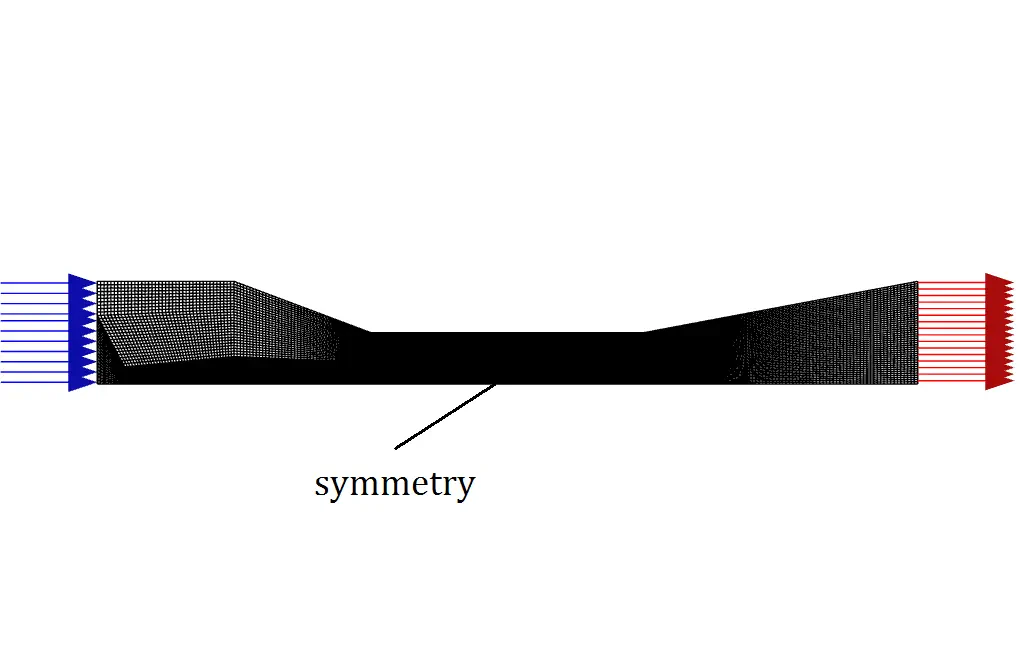
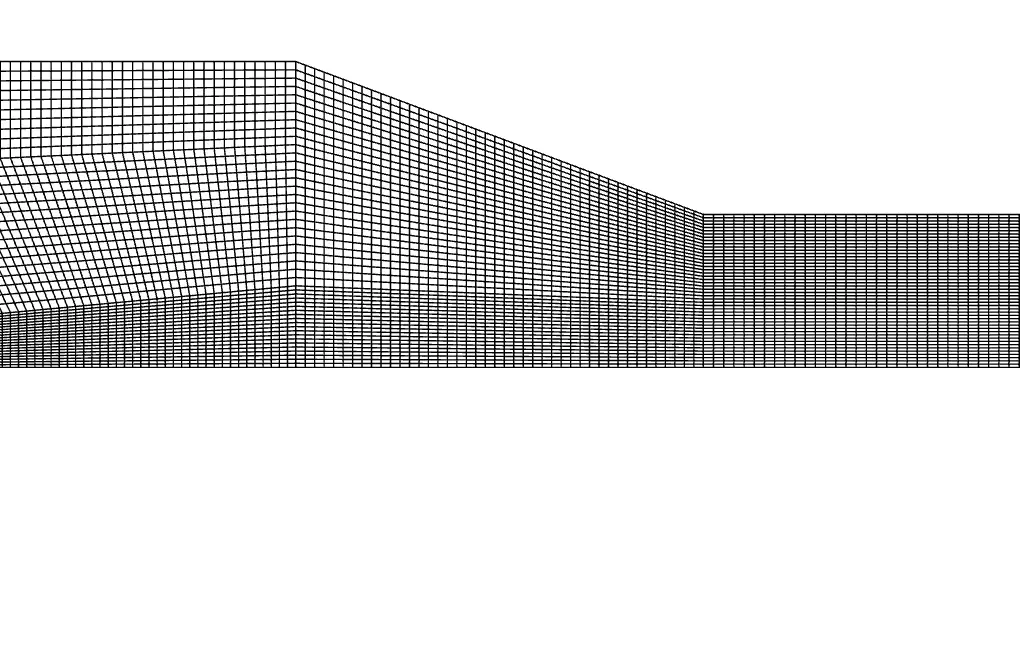
CFD Simulation Settings
The key assumptions considered in this project are:
- Simulation is done using a pressure-based solver.
- The present simulation and its results are steady.
- The effect of gravity is ignored.
The applied settings are summarized in the following table.
| (ejector) | Models | |
| Viscous model | k-epsilon | |
| Model | realizable | |
| Near wall treatment | Standard wall function | |
| Energy model | On | |
| Multi phase | VOF | |
| Phase 1 | Ammonia vapor | |
| Phase 2 | Ammonia liquid | |
| (ejector) | Boundary conditions | |
| Outlets | Pressure outlet | |
| Gauge pressure | 0 Pa | |
| Temperature | 312 K | |
| Walls | wall motion | stationary wall |
| New wall | Heat flux | 0 W/m2 |
| wall | Coupled | |
| (ejector) | Solution Methods | |
| Pressure-velocity coupling | Simple | |
| Spatial discretization | pressure | PRESTO! |
| Volume fraction | compressive | |
| momentum | second order upwind | |
| energy | second order upwind | |
| Turbulent kinetic energy | First order upwind | |
| Turbulent Dissipation rate | First order upwind | |
| (ejector) | Initialization | |
| Initialization method | Hybrid | |
Results
We present the contours of, pressure, temperature, velocity, etc.