Elliptical Nozzle With Inviscid Flow CFD Simulation
Price: $10
In this project, Inviscid Flow in Elliptical Nozzle has been simulated, and the simulation results have been investigated.
Elliptical Nozzle With Inviscid Flow CFD Simulation
Price: $10
In this project, Inviscid Flow in Elliptical Nozzle has been simulated, and the simulation results have been investigated.
Elliptical Nozzle With Inviscid Flow, ANSYS Fluent CFD Simulation Training
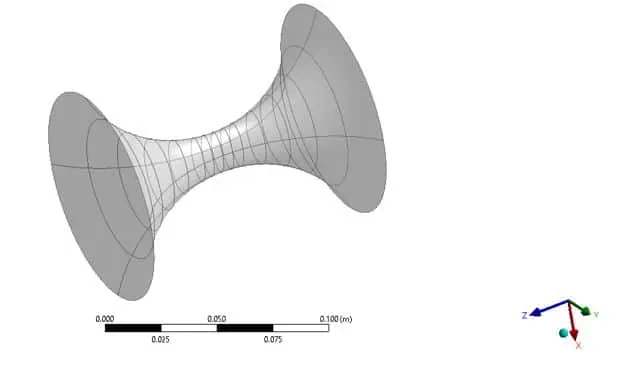
The geometry of the solution consisted of an elliptical nozzle. In this project, the airflow will enter the convergent-divergent nozzle with 9800000 pascal and 3710-kelvin pressure. After passing the throat zone, the airflow will gain speed and lose its temperature as it passes through the diffuser. (Elliptical Nozzle With Inviscid Flow)
Geometry and mesh
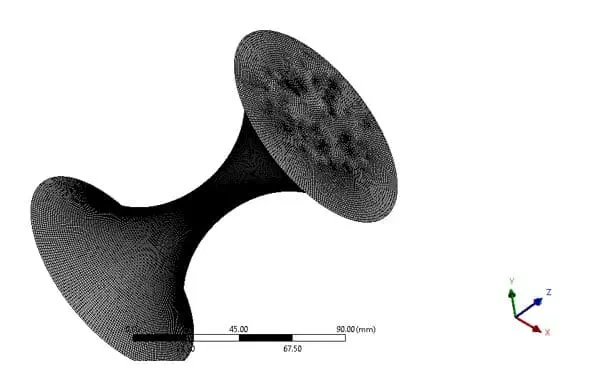
The geometry of the fluid domain is designed in the Design Modeler, edited with SpaceClaim, and the computational grid is generated using ANSYS Meshing.
Mesh is created with ANSYS meshing software, and the mesh type is unstructured. The number of cells is 1246820.
CFD Simulation
We consider several assumptions to simulate the present model:
- The pressure-based solver method has been selected.
- The simulation is steady.
- The effect of gravity is ignored.
The following table represents a summary of the defining steps of the problem and its solution:
Models | ||
Energy | On | |
Viscous | inviscid | |
Materials | ||
Fluid | Definition method | Fluent Database |
Material name | Air | |
solid | Definition method | Fluent Database |
Material name | Aluminum | |
Boundary conditions | ||
inlet | Type | Pressure inlet |
pressure | 9800000 pa | |
temperature | 3710 k | |
outlet | Type | Pressure outlet |
pressure | 101325 pa | |
temperature | 300 k | |
Material Properties | ||
air | ||
Molecular weight | 20 kg/kmol | |
Specific heat | 2494 j/kg-k | |
| Solution Methods | ||
Pressure-velocity coupling | coupled | |
Spatial discretization | pressure | Second-order |
momentum | second-order upwind | |
Energy | second-order upwind | |
Density | second-order upwind | |
Initialization | ||
Initialization method | Standard | |
Compute from | inlet | |
Elliptical Nozzle With Inviscid Flow results
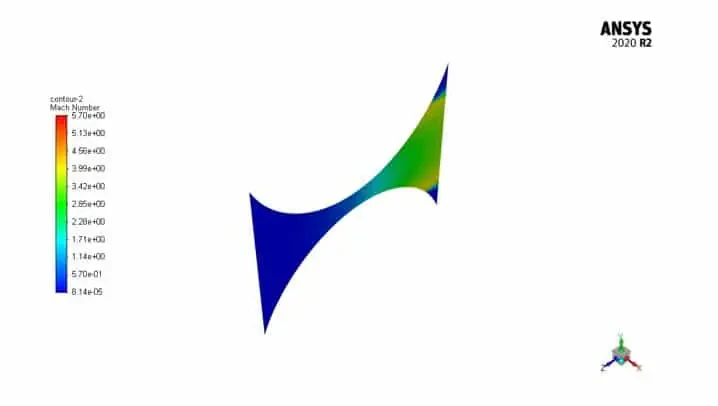
The elliptical nozzle under consideration is carried out at an inlet pressure of 9800000 pa, temperature 3710, outlet pressure of 101325 pa, and temperature of 300 K using an inviscid model. The contours of pressure, temperature, velocity, Mach number, etc., are presented. The airflow loses its heat as clear from the contours after passing through the nozzle opening.
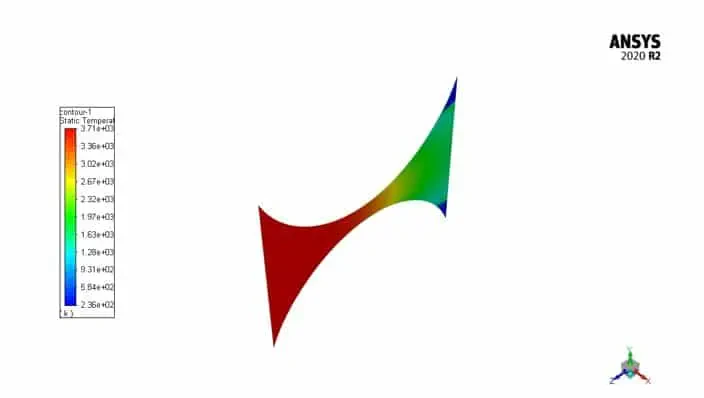
It increases its speed as the nozzle opening becomes more extensive than before the volume of passing air increases. Due to the constant air mass, its density decreases, so the velocity increases along with the nozzle according to the continuity law.
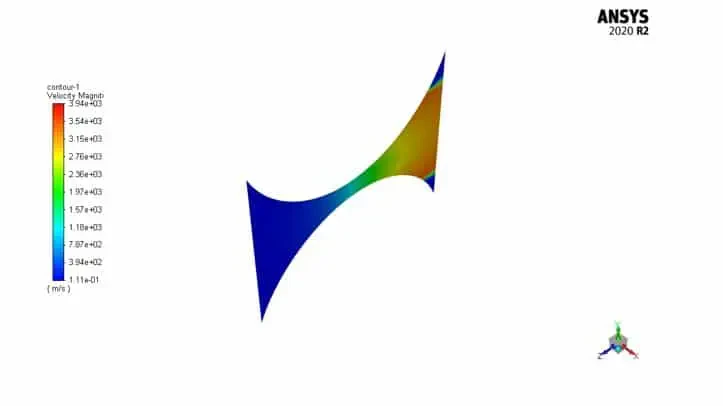
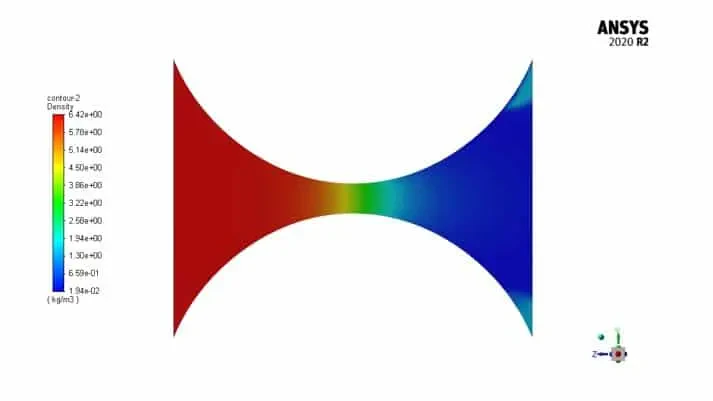
As can be seen from the Mach contour, the Mach number in the nozzle throat, according to the design mode, is equal to one and then increases in the nozzle’s divergent part.