

Evacuated U-bend Solar Collector, Paper Numerical Validation, ANSYS Fluent training
Price: $200
In this project, a 3D simulation of a U-tube solar collector is carried out while the radiation of the Sun is concentrated on the tube walls.
Evacuated U-bend Solar Collector, Paper Numerical Validation, ANSYS Fluent training
Price: $200
In this project, a 3D simulation of a U-tube solar collector is carried out while the radiation of the Sun is concentrated on the tube walls.
Project Description
A solar collector is an object that collects and concentrates solar radiation from the Sun and converts it into heat energy. These objects are primarily used for active solar heating and allow for water heating for domestic use. These collectors are typically mounted on the roof and must be very well-made and robust as they are exposed to various weather conditions. One of the popular types of solar collector is the Evacuated U-bend Solar Collector, which provides the combined effects of a highly selective surface covering and the vacuum insulation of the absorber element, thereby resulting in higher heat extraction efficiency and outlet temperatures than those for the flat-plate collector in a broad operating temperature range.
Moreover, because the U-tube collector uses an evacuated glass tube, the decrease in the efficiency of the solar collector at high operating temperatures is relatively small because of the low heat losses.
Evacuated U-bend Solar Collector Project Description
In this project, a 3D simulation of a U-tube solar collector is carried out while the radiation of the Sun is concentrated on the tube walls. The heating energy is considered as uniform heat flux all over the tube.
The tube wall has a thickness of 0.5 mm made of copper; heat will pass the copper due to conduction and then enters the flow because of the convection phenomenon.
Here we have validated the paper:
‘Effect of nanoparticle shape of Al2O3-Pure Water nanofluid on evacuated U-Tube solar collector efficiency
Geometry & Mesh
The geometry of the solution is a 3D tube whose diameter and length are 8mm and 3.8m, respectively.
Design Modeler software is used to create the geometry of the solution.
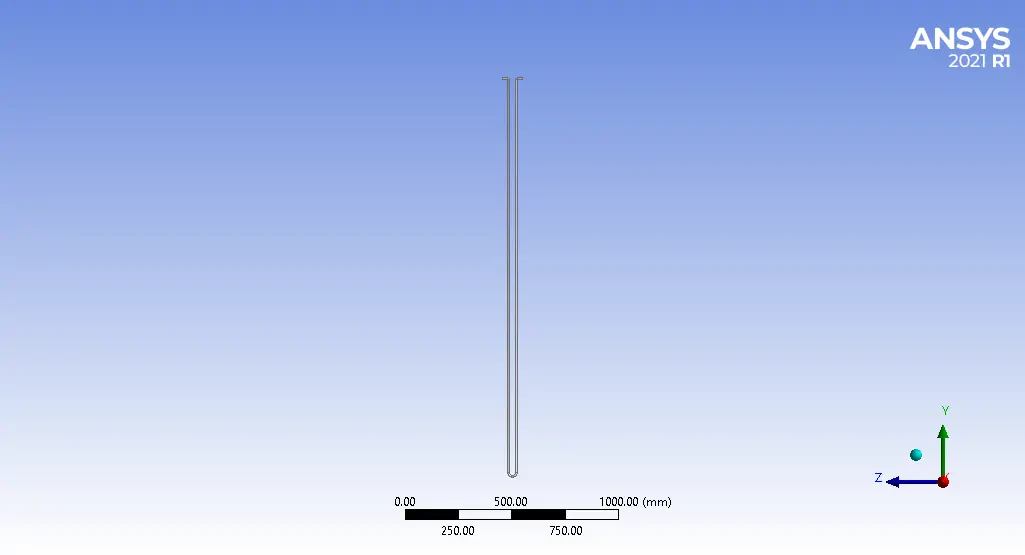
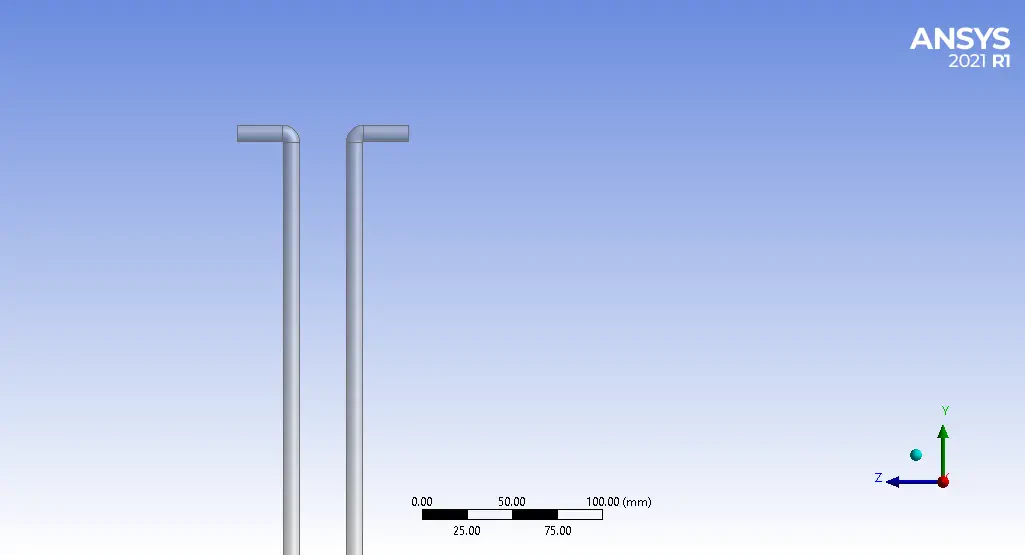
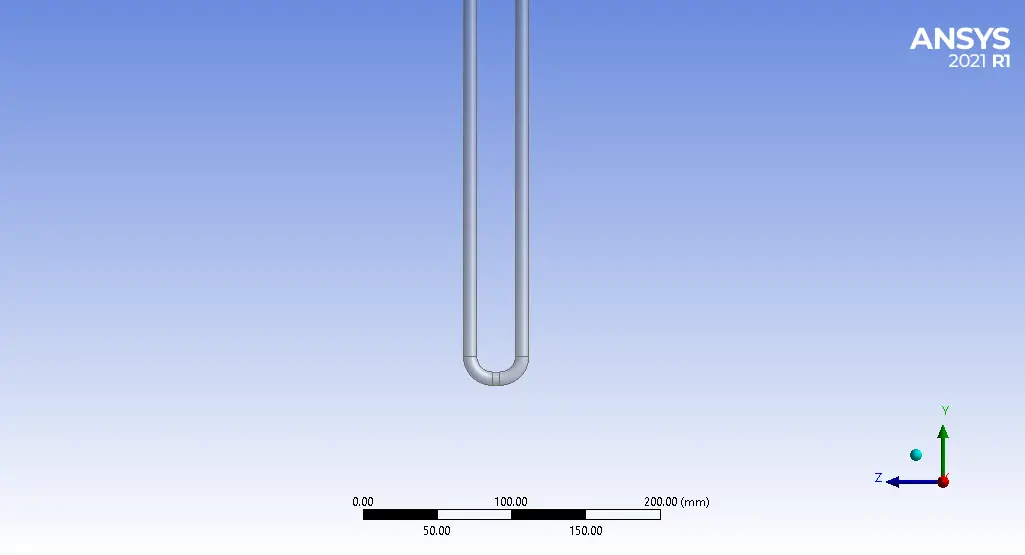
ANSYS Meshing software is used for generating the mesh of the solution. The elements are all tetrahedra, and the boundary of the tube has a boundary layer (Inflation).
The number of the elements is about 1000000:
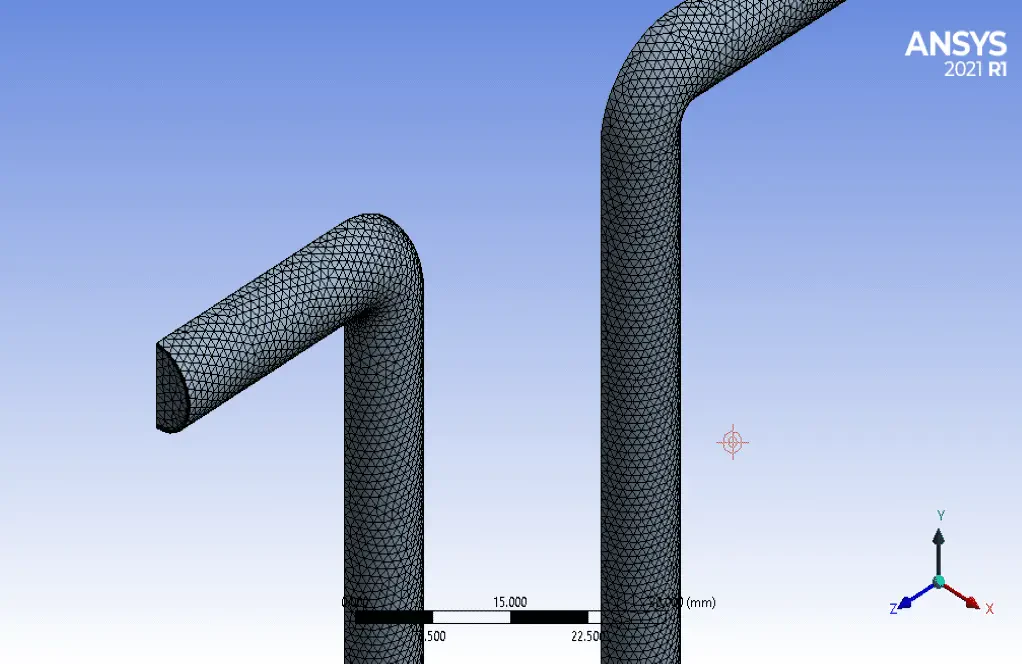
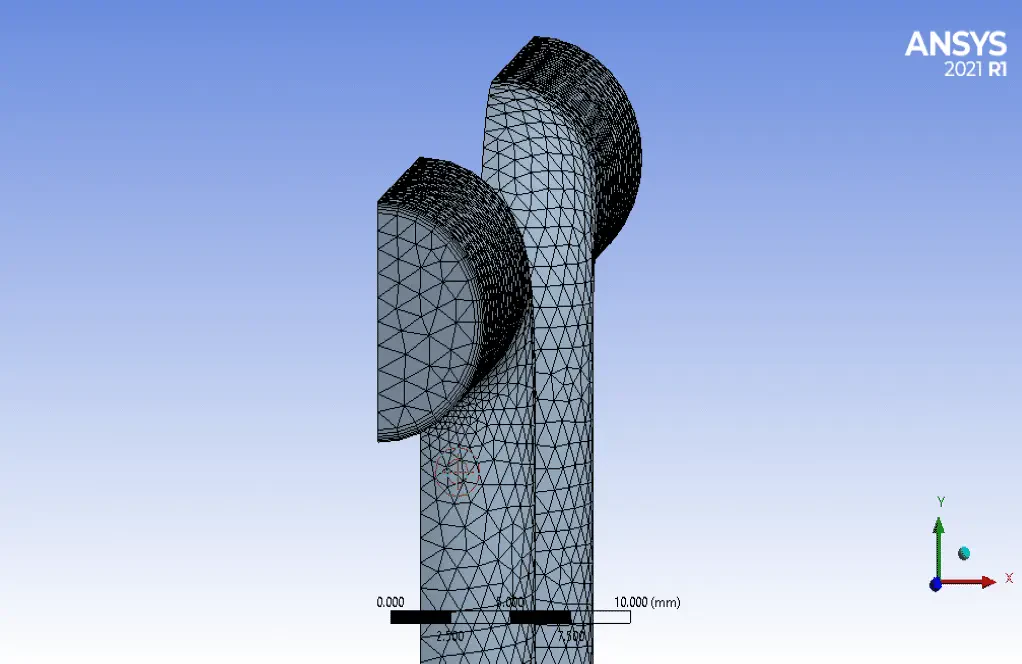
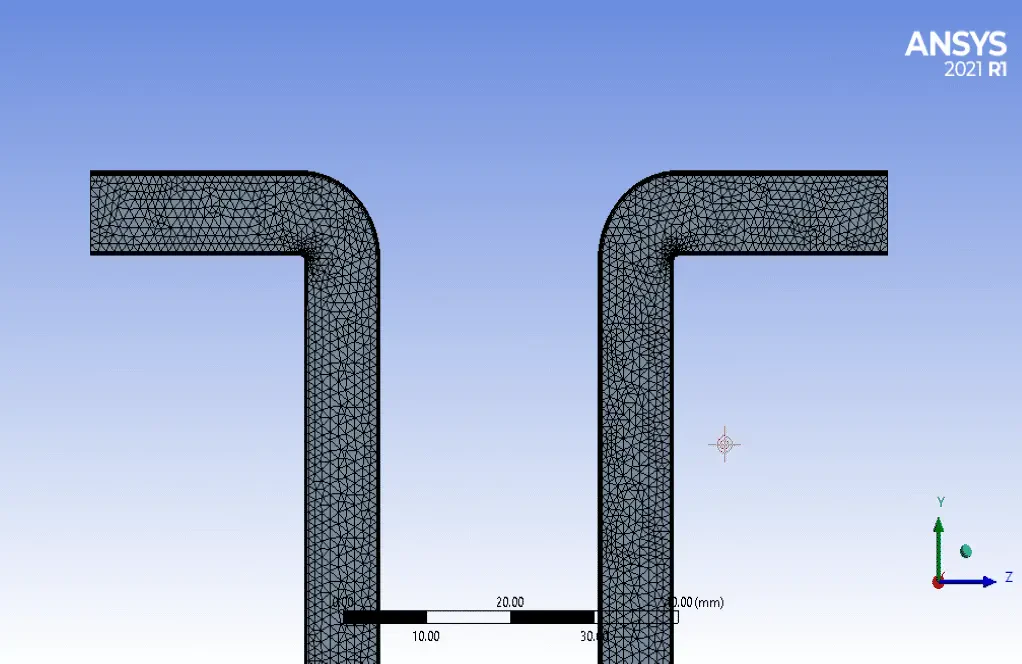
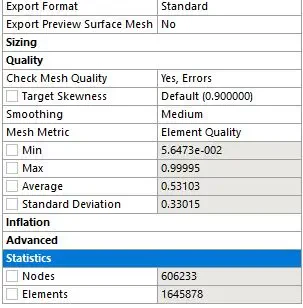
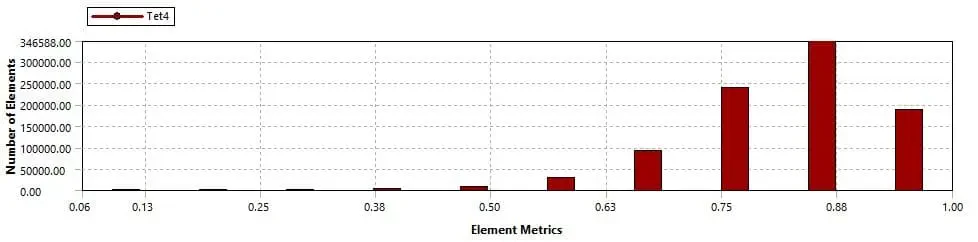
The charts below show the quality of the elements.
The elements’ minimum, maximum, and average quality are 0.056, 1, and 0.53103, respectively.
Evacuated U-bend Solar Collector CFD Simulation
We consider several assumptions to simulate the present model:
- We perform a pressure-based solver.
- The energy equation is on.
- The present model is steady.
- The effect of gravity is considered.
The following table represents a summary of the defining steps of the problem and its solution:
| Material Properties | |
| Name (Fluid) | Water liquid |
| Boundary Condition | |
| Type | Amount (units) |
| Outlet | |
| pressure outlet | gauge pressure = 0 pa |
| wall | |
| Wall | No-slip Heat flux = 950 w/m2 |
| Mass-flow-Inlet | |
| Inlet | Mass flow rate = 0.01 kg/s Temperature = 293 k |
| symmetry | |
| symmetry | |
| Models | |||
| Energy | on | ||
| Turbulence models | |||
| viscous model | Laminar | ||
| Solution methods | ||
| SIMPLE | pressure velocity coupling | |
| Second-order upwind | pressure | spatial discretization |
| Second-order upwind | momentum | |
| Second-order upwind | energy | |
| Initialization | ||
| standard | initialization method | |
| Inlet | Compute from | |
| 0 (Pa) | gauge pressure | |
| 0 (m/s) | y-velocity | |
| 0 (m/s) | x-velocity | |
| -0.31947 (m/s) | z-velocity | |
| 293 k | temperature | |
| Run calculation | ||
| Number of Iterations | 300 |
Results & Discussion
At the end of the solution process, two-dimensional contours of pressure, velocity, and tube temperature are obtained.
As water flows through the tube, the heat due to uniform heat flux on the wall warms it up so the outlet temperature would be higher than the inlet.
As can be seen in the results, the average Nusselt number of the Evacuated U-bend Solar Collector is obtained and is compared by the paper chart.
our simulation: 4.94
paper result: 4.95