

External Flow Passing Through a Flat Plate, ANSYS Fluent CFD Training
Price: Free
The present problem simulates the external flow of air passing through a flat plate five different Reynolds.
External Flow Passing Through a Flat Plate, ANSYS Fluent CFD Training
Price: Free
The present problem simulates the external flow of air passing through a flat plate five different Reynolds.
Project Description
The present problem simulates the external flow of air passing through a flat plate by ANSYS Fluent software. The operating fluid used in the simulation process is air, which has a density of 1.225 kg.m-3, a viscosity of 0.000017894 kg.m-1.s-1 and a thermal conductivity of 0.0242 Wm-1.K -1. The model is two dimensional; So that the lower edge of the model represents the plate and the two vertical edges on the left and right of the model are equivalent to the inlet and outlet of the air flow. The plate temperature is assumed to be a constant value of 333 K and the free air flow temperature is assumed to be 273 K.
The flow is also of the laminar type because the definition values for the Reynolds number are less than the critical Reynolds in the case of external flows on a plate. The values of the defined Reynolds are equal to 10,000, 20,000, 30,000, 40,000, and 50,000, respectively, which will determine the amount of incoming air velocity according to the relation related to the Reynolds number. The purpose of the problem is to study the airflow behavior on a plate and to investigate the velocity and temperature distributions as well as the hydrodynamic boundary layer.
Flat Plate Geometry & Mesh
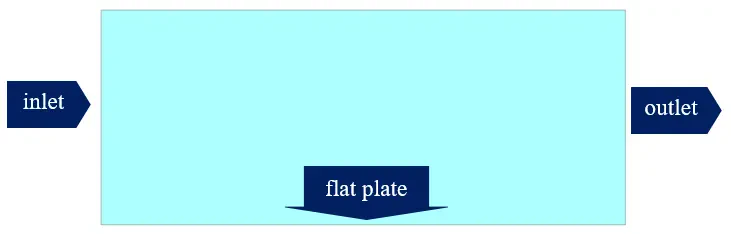
The present 2-D model is drawn using Design Modeler software. This model consists of a simple rectangle in which the lower side represents the flat plate, the upper side represents the condition of symmetry, and the lateral sides represent the inlet and outlet of the open air flow. The following figure shows a view of the geometry.
(external flow)
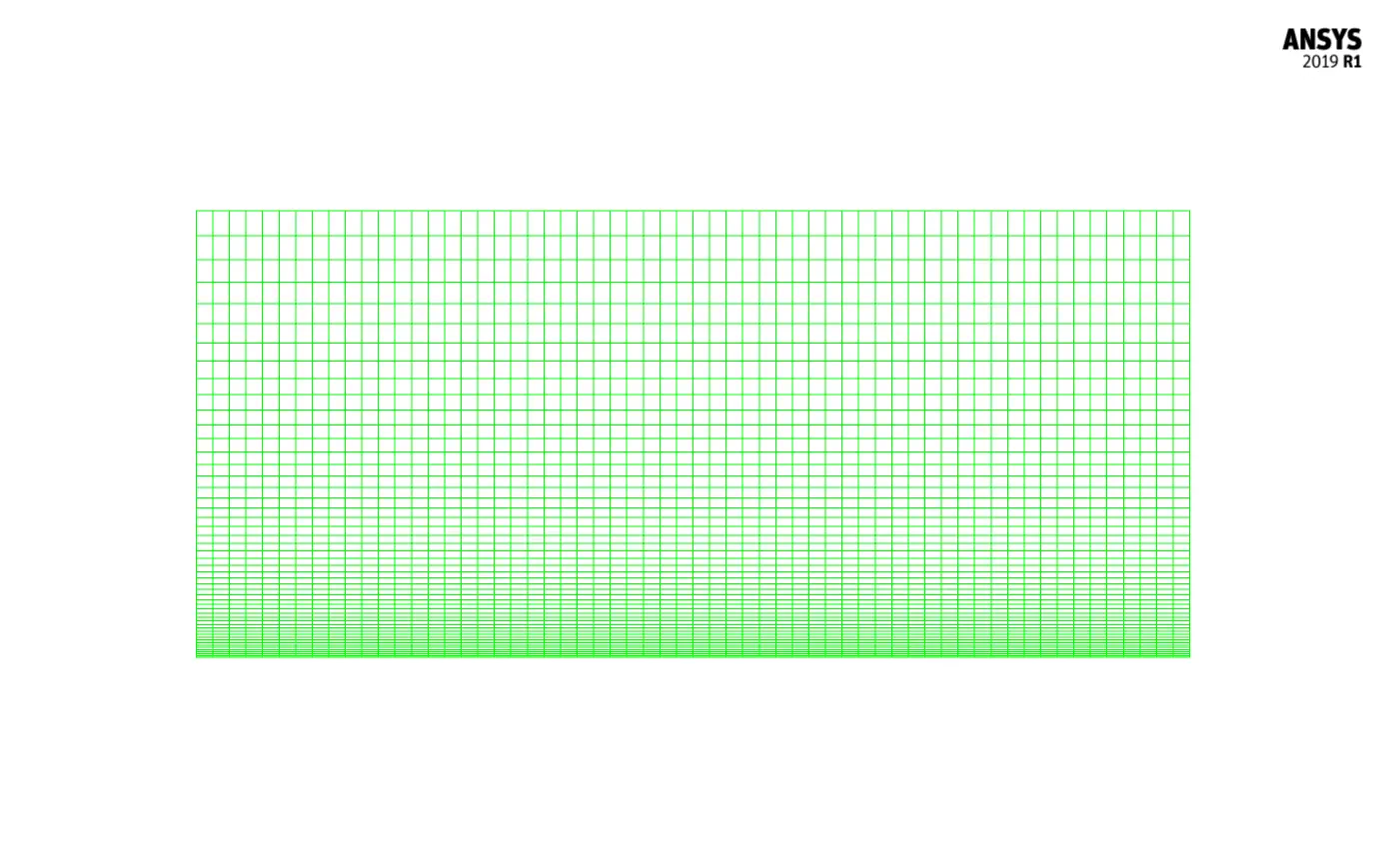
The meshing of the model has been done using ANSYS Meshing software and the mesh type is structured. The element number is 3000. The following figure shows the mesh.
External Flow CFD Simulation Setting
To simulate the present model, several assumptions are considered:
- We perform a pressure-based solver.
- The simulation is steady.
- The gravity effect on the fluid is ignored.
A summary of the defining steps of the problem and its solution is given in the following table:
| Models | ||
| Viscous model | Laminar | |
| Boundary conditions (Flat Plate) | ||
| Inlet | Velocity inlet | |
| velocity magnitude | variable | |
| temperature | 273 K | |
| Outlet | Pressure outlet | |
| gauge pressure | 0 Pascal | |
| Walls | Wall | |
| wall motion | stationary wall | |
| Solution Methods (Flat Plate) | ||
| Pressure-velocity coupling | SIMPLE | |
| Spatial discretization | pressure | second order |
| momentum | second order upwind | |
| Initialization | ||
| Initialization method | (Flat Plate) | Standard |
| velocity (x,y) | variable | |
| gauge pressure | 0 pascal | |
| temperature | 273 K | |
External Flow Results
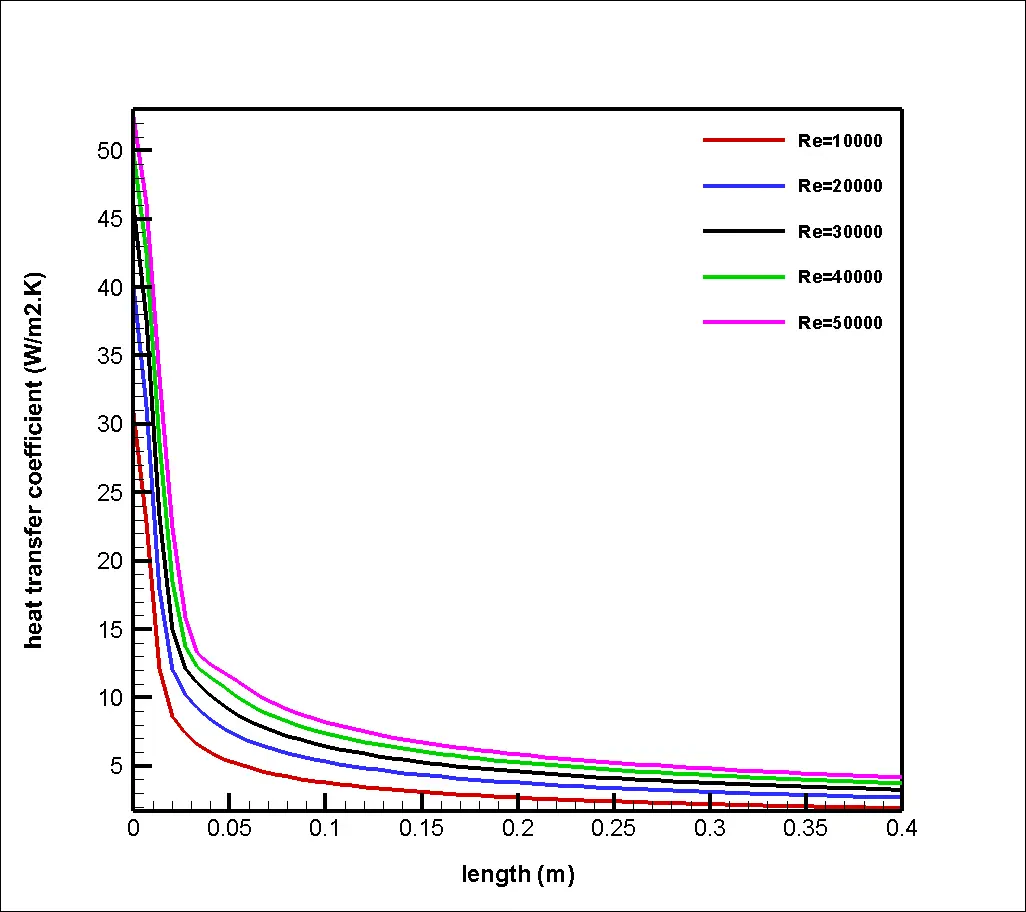
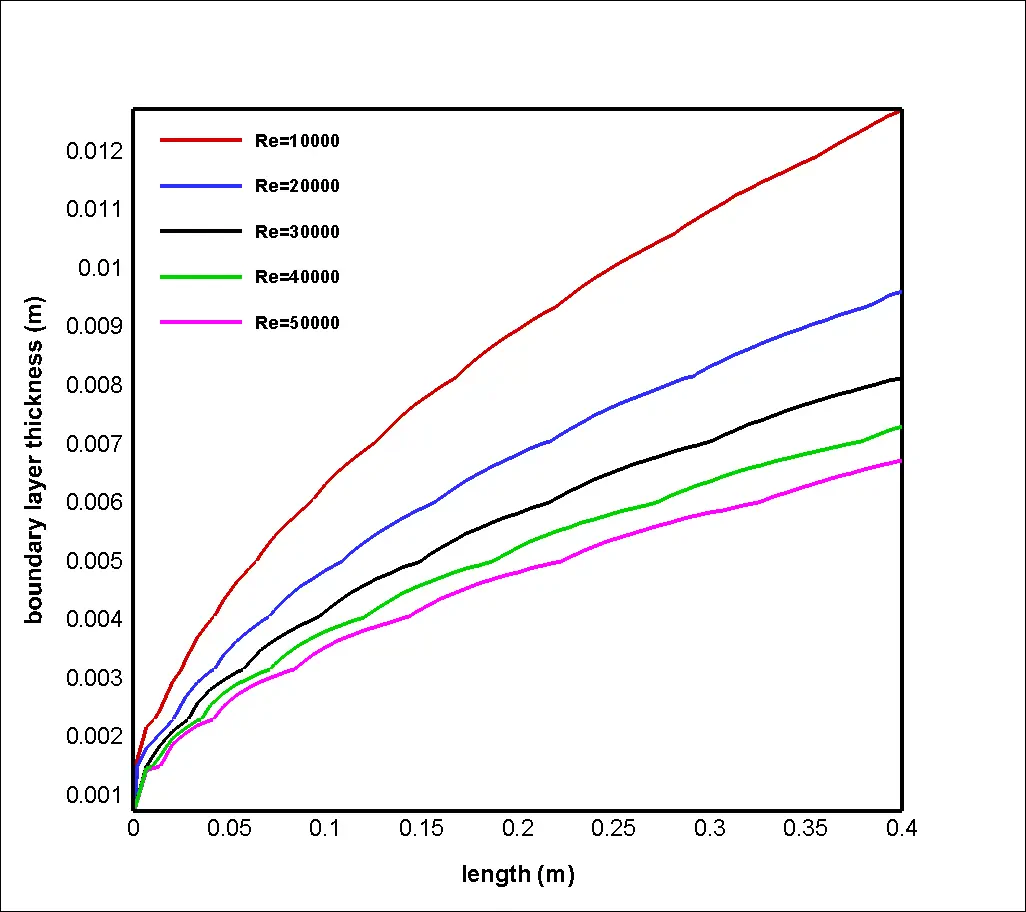
At the end of the solution process, two-dimensional contours related to temperature and velocity distributions, as well as two-dimensional velocity vectors, and diagrams of heat transfer coefficient and boundary layer thickness along the length of the plate are obtained. These results are obtained in all five different Reynolds.
(external flow )
(Flat Plate)