

F1 Aerodynamics CFD Simulation, Pressure-Based and Density-Based
Price: $36
- In this project F1 Aerodynamics CFD Simulation is carried out using ANSYS Fluent software.
- We design the 3-D model by the Design Modeler software.
- The Mesh is generated by ANSYS Meshing software, and the element number equals 1,253,296.
- Pressure-Based and Density-Based solvers are used in the simulation.
Description
In this project, aerodynamic coefficients of a Formula One (F1) car by two different solvers of pressure based and density based has been studied. at a speed of 111 meters per second with a lateral angle of zero degrees (actually a straight path).
This velocity at the ground level is equivalent to Mach number approximately 0.32. We know this area from Mach number is the transition zone from incompressible to compressible flow, so on this geometry, the drag coefficient is investigated using two pressure-based and density-based solvers is discussed.
Since the flow characteristics also affects the upstream in the subsonic stream, the computational domain is considered big enough. Downstream, due to the vortices falling behind the geometry to achieve the appropriate residues in solving the larger computational domain, is considered.
The geometry of the solution is modeled in Design Modeler software while the elements are generated in ANSYS Meshing software. The Polyhedra elements number is 1,253,296.
F1 Aerodynamics CFD Simulation Methodology
This problem is solved in steady mode using pressure-based and density-based methods.
Also, Realizable k-epsilon model is used to model the turbulence of the flow.
Conclusion
Examining the status of the results during the iterative solution (monitoring) and the residuals reaching the convergence criterion can help decide whether the solution converges. According to the problem, the convergence process of the drag force has been studied to ensure the convergence of the problem. The non-noticeable change in the desired quantity indicates the convergence of the numerical solution.
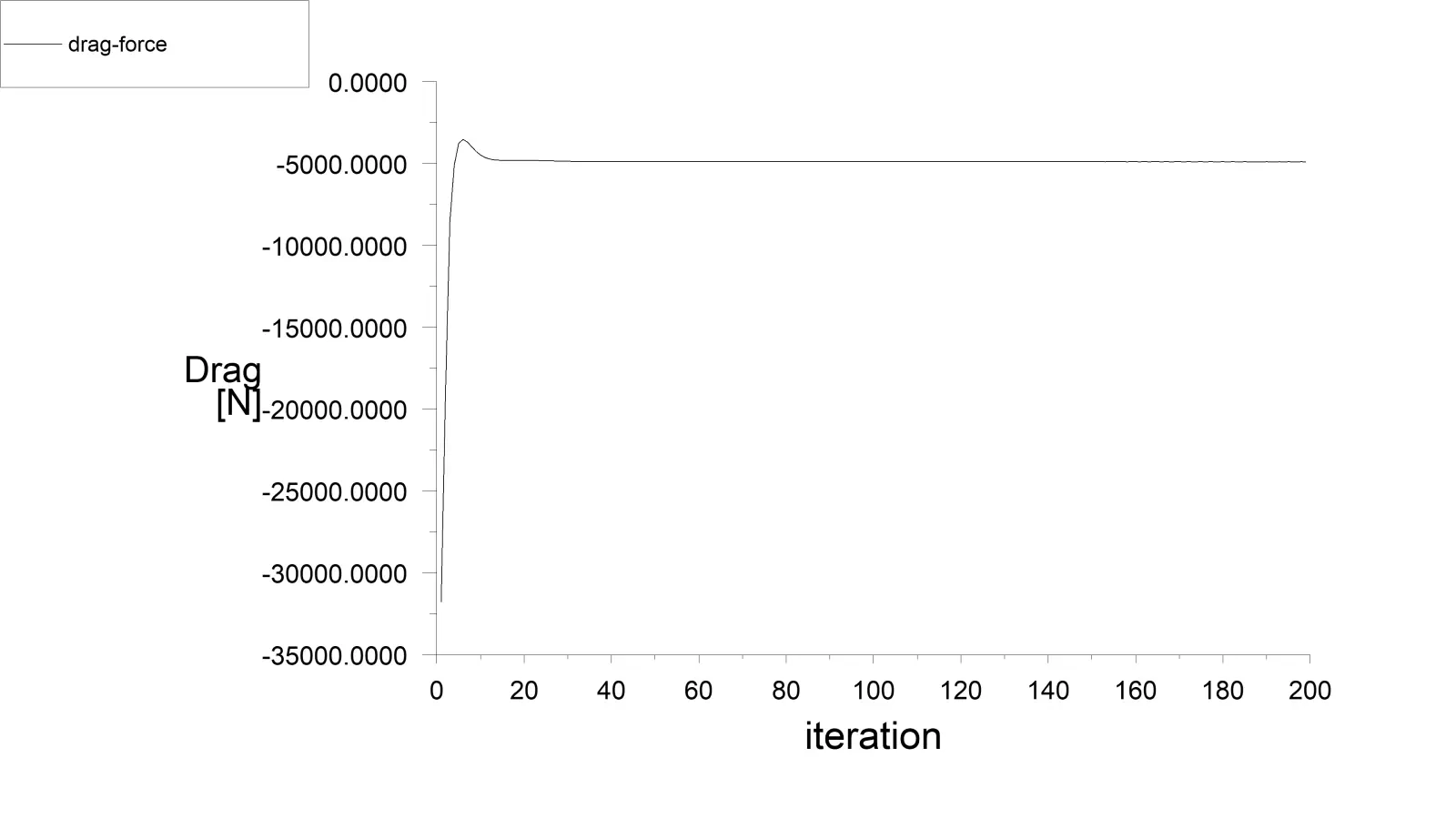
Pressure Based Solver
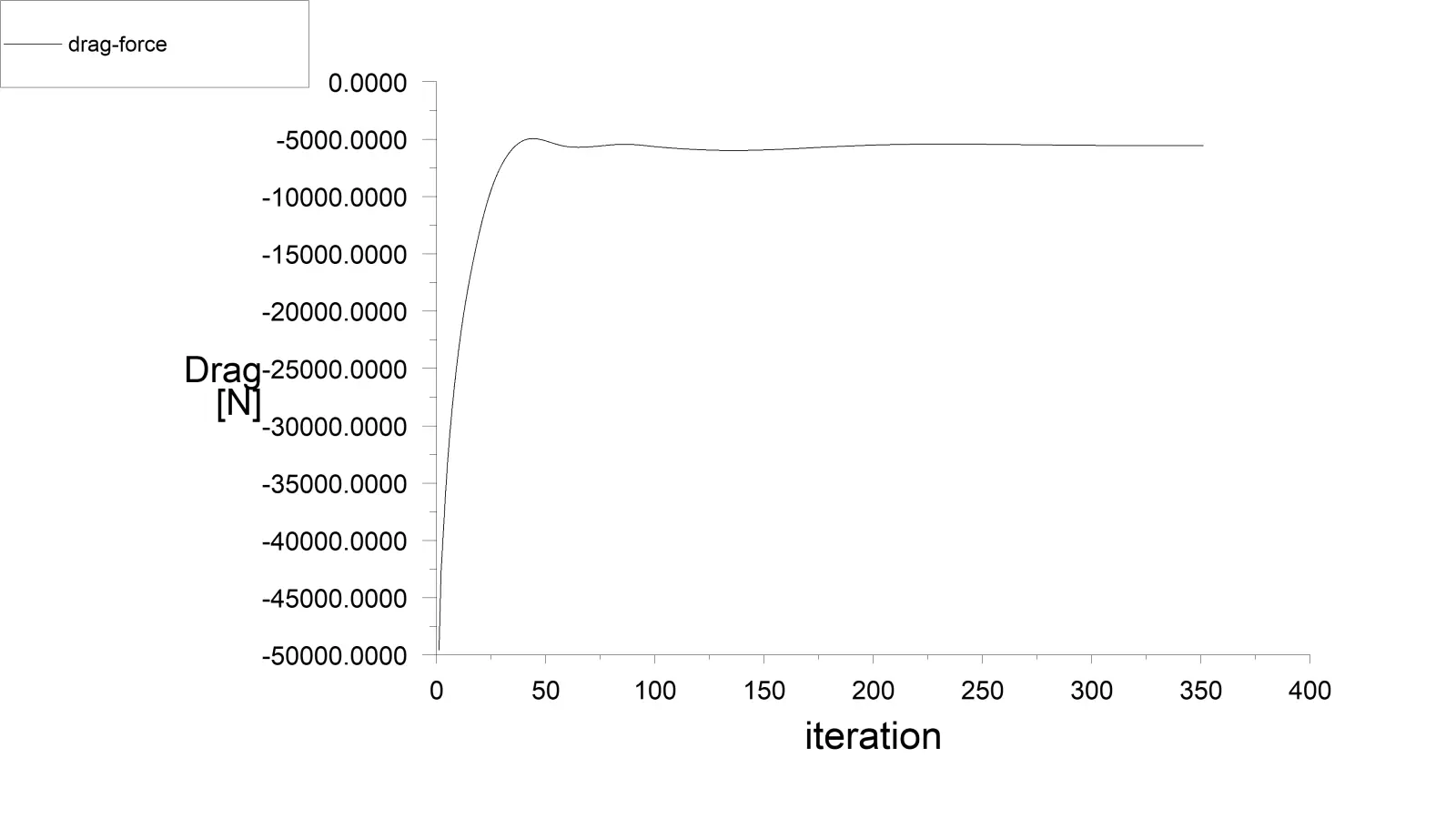
Density Based
The following table shows the drag force and the number of iterations of the solution for convergence for the two modes. The forces are in Newtons.
| Drag Force (N) | Number of iterations | |
| pressure-based | -4872.6194 | 200 |
| density-based | -5542.2328 | 350 |
As shown in the table above, the drag force is almost the same for both density-based and pressure-based solvers, i.e., for this Mach and this geometry, the compressible flow CFD simulation applying Density-Based solver had a good effect on the solution results.
The difference is that convergence in the Pressure-Based solver requires fewer iterations of the solution, so it is more cost-effective in terms of time. So, the lower computational cost and the approximate accurate results in comparison with Density-Based results, make the Pressure-Based solver more appropriate for this CFD simulation.