Fin Pipe Radiator, (CHT) Conjugated Heat Transfer CFD Simulation, ANSYS Fluent Training
Price: $80
- The problem numerically simulates the Fin Pipe Radiator using ANSYS Fluent software.
- We design the 3-D model with the Design Modeler software.
- We mesh the model with ANSYS Meshing software, and the element number equals 290250.
- We perform the Conjugate Heat Transfer analysis for a radiator.
Description
In this project, the steady cooling process of hot water flow in a fin pipe radiator is investigated by ANSYS Fluent software.
Due to the high computational cost, only one fin pipe of a radiator is simulated. The present model is designed in three dimensions using Design Modeler software.
The geometry for analyzing this simulation consists of a room and a balcony. The meshing of the model has been done using ANSYS Meshing software.
The mesh type used for this geometry is structured, and the element number is 290250.
Fin Pipe Methodology
The Conjugate Heat Transfer (CHT) analysis type allows for the simulation of heat transfer between solid and fluid domains by exchanging thermal energy at the interfaces between them.
In this project, water flows in the pipe between concentric fins while free convection boundary condition is imposed at the fin surface. Also, the water inside the pipe exchanges heats with the fin based on forced convection.
Water enters and exits the domain with a temperature equal to 327K and 326.6214K, respectively. Moreover, the standard k-epsilon model and energy equation are enabled to solve the turbulent fluid equation and calculate temperature distribution within the tube and the fins.
Fin Pipe Conclusion
At the end of the solution process, two and three-dimensional contours related to the velocity, temperature, pressure, and velocity vectors are obtained.
Based on the calculated data, the Water mass flow rate at the inlet is 0.0783 kg/s.
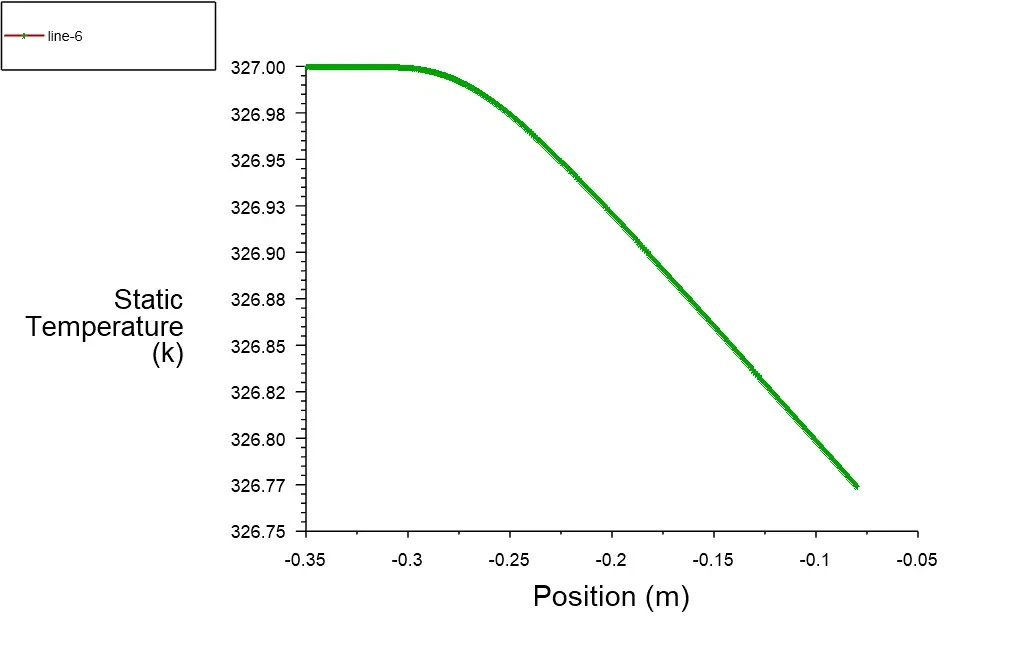
Water temperature at the inlet and outlet is equal to 327K and 326.6K respectively which is the result of a heat transfer rate equal to 124 w for the steady cooling process.
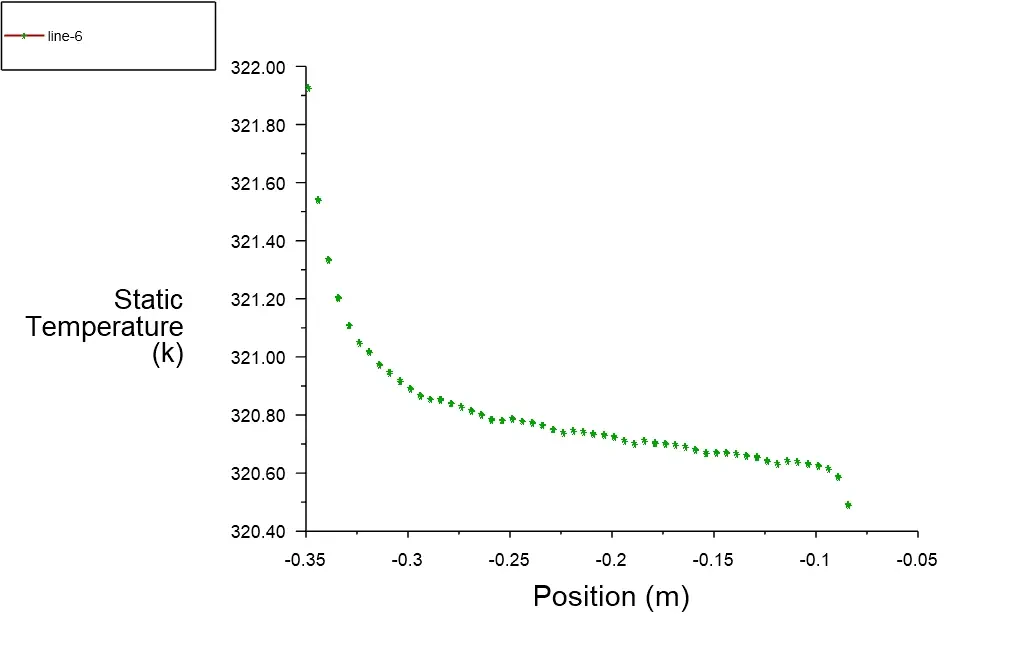
The first and the second graphs show the fins and fluid temperature as a function of position, respectively.