

Flat Plate Solar Collector, Conjugated Heat Transfer (CHT)
Price: $28
- The current CFD Analysis simulates the Flat Plate Solar Collector, Conjugated Heat Transfer via ANSYS Fluent software.
- We have designed the initial geometry using DesignModeler software and created the mesh on this geometry using ANSYS Meshing software.
- The mesh type is Tetrahedral with 5592039 cells.
- Conduction and Convection phenomena are involved in this simulation.
- Natural Convection is considered in the air domain, and Forced Convection is considered in the heat transfer fluid (HTF) domain.
- The Discrete Ordinate Radiation model is used.
Flat Plate Solar Collector Conjugated Heat Transfer (CHT), ANSYS Fluent CFD Training
Introduction
Flat Plate Solar Collectors (FPSC) or Photovoltaic-Thermal (PV/T) systems are widely used in the solar industry to convert solar radiation into thermal energy. The efficiency of FPSCs depends on various factors, including the design of the collector, the materials used, and the collector’s location. In this simulation, we investigate radiation’s effects on the water’s temperature passing through pipes in an FPSC located in Doha with a 45-degree tilt angle using ANSYS Fluent software. The geometry of the FPSC was designed using DesignModeler software and meshed using ANSYS Meshing software in Tetrahedral type. It must be noted that the whole number of elements created is 5592039.
Flat Plate Solar Collectors Methodology
The simulation was conducted by solving Navier-Stokes equations for fluid flow, energy equations for heat transfer, and DO radiation for direct irradiation. The boundary conditions were set as follows:
– Inlet temperature of water = 300k
– Inlet mass flow rate of water = 0.02 kg/s
– Outlet pressure = atmospheric pressure
– Solar irradiation = 800 W/m2
– The amount of volumetric heat flux generated in the PV layer is also determined from the following equation:
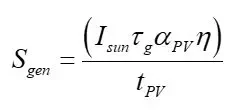
In the above equation, Sgen is the volumetric heat flux (W/m3), Isun is the solar heat flux (W/m2), τg is the glass transmittance, αPV is the PV absorption coefficient, η is the nominal panel efficiency, and tPV is the PV layer thickness (m). The values of these parameters are presented in the table below.
| Parameters | Value |
| Isun | 800 (W/m2) |
| τg | 0.05 |
| αPV | 0.9 |
| η | 0.14 |
| tPV | 0.0005 m |
The Discrete Ordinate (DO) Radiation Model simulates radiation behavior on the FPSC.
Conclusion
The simulation results showed that solar radiation affects the temperature of the water passing through pipes in an FPSC. The average water temperature is equal to 306.486 K, and average PV layer temperature is equal to 310.133 K.