

Fly Ash Cyclone CFD Simulation, Ansys Fluent Training
Price: $48
In this project, Fly Ash Cyclone has been simulated and the results of this simulation have been investigated.
Fly Ash Cyclone CFD Simulation, Ansys Fluent Training
Price: $48
In this project, Fly Ash Cyclone has been simulated and the results of this simulation have been investigated.

Fly Ash Cyclone Project Description
In this project, Ansys Fluent software has simulated the motion of particles in a Fly Ash Cyclone CFD Simulation. We used the one-way DPM to simulate the discrete phase. A cyclone is a device used to separate particles from gas and has many applications in industry. The Eulerian-Lagrangian technique is applied in the cyclone separator simulation. In this approach, the gas is treated as a continuum, and Lagrangian tracking tracks individual solid particles through the flow field to determine their position. In cyclone separators, the drag and gravity forces are considered significant due to the large ratio of the gas-particle density.
Cyclone
A Cyclone separator is a particulate control system used in industries to control the particulate emissions to the atmosphere. Cyclones are efficient, cost-effective, and consume low energy. The cyclone separator separates particles of different sizes from gas by centrifugal force. The design of cyclones is a little complex, but its high separation efficiency compensates for it. Cyclones are centrifugal separators consisting of a barrel (the upper chamber) where separation occurs and a cone (the lower section) where collection takes place.
The flow field and performance of the cyclone separator are affected by gas-solid interactions inside the cyclone. The presence of particles does not affect the flow field due to small particle loading in the cyclone, and coupling of the particle effect in-stream is considered significant. The basic principle of separation is that the particles with higher densities have higher inertia, and hence they tend to revolve in a larger radius. The heavier particles spin near the wall where they slide down, and the lighter particles rotate near the center and are collected out of the cyclone at the top.
Geometry & Mesh
The 3D geometry of this project has been produced with SpaceClaim software.
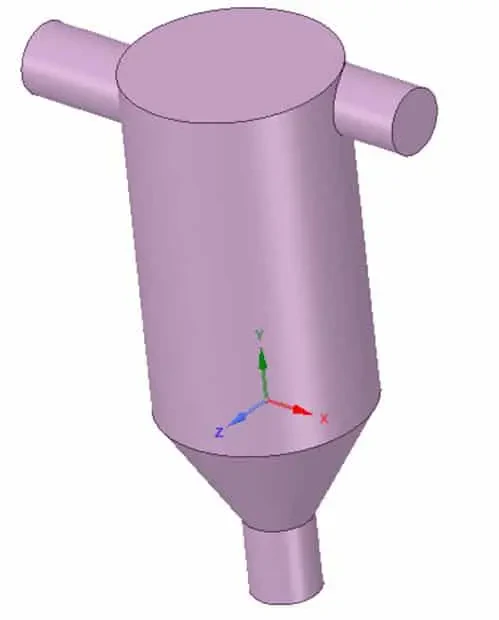
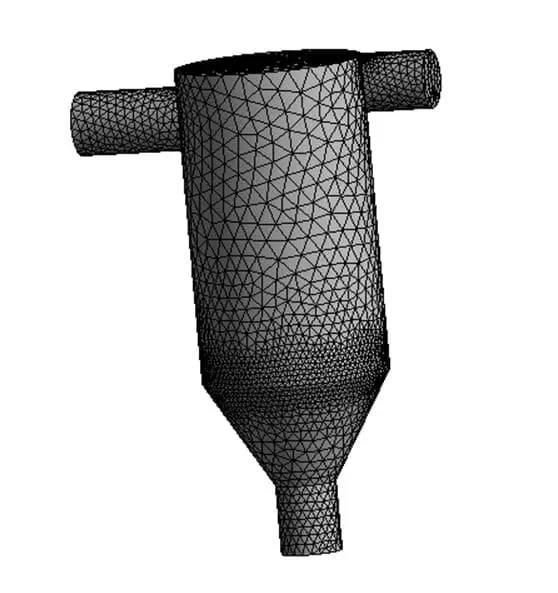
Mesh is created with Ansys meshing software, and the mesh type is unstructured. The number of cells is 1028959.
Fly Ash Cyclone CFD Simulation
To simulate the present model, we consider several assumptions:
- The solver is pressure-based.
- The current simulation is unsteady in terms of time.
- The gravity effect is equivalent to -9.81 m.s-1.
Here is a summary of the steps for defining the problem and its solution in the following table:
| Models | |||
Viscous model | Reynolds stress | ||
Discrete phase | on | ||
| particle treatment | unsteady particle tracking | ||
material in injection | Anthracite | ||
particle type in injection | Inert | ||
injection type | group | ||
| Boundary conditions | |||
Inlet | Velocity inlet | ||
velocity | magnitude | 5.9 m.s-1 | |
discrete phase BC type | escape | ||
Outlet | Pressure outlet | ||
gauge pressure | 0 Pascal | ||
discrete phase BC type | escape | ||
walls | wall | ||
wall motion | stationary wall | ||
discrete phase BC type | reflect | ||
| Solution Methods | |||
Pressure-velocity coupling | simple | ||
Spatial discretization | pressure | second-order | |
momentum | first-order | ||
Modified turbulent viscosity | first-order upwind | ||
Initialization | |||
Initialization method | hybrid | ||
Fly Ash Cyclone Results
At the end of this simulation, The motion of the particle inside the cyclone was investigated. Particle velocity, pressure, and air gas flow counters were also examined. It was also observed that lighter and heavier particles separate due to centrifugal force and gravity. It is observed that most of the particles entering from the inlet exit from the lower outlet and air also leaves the upper outlet, and a small number of particles are trapped in the upper part of the cyclone.