

Gas Sweetening Hydrodynamic, ANSYS Fluent CFD Simulation Tutorial
Price: $16
- The present problem deals with the hydrodynamic simulation of a gas sweetening system using ANSYS Fluent software.
- The present model is designed in three dimensions using Design Modeler software.
- We carry out the model's meshing using ANSYS Meshing software. The element number is 2168649.
- A multiphase model of the VOF type has been used to define the two-phase of sour gas and an amine stream.
Project Description
The present problem deals with the hydrodynamic simulation of a gas sweetening system using ANSYS Fluent software. Gas sweetening is generally the process of removing hydrogen sulfide, carbon dioxide, mercaptans, and other impurities from natural gas streams and synthetic gas to make the gas suitable for transportation and use. Sour gas must be sweetened; Because hydrogen sulfide and carbon dioxide have a high corrosive effect on gas pipelines and are also considered a group of toxins for humans.
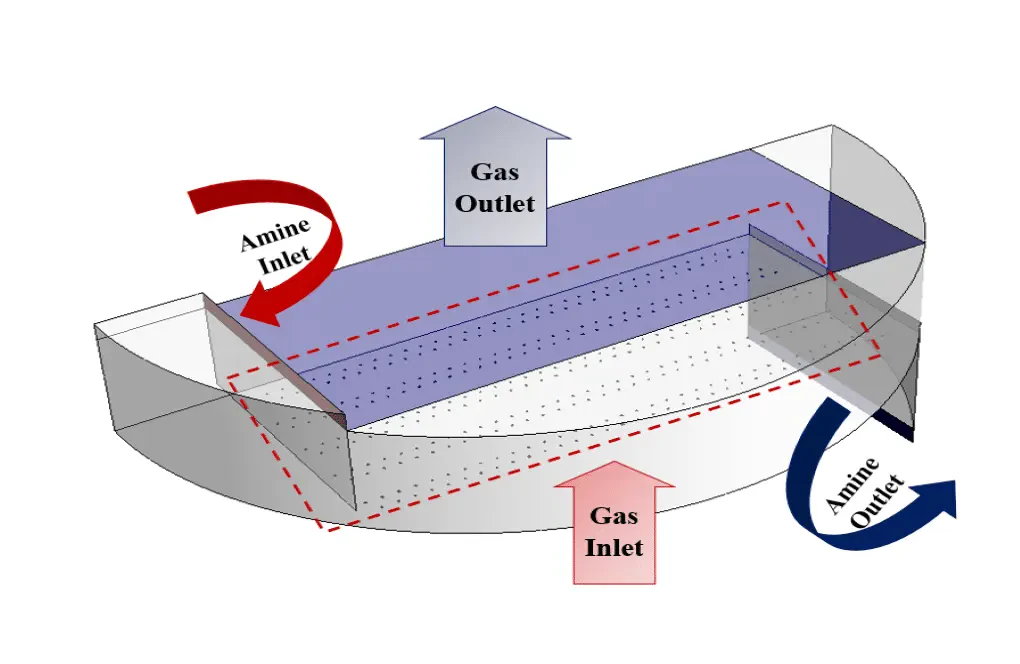
In this project, two materials are defined within the computational domain, which includes a particular sour gas and an amine stream; However, because this project only deals with the hydrodynamic modeling of this process, the gas removal process does not occur due to the occurrence of a physical or chemical phenomenon. At the same time, water flow is used as the amine material. Therefore, a multiphase model of the VOF type has been used to define this two-phase computational domain. Two inlets for amine and gas flows in the device are used, the amine stream enters at a speed of 0.3 m.s-1 and then collides with the gas stream inside the device.
Geometry & Mesh
The present model is designed in three dimensions using Design Modeler software. The present model is related to a gas sweetening device into which gas and amine streams enter.
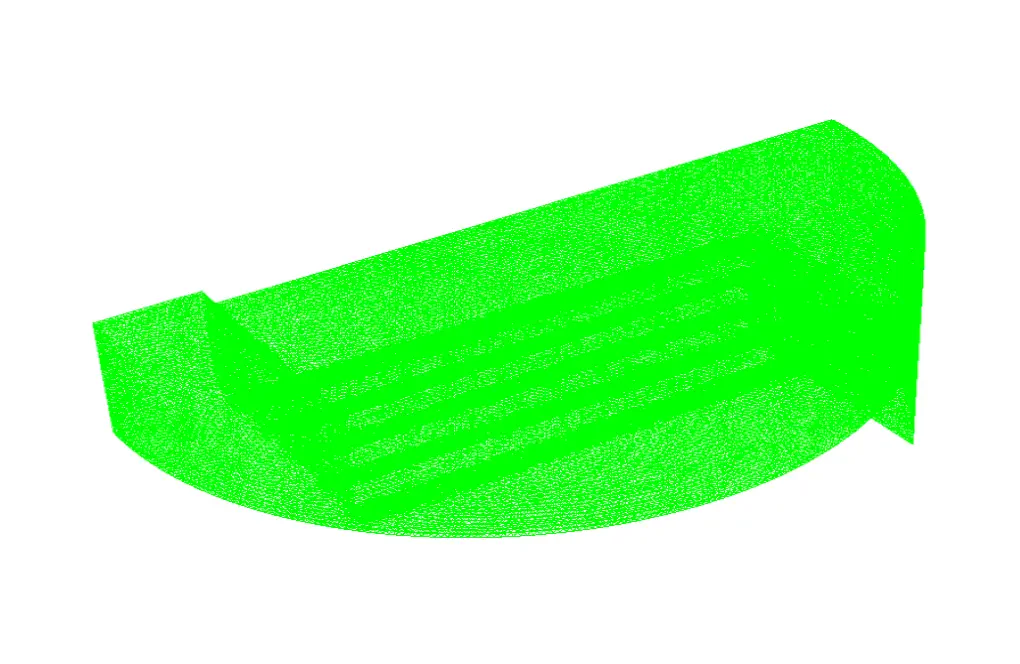
We carry out the model's meshing using ANSYS Meshing software. The mesh type is unstructured. The element number is 2168649. The following figure shows the mesh.
CFD Simulation
We consider several assumptions to simulate the present model:
- We perform a pressure-based solver.
- The simulation is steady.
- The gravity effect on the fluid is equal to -9.81 m.s-2 along the vertical axis.
The following table represents a summary of the defining steps of the problem and its solution:
| Models | ||
| Viscous | k-epsilon | |
| k-epsilon model | RNG | |
| near wall treatment | standard wall function | |
| Multiphase Model | VOF | |
| number of eulerian phases | 2 (gas & water) | |
| interface modeling | dispersed | |
| Boundary conditions | ||
| Inlet - Gas | Velocity Inlet | |
| velocity magnitude | 0 m.s-1 | |
| water volume fraction | 0 | |
| Inlet - Amine | Velocity Inlet | |
| velocity magnitude | 0.3 m.s-1 | |
| water volume fraction | 1 | |
| Outlet - Gas | Pressure Outlet | |
| gauge pressure | 0 pascal | |
| Outlet - Amine | Pressure Outlet | |
| gauge pressure | 0 pascal | |
| Walls | Wall | |
| wall motion | stationary wall | |
| Methods | ||
| Pressure-Velocity Coupling | SIMPLE | |
| pressure | PRESTO | |
| momentum | second order upwind | |
| turbulent kinetic energy | first order upwind | |
| turbulent dissipation rate | first order upwind | |
| volume fraction | first order upwind | |
| Initialization | ||
| Initialization methods | Standard | |
| gauge pressure | 0 pascal | |
| velocity (x,y,z) | 0 m.s-1 | |
| water volume fraction | 0 | |
Gas Sweetening Results
At the end of the solution process, two-dimensional and three-dimensional contours related to pressure, velocity, and volume fraction of gas and water are obtained. As the contours show, the gas and amine currents collide after passing through the internal barriers in the device, and as a result of this collision, the amine current can transfer part of the gas flow out of the device.