

Golf ball Aerodynamics, ANSYS Fluent CFD Simulation Training
Price: Free
In this project, a golf ball is studied aerodynamically, at speed with lateral angle and zero degree angle of attack using ANSYS Fluent software.
Golf ball Aerodynamics, ANSYS Fluent CFD Simulation Training
Price: Free
In this project, a golf ball is studied aerodynamically, at speed with lateral angle and zero degree angle of attack using ANSYS Fluent software.

Problem Description
In this project, a golf ball with dimples and a similar sphere without dimple are studied aerodynamically, at speed with lateral angle and zero degree angle of attack using ANSYS Fluent software. The intended speed is 94 meters per second.
Introduction
In the dynamic simulation, quasi-experimental aerodynamic coefficients are used. These coefficients are obtained by quasi-experimental software. The coefficients obtained in these softwares have many errors. To achieve more accurate coefficients, numerical simulation by computational fluid dynamics is used, and the coefficients obtained by semi-experimental simulation software are calibrated using CFD coefficients. In this research, the calculation of aerodynamic coefficients has been done using numerical simulations and Fluent commercial software.
Golf Ball Geometry & Mesh
In this section, the geometry of the golf ball and spherical ball without dimple and the grid on it are examined.
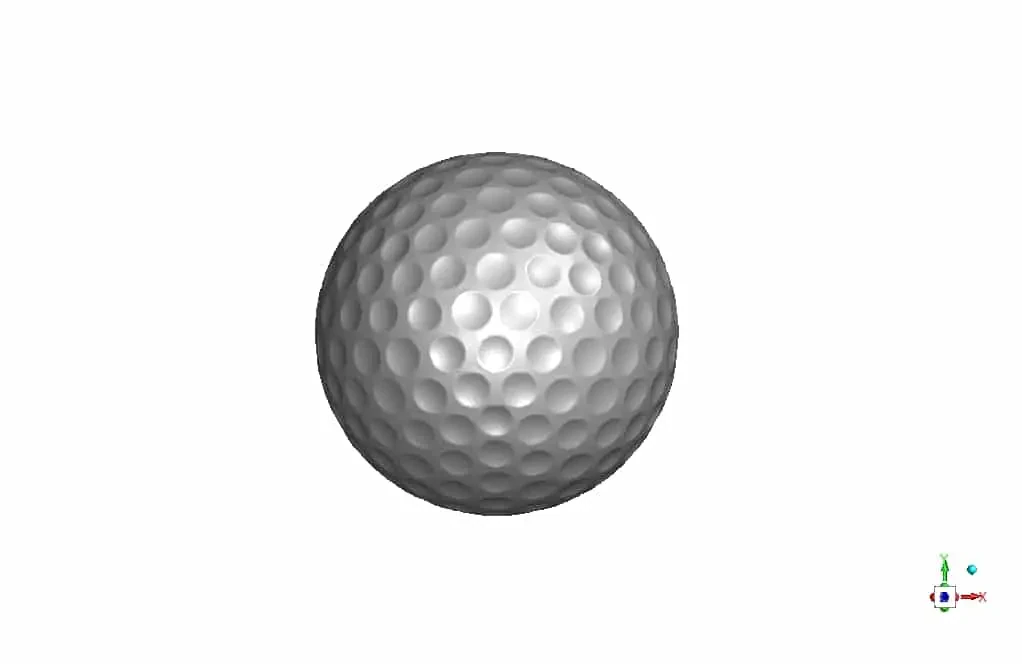
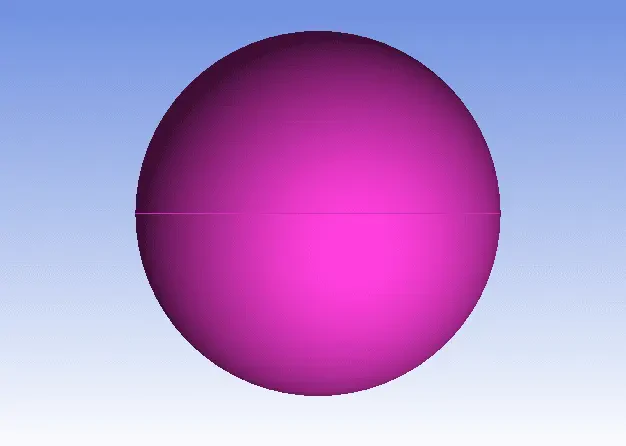
One of the most influential and time-consuming steps in numerical simulations, is grid generation. The better mesh quality, make other solving steps to proceed more accurately. Due to the dimensions of the problem and the car's geometry, the prism grid has been used for the boundary layer, and the unstructured grid has been used for other parts of the solution domain. To generate a mesh in ICEM software, you must first determine the size of the mesh elements in different parts according to the dimensions of the problem and the type of flow and geometry of the object under study. Various methods have been proposed to create an unstructured mesh in ICEM software. This software has two top-down and bottom-up methods for generating a UNS mesh. Below, we introduce these two methods.
To create a suitable mesh, the combined (hybrid) method is used so that the whole solution domain, including surfaces and lines, is meshed with the help of the Octree method. Then with the help of the Delauney method and with the help of the existing mesh, a smooth mesh is created in the whole solution domain. The following figure shows the grid on the middle page:
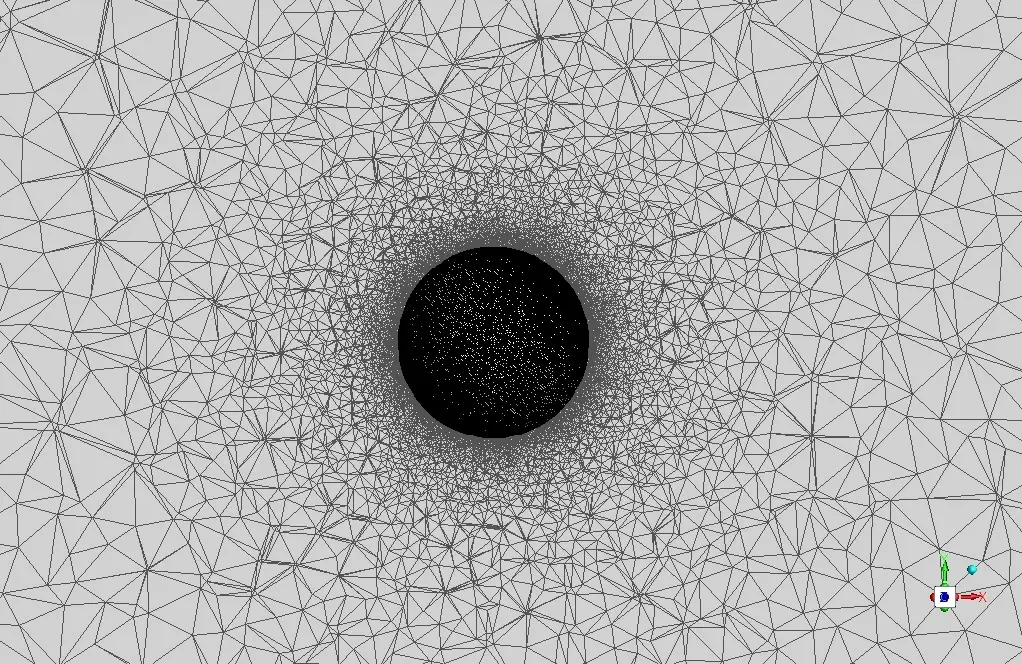
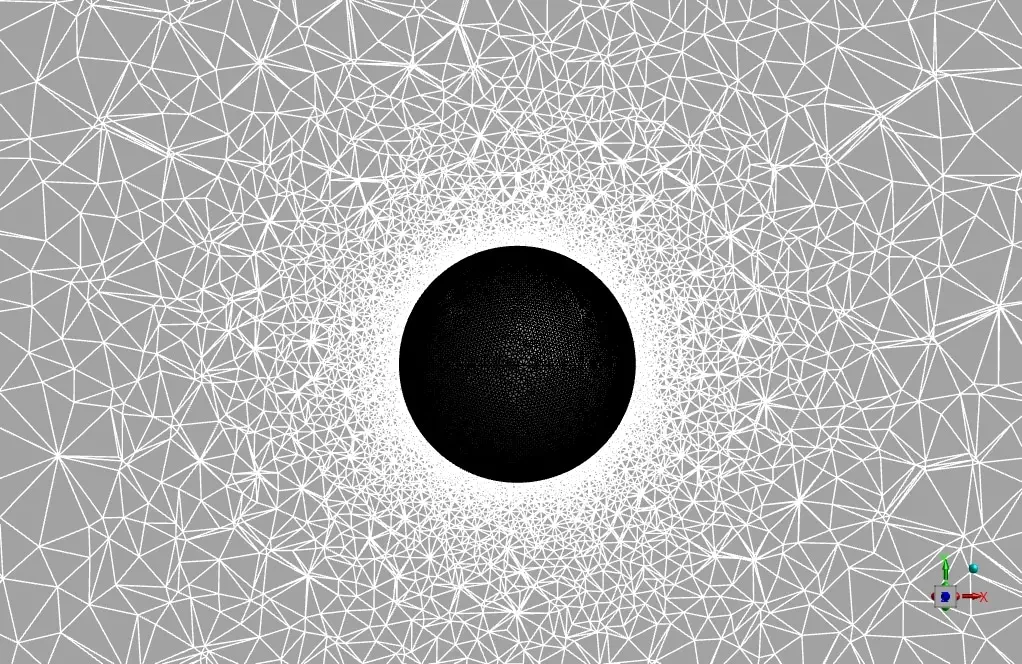
The mesh is fragmented in parts of the geometry where the radius changes abruptly, and on the fractures and dimples, it is larger in other areas.
Solution Settings
We investigate the issue numerically, using Fluent commercial software, and solve this problem in Steady mode using the pressure-base method. Also, we use Fluent software to solve the governing equations numerically. In this chapter, we consider flow conditions, type of boundaries, type of solvent, and flow discretization methods..
Fluid Properties
In this research, the fluid is air. The following table shows the air properties extracted from the Fluent software database, given that the current is in an incompressible regime and its density is constant.
| Amount (units) | Fluid Properties(air) |
| 1006.43 (J/kg.K) | Thermal pressure coefficient |
| 0.0242(w/m.k) | Thermal conductivity |
Boundary Conditions (Golf Ball)
One of the most influential variables in the numerical solution process is boundary conditions. For this purpose, we use different boundary conditions in the computational range. We introduce these conditions as:
- wall
- velocity inlet
- pressure outlet
models (car) K-epsilon viscous model realizable K-epsilon model Near wall treatment Standard wall function boundary conditions (car) velocity inlet inlet 94 m/s velocity magnitude (m/s) pressure outlet outlet 0 Pascal gauge pressure wall wall of body stationary wall wall motion solution methods (car) couple pressure velocity coupling second order pressure spatial discretization second order upwind momentum first order upwind turbulent kinetic energy first order upwind turbulent dissipation rate initialization (car) standard initialization method 0 (Pa) gauge pressure 94 (m/s) x-velocity 0 (m/s) y-velocity , z-velocity
Convergence
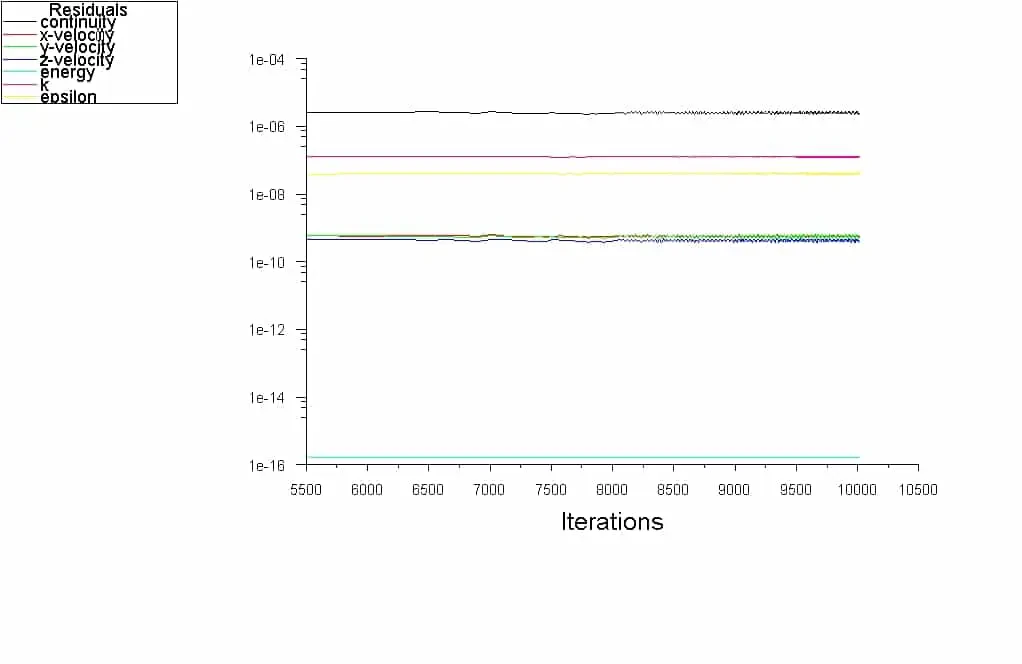
In computational fluid dynamics, We use iterative solutions to achieve the answer to the problem. These iterative solutions start by taking the initial values and continue solving until they reach the convergence criterion or the number of steps specified by the user. We define different criteria for the convergence of the problem. One of the most widely used criteria for determining the convergence of a problem is residual values. Residuals are the sum of the values calculated on all cells in the current and previous time steps. They are calculated in each iteration, and the solution continues until its value is less than the criterion specified by the user. It is usually recommended to reduce the residual values by 3 or 4 orders. We can see in the figure below, all residuals, including velocities and parameters of the perturbation model, are smaller than 10e-3.
Results & Discussions (Golf Ball)
In this chapter, we present the results related to simulation and analyzed qualitatively. The quality of the flow around the Golf ball body has been studied using boundary diagrams. The figure below shows the dimples and pathlines on the golf ball.
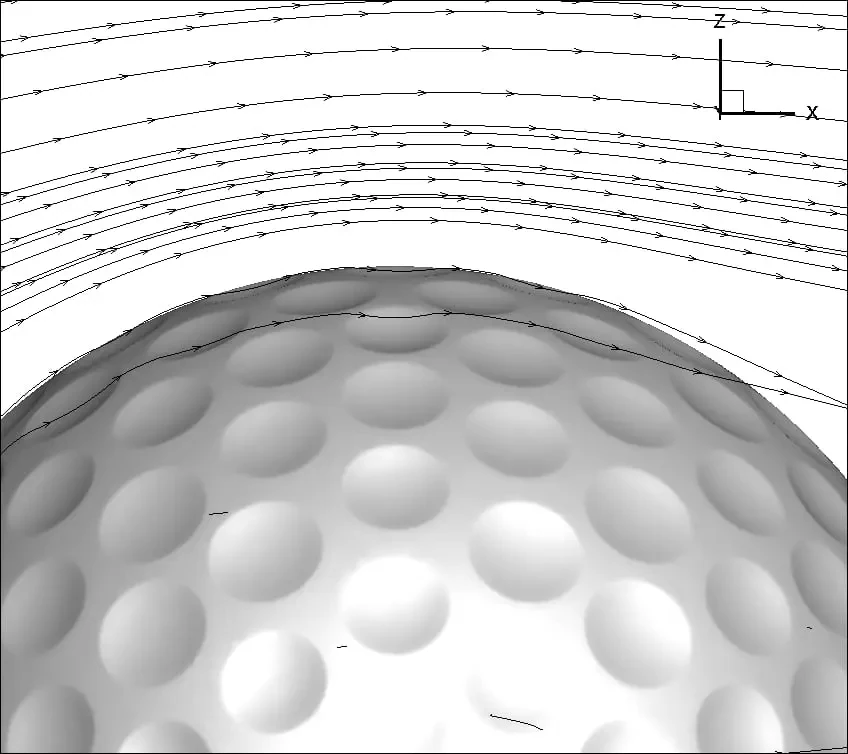
The results show that the roughness of the sphere and the depressions (dimple) on the golf ball at relatively high Reynolds numbers increase the momentum on the surface and the turbulence in the boundary layer and delay the flow separation, which reduces the drag force. But at low Reynolds numbers in layered flow, the flow separates from the surface, and the drag coefficients for both smooth balls and golf balls are very close to each other.
You can obtain Geometry & Mesh file and a comprehensive Training Movie that presents how to solve the problem and extract all desired results.