

Greenhouse Ventilation and Design Improvement, Industrial Application
Price: $240
- In this project, an industrial Greenhouse has been numerically simulated by ANSYS Fluent.
- Studying relative humidity, airflow velocity and thermal condition.
- Removing Ammonia as a pollutant.
- Greenhouse design improvement.
- HVAC analysis.
Greenhouse Ventilation and Design Improvement, Industrial Application, Numerical Study
Introduction
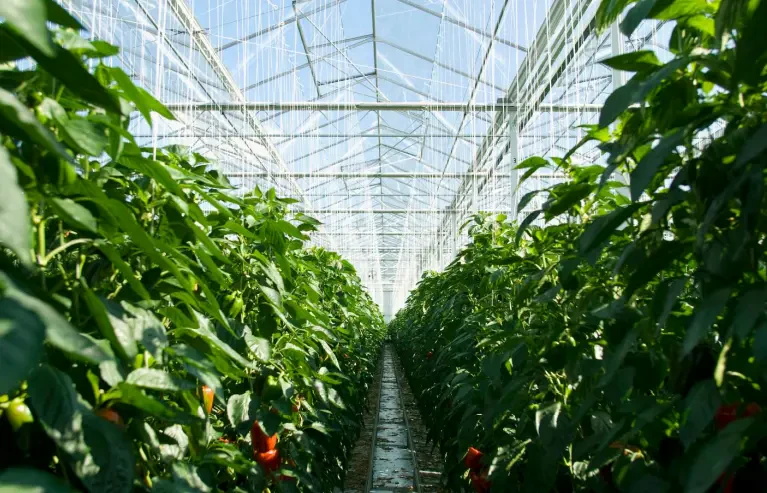
A greenhouse refers to a glass or plastic structure that separates part of a field from the ambient. It provides shelter and protects plants against severe climate changes and disruptive factors like insects and animals, for instance, in excessive cold or hot seasons.
Thus, designing a greenhouse environment aims to provide a safe and ideal condition for sensitive plants to grow steadily, which may be challenging and hard to control based on limitations and facilities!
Project Description
In this project, we set the target to design a greenhouse in a 5*10meter rectangular field that provides standard environmental conditions in the summer, such as acceptable temperature range (294~298.5K) and high humidity (25%<Mass fraction of H2O<30%) along with low ammonia fraction(<15 ppm).
On the other hand, Several limitations set by the client, like dense vegetation and sensitive plants, led us to have 6 rows of longitudinal carriers implemented at two different heights.
The greenhouse has two industrial fans with a 0.5kg/s mass flow rate, but they couldn't satisfy the client's demand. Thus, we have completed the mission of providing optimal conditions using numerical methods (CFD simulation) by ANSYS Fluent software. We perform the project in three steps, which we will explain in detail.
Greenhouse Step 1: (Considering Industrial fans)
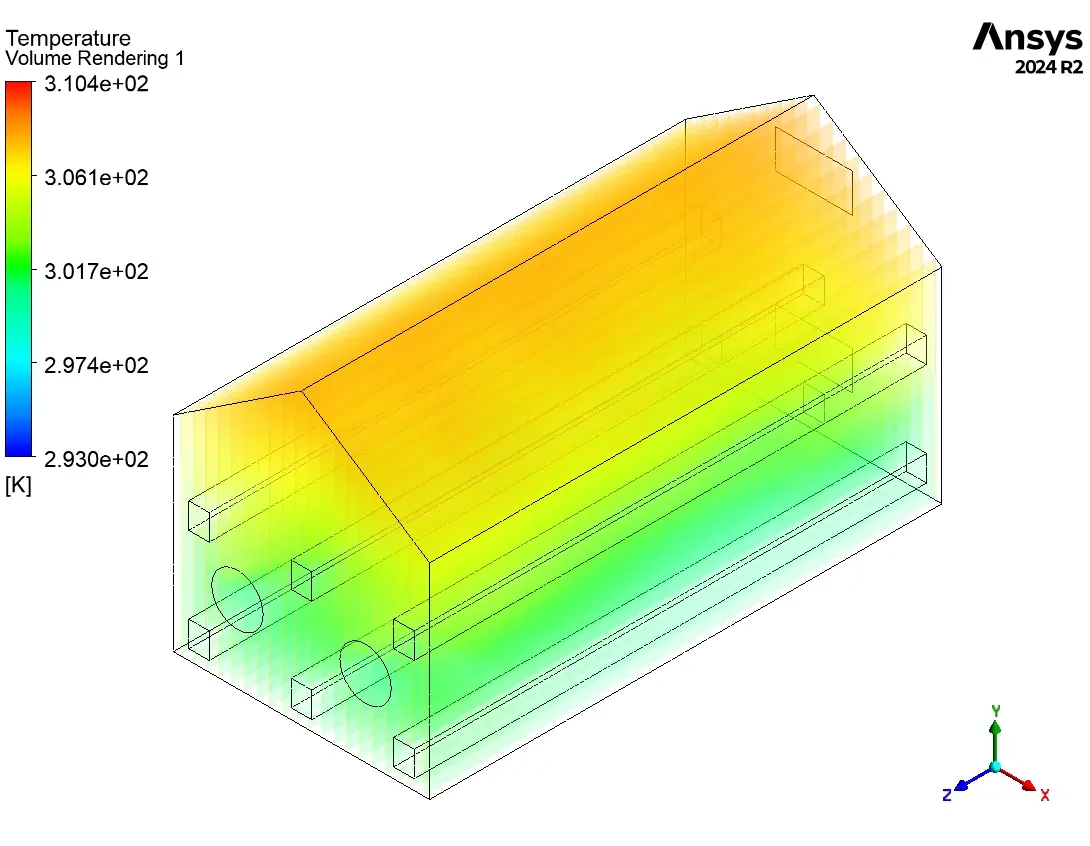
In the first step, we simulate the greenhouse in its initial condition considering two industrial fans. After the simulation, the volume average temperature is reported as 307.22K and an H2O mass fraction of 0.24% & 6.37 ppm ammonia, revealing the greenhouse's critical condition.

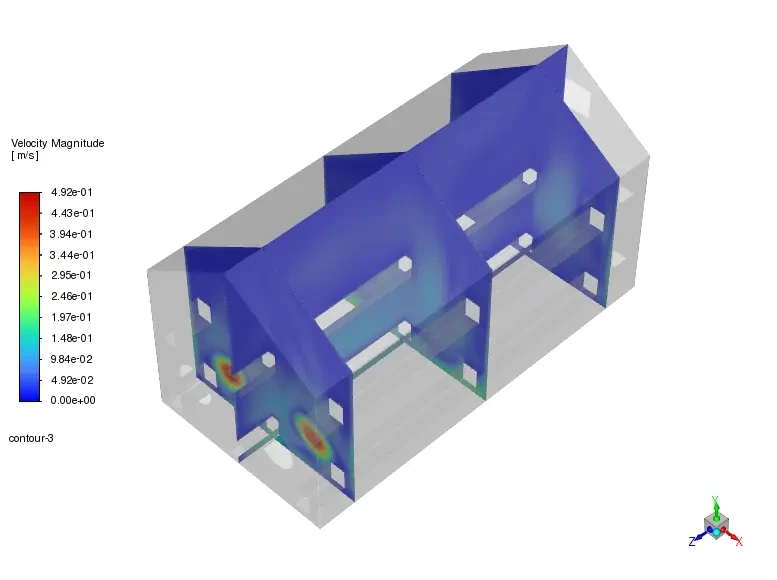
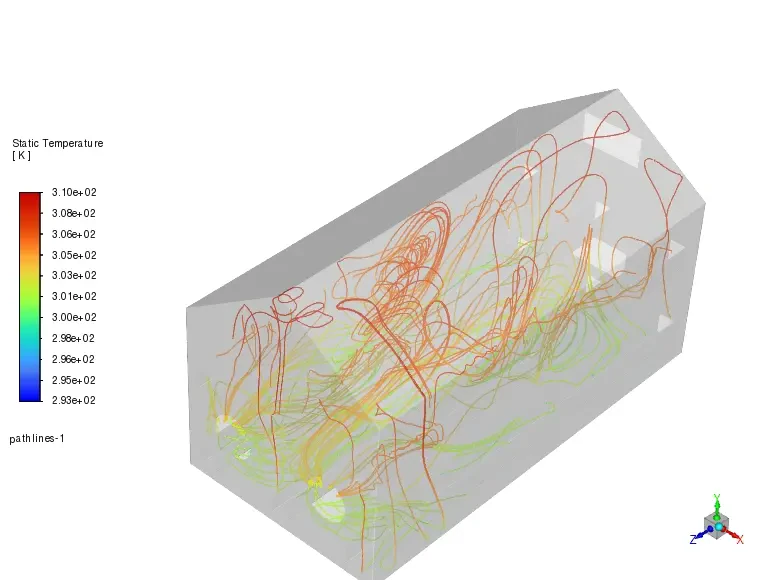
Also, the extracted temperature and velocity contours show the inefficient ventilation system. This couldn't recirculate air effectively, and the bulk air remains constant except around the fan's height region. This couldn't satisfy either of the criteria.
Note that we employ simplification due to high computational cost and considering an engineering point of view. The effect of industrial fans was applied by using negative pressure in the outlet boundary illustrated below.
Temperature Contour :
Velocity Contour :
Streamline:
Greenhouse Step 2: (Using a Water-cooled air conditioner)
In the second step, we propose a water-cooled air conditioner to install in front of the fans on the other wall of the greenhouse. This helps air circulation and decreases the temperature along with increasing H2O.
The mentioned idea was applied, and the results show an improvement in temperature and H2O mass fraction, and NH3 by 298.75K & 19.8% & 2.72ppm respectively. The humidity and ammonia fraction get in the acceptable range, but still, the temperature needs to decrease.

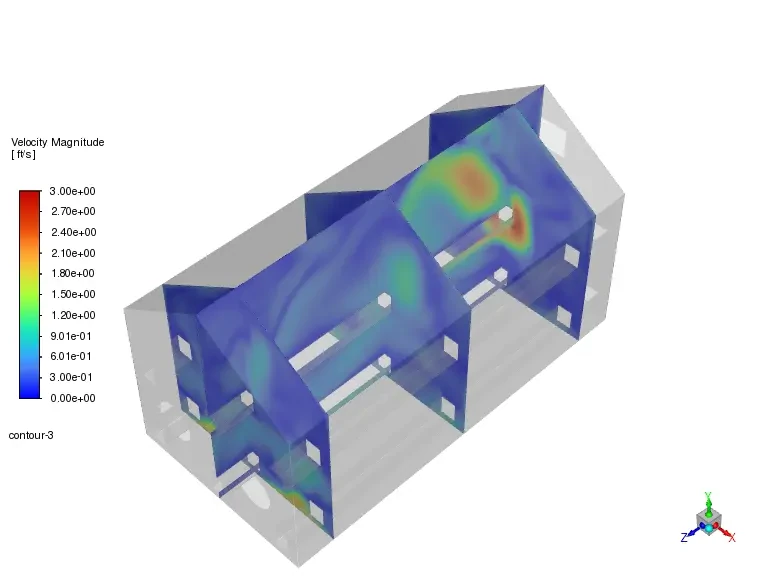
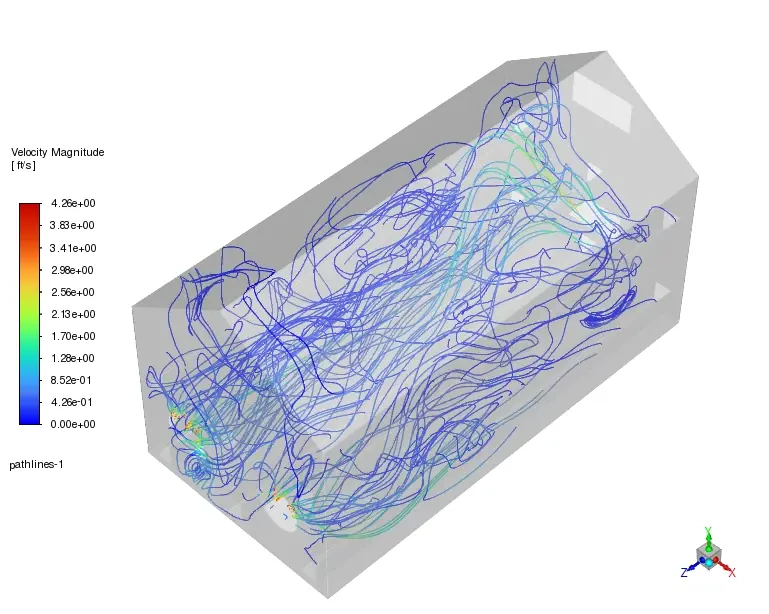
Furthermore, as depicted in the contours, the air conditioner couldn't help efficiently with circulation. Hot air got stuck under the roof because the cool inlet air mostly flows through the fans, as seen in the streamlined contour.
Therefore, we suggest increasing the inlet velocity of the air conditioner. Still, as mentioned, the plants are very sensitive and can be harmed by direct contact with high-speed air. So we've faced another limitation here, leading to the relocation of the air conditioner.
Velocity Contour :
Velocity Streamline :
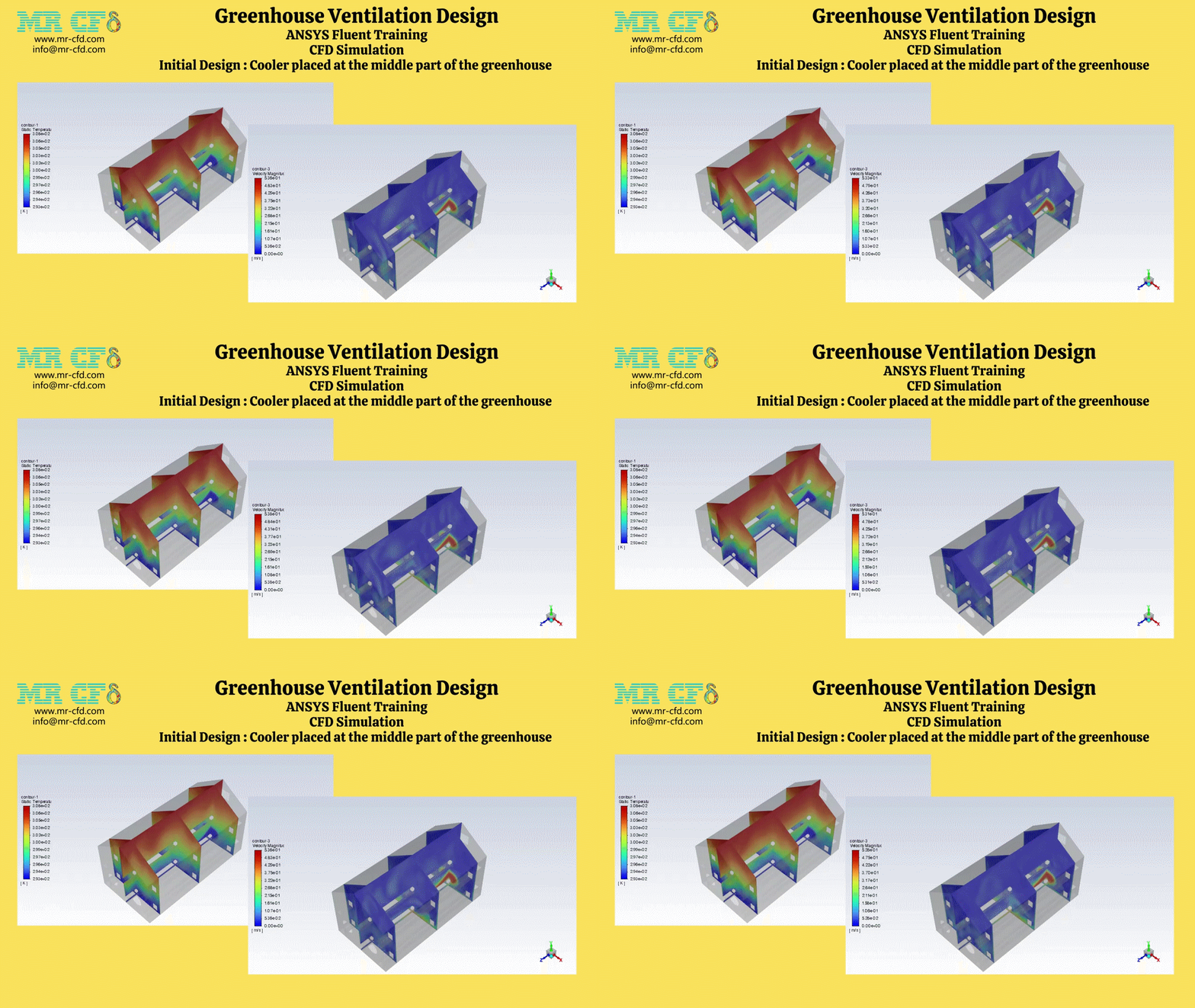
Animations :
Greenhouse Step 3: (Considering New position)
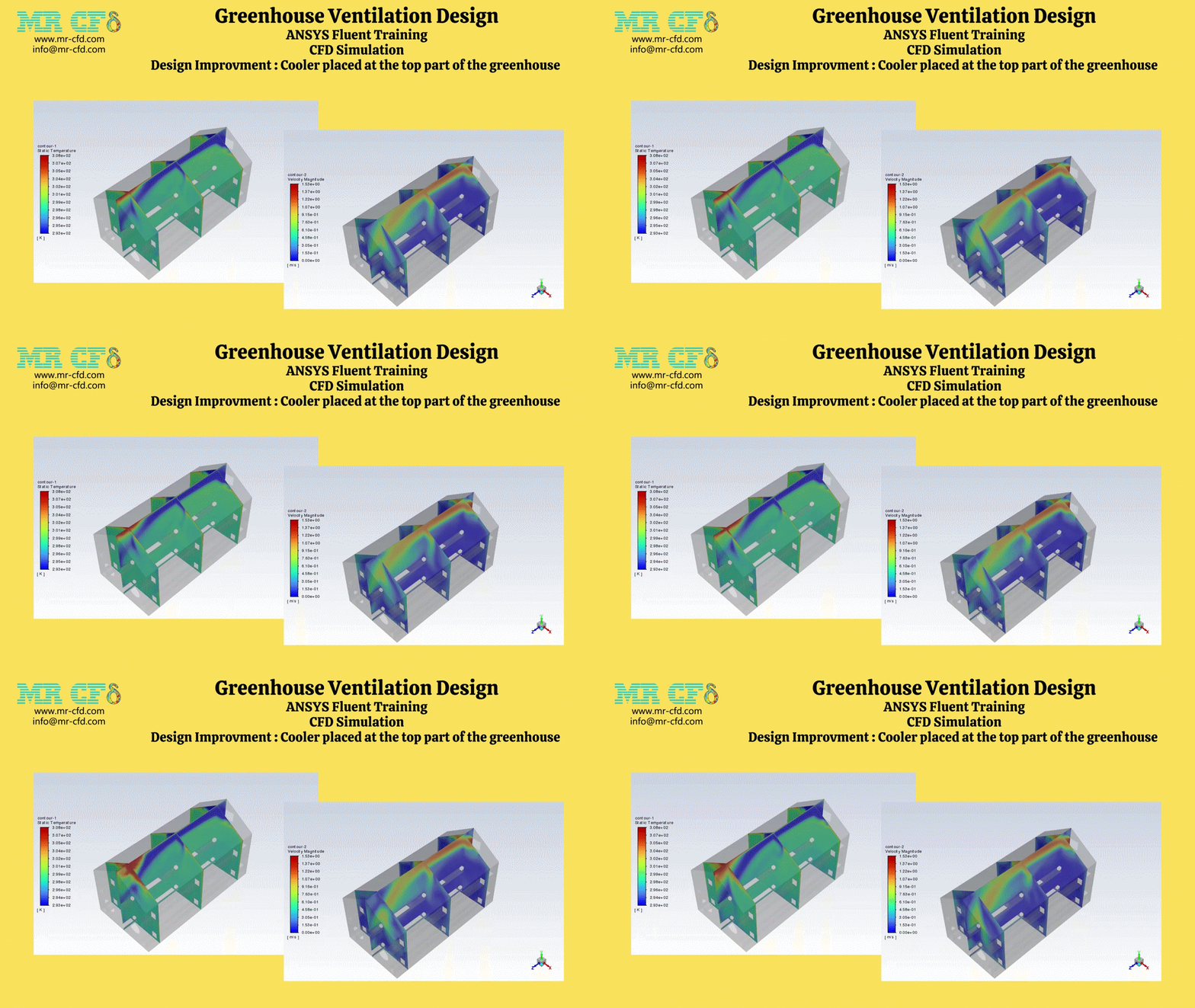
Considering the objectives and limitations, we have proposed to install the water-cooled air conditioner near the ceiling. Thus, it would be possible to increase the velocity and benefit from the natural convection. As a result, we achieved all targets, and values reached298.13K, 25.9% and 3.08ppm.

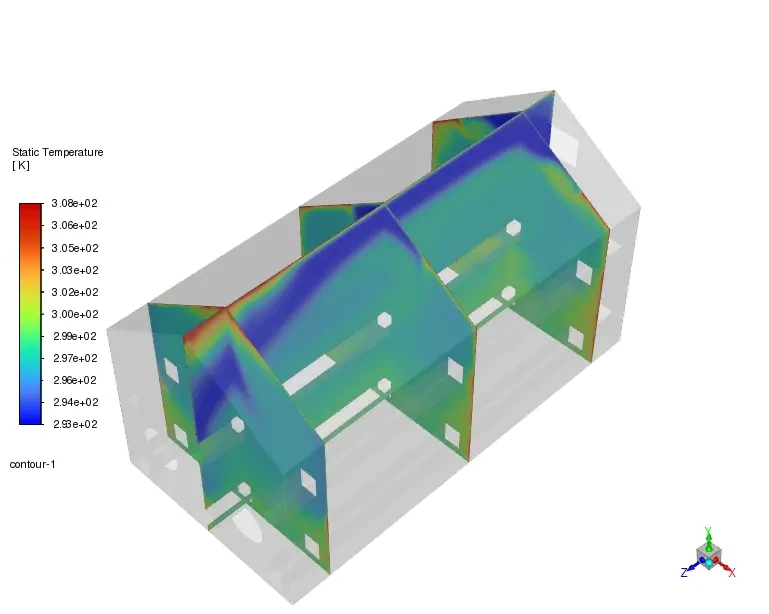
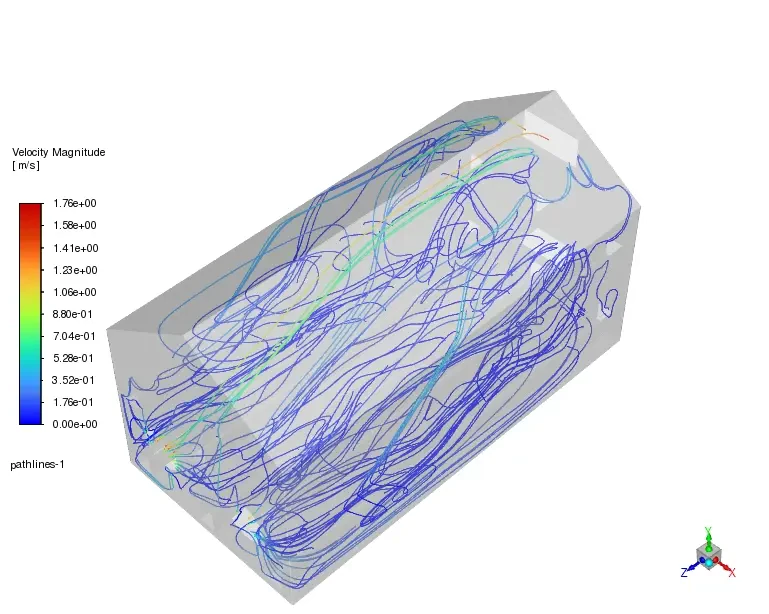
Importantly, the temperature contour illustrates how the air circulation significantly improved, all rows experienced similar conditions, and the plants were not in direct contact with high-speed air, preventing any probable damage. The reason behind this is visible in the streamlined contour.
The cold air enters the domain near the ceiling, and due to the density gradient between hot and cold air, it falls. The repetitive process causes optimal recirculation in the greenhouse.
Temperature Contour :
Velocity Streamline :
Animations :
Conclusion
In this industrial project, we investigated greenhouse ventilation and design improvement. The employer presented a plan for the interior space of a greenhouse. The important factors for the ventilation of this space include a suitable temperature range, high acceptable humidity, and maximum reduction of ammonia.
The basic design of this greenhouse only consists of two industrial fans. In the first step, the MR-CFD simulation expert group performed a numerical simulation and analyzed its results. The experts concluded that the present design does not satisfy the three objective factors. So, fans alone cannot improve the greenhouse's air condition.
Therefore, the CFD team suggested to the client install a water-cooled air conditioner on the wall in front of the fans. In the second step of the simulation, promising results were obtained. The use of coolers has significantly helped to increase air humidity and reduce ammonia. However, this method was insufficient because the temperature was still in the upper range.
This is because the hot air accumulates near the greenhouse ceiling due to the buoyancy effect and stagnation, and the cooling system installed in the middle height of the space cannot circulate it.
The easiest solution is to increase the speed of the cold air in the cooling system, which is harmful to greenhouse products. So, the MR-CFD group suggested to the project's client to change the location of installing the water-cooled air conditioner. So we started the third step of the simulation with this idea.
The final results of the third step were extremely satisfying. We were able to satisfy all three factors by presenting suitable ideas.
You may be wondering how the temperature range was reduced. Note natural convection heat transfer and buoyancy effect. Warm air moves to the environment's top due to its lightness and less density. So the hot air accumulates in the vicinity of the roof of the greenhouse.
Now, it is enough to install the cooling system on top of the greenhouse's interior. The cooling airflow reduces the temperature of the accumulated air. As the temperature increases and becomes heavier, the air falls again, and as a result, continuous air recirculation is created.