

Heat Exchanger with Twisted Barrier CFD Simulation
Price: $8
The present problem simulates heat transfer within a heat exchanger in three dimensions using ANSYS Fluent software.
Heat Exchanger with Twisted Barrier CFD Simulation
Price: $8
The present problem simulates heat transfer within a heat exchanger in three dimensions using ANSYS Fluent software.
Heat Exchanger with Twisted Barrier, ANSYS Fluent CFD Simulation Training
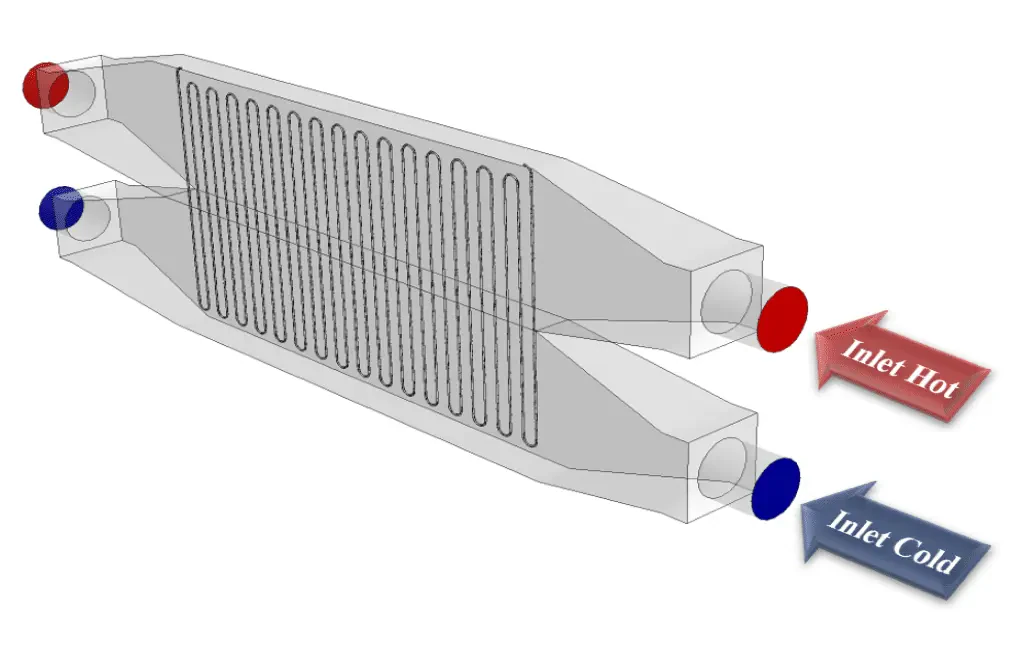
The present problem simulates heat transfer within a heat exchanger in three dimensions using ANSYS Fluent software. In this simulation, the HEX consists of two parts; the upper part is for the passage of the hot current, and the lower part is for the passage of the cold current. Also, a twisted barrier is used inside the HEX to affect the flow rate of hot and cold water and, consequently, increase the heat transfer between them. Hot water flow with a speed of 5 ms-1 and temperature of 340 K enters from the upper part of the HEX, and cold water flow enters with a speed of 5 ms-1 and temperature of 300 K from the lower part. This work investigates the heat transfer process between the cold and hot sides of the HEX.
Heat Exchanger Geometry & Mesh
The present model is designed in three dimensions using Design Modeler software. The present model is related to a heat exchanger, consisting of two parts (the hot part at the top and the cold part at the bottom), and a twisted barrier is used inside it.
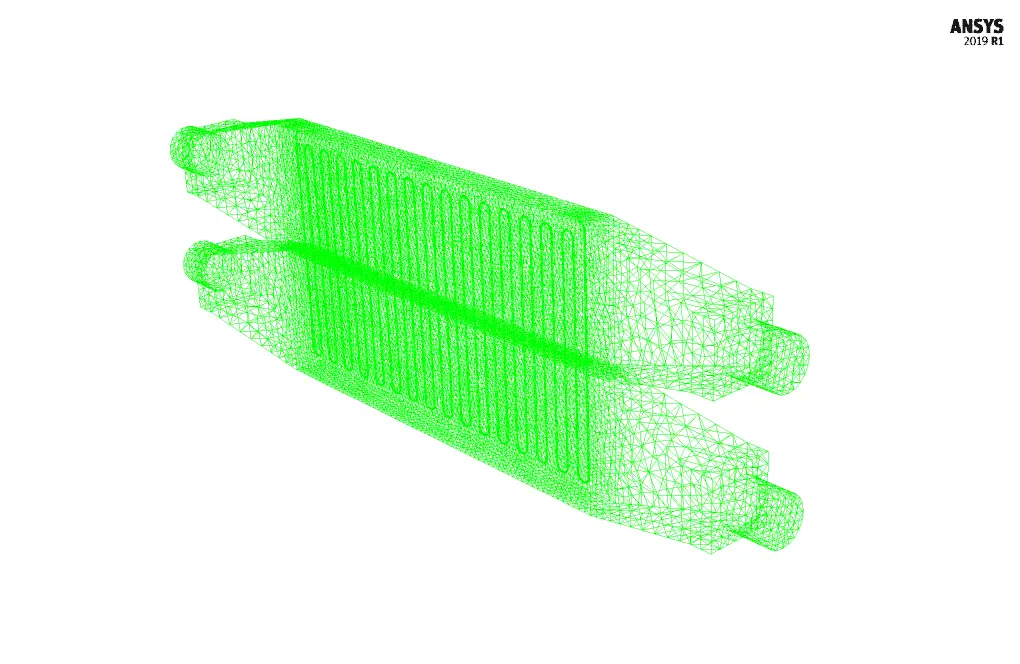
We carry out the model's meshing using ANSYS Meshing software. The mesh type is unstructured. The element number is 1201056. The following figure shows the mesh.
Heat Exchanger CFD Simulation
We consider several assumptions to simulate the present model:
- We perform a pressure-based solver.
- The simulation is steady.
- The gravity effect on the fluid is ignored.
The following table represents a summary of the defining steps of the problem and its solution:
| Models (Heat Exchanger) | ||
| Viscous | k-epsilon | |
| k-epsilon model | standard | |
| near wall treatment | standard wall functions | |
| Energy | On | |
| Boundary conditions (Heat Exchanger) | ||
| Hot Inlet | Velocity Inlet | |
| velocity magnitude | 5 m.s-1 | |
| temperature | 340 K | |
| Cold Inlet | Velocity Inlet | |
| velocity magnitude | 5 m.s-1 | |
| temperature | 300 K | |
| Hot Outlet | Pressure Outlet | |
| gauge pressure | 0 pascal | |
| Cold Outlet | Pressure Outlet | |
| gauge pressure | 0 pascal | |
| Middle Wall | Wall | |
| wall motion | stationary wall | |
| thermal condition | coupled | |
| Other Walls | Wall | |
| wall motion | stationary wall | |
| heat flux | 0 W.m-2 | |
| Methods (Heat Exchanger) | ||
| Pressure-Velocity Coupling | SIMPLE | |
| Pressure | second order | |
| momentum | second order upwind | |
| turbulent kinetic energy | first order upwind | |
| turbulent dissipation rate | first order upwind | |
| energy | second order upwind | |
| Initialization (Heat Exchanger) | ||
| Initialization methods | Standard | |
| gauge pressure | 0 Pascal | |
| x-velocity | 5 m.s-1 | |
| y-velocity & z-velocity | 0 m.s-1 | |
| temperature | 340 K (patch) | |
Heat Exchanger with Twisted Barrier Results & Discussions
At the end of the solution process, two-dimensional and three-dimensional counters related to pressure, velocity, and temperature inside the heat exchanger are obtained. Two-dimensional and three-dimensional path lines and two-dimensional and three-dimensional velocity vectors are also obtained. The results show that heat transfer has occurred between the cold and hot sides of the heat exchanger.