Heat pipe (Thermosyphon) CFD Simulation Using VOF Multiphase Model
Price: $48
- The problem numerically simulates a Heat pipe using ANSYS Fluent software.
- We design the 3-D model by the Design Modeler software.
- We Mesh the model by ANSYS Meshing software, and the element number equals 18000.
- We perform this simulation as unsteady (Transient).
- We use the VOF Multi-Phase model to define Mass Transfer in the form of Evaporation-Condensation.

Heat pipe CFD Simulation Using Multiphase VOF Model, Ansys Fluent Training
In this project, a heat pipe using the multiphase VOF model has been simulated, and the simulation results have been investigated using ANSYS Fluent software. We perform this CFD project and investigate it by CFD analysis.
The present model is designed in three dimensions using the Design Modeler software. The dimensions of the present geometry include a rectangle 10 cm long and 1.2 cm wide.
This geometry is meshed in Ansys meshing software, and the total number of cells is 18000.
Also, due to the nature of the present problem, the transient solver has been used.
Heat Pipe Methodology
This study simulated the heat pipe problem using Ansys Fluent software. The project was analyzed using the multiphase VOF model and activating the mass transfer of evaporation and condensation.
A hot wall with a temperature of 400 K and a cold surface with a temperature of 300 K was assumed. Solving the problem in a time-dependent manner, the formation of water droplets in the upper part of the geometry and their downward movement were observed due to capillary and gravity.
Also, the Saturation property was entered piecewise linearly. Moreover, the realizable k-epsilon model is used to solve turbulent fluid equations.
Heat Pipe Conclusion
At the end of the solution process, two-dimensional contours related to water and vapor volume fraction, mass transfer rate, and temperature are obtained.
By observing the volume fraction contours of the water at two different times, it is clear that the repetition loop of the evaporation & condensation process has been established. The droplets formed at the top of the tube move downwards due to gravity and wall capillary.
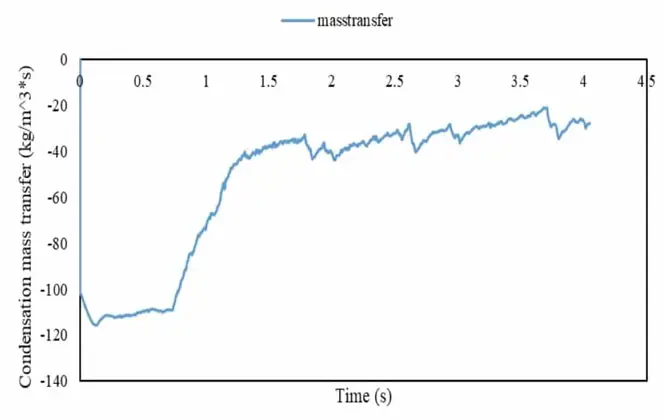
In addition, mass transfer, temperature, and vapor phase densities are included. The density of the vapor changes over time because it follows the ideal gas law. The mass transfer rate tended toward an average value. This indicates a balance between evaporation and condensation inside the heat pipe.