

Hydrate Formation in Elbow Pipe, Mixture Multiphase
Price: $32
- The problem numerically simulates hydrate formation flow inside a tube with a 90-degree elbow using ANSYS Fluent software.
- We design the 3-D model by the Design Modeler software.
- We mesh the model with ANSYS Meshing software.
- The mesh type is Structured, and the element number equals 55040.
- We use the Mixture Multi-Phase to define hydrate material.
- We define a Mass Transfer in the form of Evaporation-Condensation.
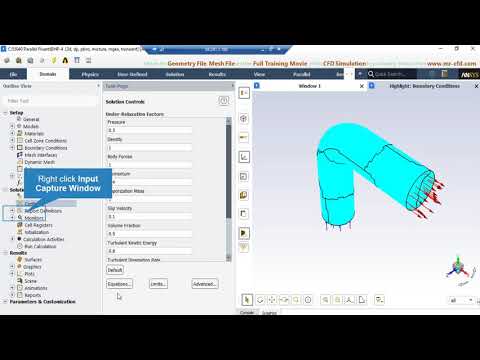
Hydrate Formation, Mixture Multiphase Flow in Elbow Pipe, ANSYS Fluent CFD Simulation Tutorial
The present problem simulates hydrate formation flow inside a tube with a 90-degree elbow using ANSYS Fluent software. We perform this CFD project and investigate it by CFD analysis.
The hydrate in this project is a combination of three different materials: water, water vapor, and methane. The present model is designed in three dimensions using Design Modeler software.
The current model is for a tube with a 90-degree elbow diameter equal to 2 cm. The meshing of the present model has been done using ANSYS Meshing software. The mesh type is Structured, and the element number equals 55040.
Also, a transient solver is used due to the nature of the problem, which is a time-progressing phenomenon.
CFD Methodology
Hydrates are organic substances composed of three materials: water, water vapor, and methane. Hydrate is assumed to be obtained by converting the water vapor phase to the liquid water phase in the condensation process.
Therefore, to define this hydrated material, the multiphase mixture model is used. Also, mass transfer is defined as the evaporation-condensation process between the liquid water phase and water vapor.
This evaporation-condensation process will occur at the saturation temperature, a polynomial function of the pressure value.

The inlet stream enters the elbow in the form of a mixture of water vapor and methane at a speed of 2 m/s and a temperature of 315 K; So, the inlet flow consists of 80% methane and 20% water vapor.
After the mixture enters the knee and due to the convection heat transfer, the condensation phenomenon occurs. As a result, some water is produced and added to the existing composition to form a hydrating substance.
Also, the RNG k-epsilon model and energy equation are enabled to solve the turbulent fluid equations in the domain and calculate temperature change within the domain, respectively.
Hydrate Formation in Elbow Pipe Conclusion
After the solution process, two-dimensional and three-dimensional contours related to the liquid water phase's pressure, methane velocity, temperature, and volume fraction are obtained. These results are obtained at different simulation process times (between 0.06 s to 0.24 s).
As can be seen from the pictures, as the simulation process progresses, the volume fraction of liquid water produced increases, indicating that the condensation process is taking place.
Also, as seen in velocity and pressure contour, the wake region becomes noticeable after the flow passes over the 90-degree bend. Moreover, secondary flows are formed at the outlet boundary due to the fluid flow passing inside a 90-degree pipe.