Hydrocyclone with a Tangent-Circle Inlet CFD Simulation, Paper Numerical Validation
Price: $210
- The problem numerically simulates the Hydrocyclone with a Tangent-Circle Inlet using ANSYS Fluent software.
- We design the 3-D model with the Design Modeler software.
- We mesh the model with ANSYS Meshing software, and the element number equals 228517.
- This simulation is validated with a reference article.
- We perform this simulation as unsteady (Transient).
- We use the VOF Multiphase model to define water and air.

Description
The present problem simulates the two-phase flow of air and water inside a Hydrocyclone by ANSYS Fluent software.
The simulation is based on a reference article, “Effects of curvature radius on separation behaviors of the Hydrocyclone with a tangent-circle inlet,” Its results are compared and validated with the results in the article.
The geometry of this model consists of a water inlet and two pressure outlets and is modeled in the Design Modeler. It has meshed in ANSYS meshing. The mesh type used for this geometry is unstructured. The total element number is 228517.
Hydrocyclone Methodology
This project simulates a two-phase flow of water and air inside a Hydrocyclone. The water will enter the computational domain tangentially with a velocity of 6m/s based on the paper.
The Reynolds Stress Model is exploited to solve fluid flow equations, and the VOF multiphase model is used to investigate the phase interactions of the water and air core. The present simulation and its results are transient.
Hydrocyclone Conclusion
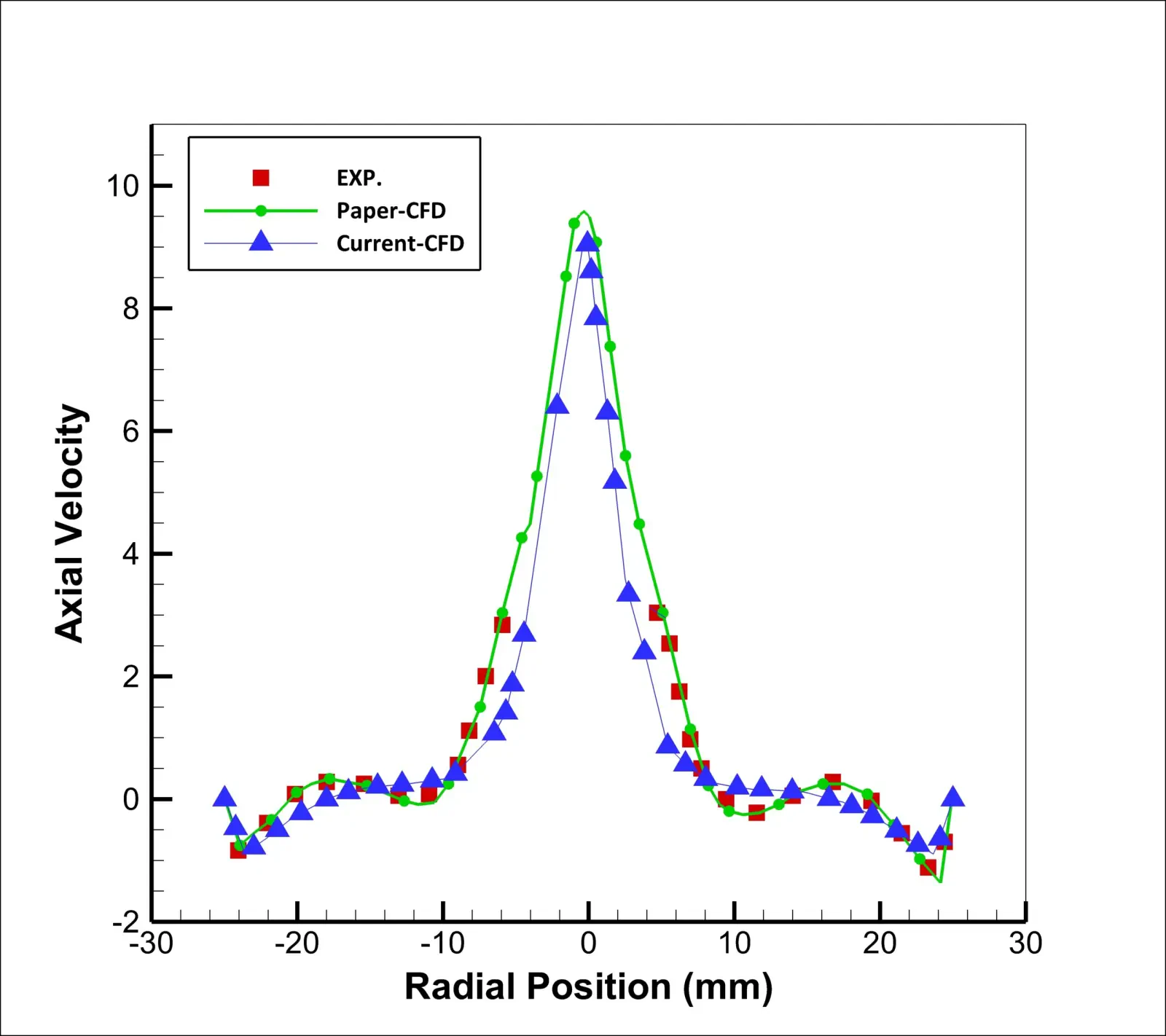
At the end of this simulation, the results of the present work are compared and validated with the results obtained by the paper. For this purpose, the diagram in figure 10 shows the changes in the axial velocity of the fluid mixture based on the radial position of the Hydrocyclone.