

Inviscid Supersonic Flow Over F-16 Aircraft Simulation
Price: $28
- Simulation of Inviscid Supersonic Flow Over F-16 Aircraft.
- CFD Analysis of High Much Flow.
- Steady State CFD Simulation.
- Using Fluent Meshing Software for Mesh Generation.
Inviscid Supersonic Flow Over F-16 Aircraft Simulation
Price: $28
- Simulation of Inviscid Supersonic Flow Over F-16 Aircraft.
- CFD Analysis of High Much Flow.
- Steady State CFD Simulation.
- Using Fluent Meshing Software for Mesh Generation.
Inviscid Supersonic Flow Over F-16 Aircraft, CFD Simulation Ansys Fluent Training
In this project, supersonic flow over an F-16 aircraft considering inviscid fluid was simulated in Ansys Fluent software, and then the results were investigated. Supersonic speed is the speed of an object that exceeds the speed of sound. It is estimated to be around 343 m/s in the dry air at a temperature of 20 C. In this simulation, the F-16 aircraft experiences 400m/s speed, so the Mach number is 1.16, and the working fluid is assumed to be inviscid, so there would be no shear stress.
Geometry & Mesh
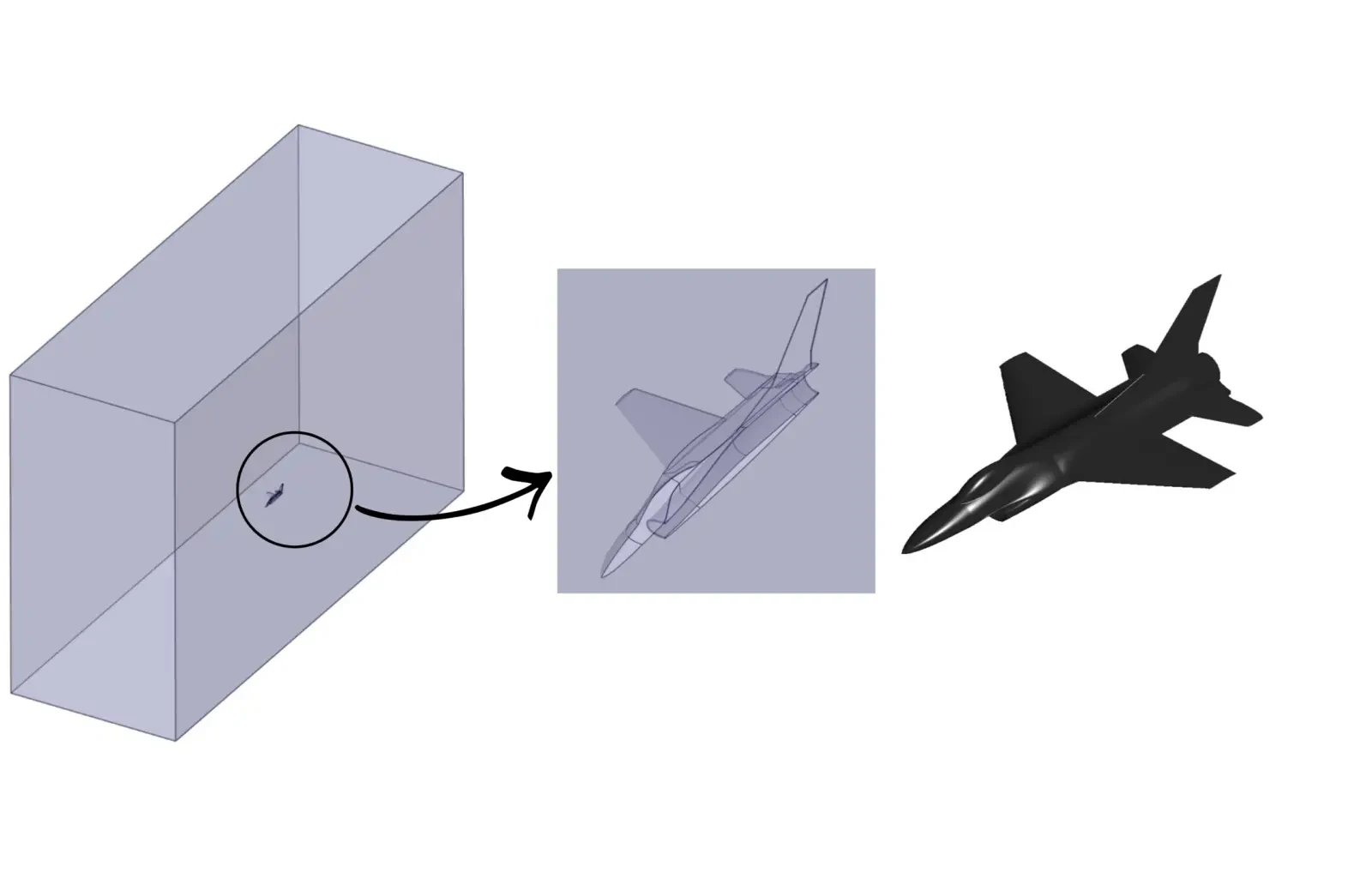
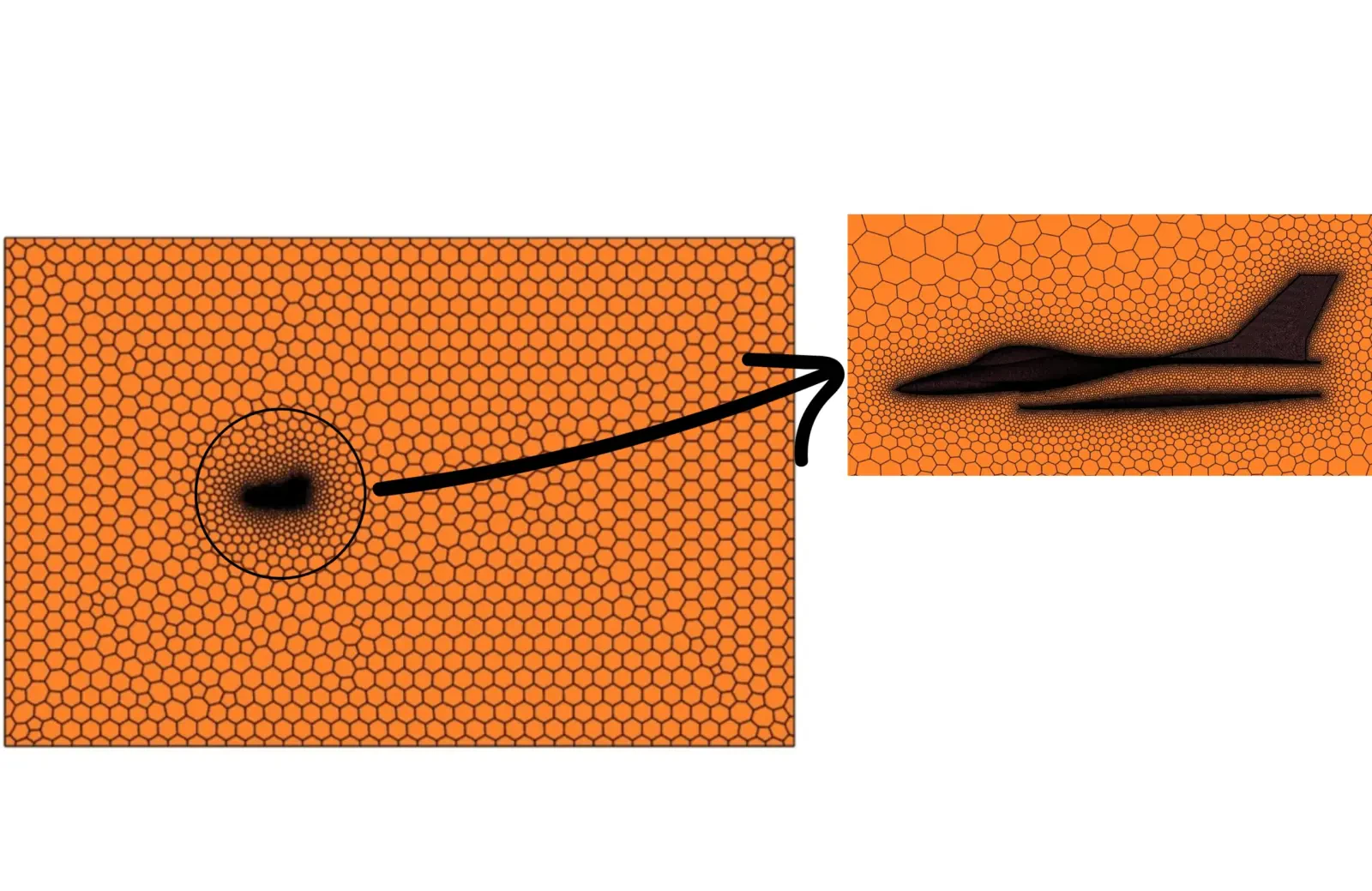
The 3D geometry was imported and generated in SpaceClaim software. An F-16 aircraft model is imported and placed at the middle of an enclosure. In addition, an unstructured mesh grid was carried out using Fluent Meshing software, and overall, 979273 elements were generated.
Inviscid Supersonic Flow CFD Simulation
Several assumptions have been considered to simulate supersonic flow over F-16 aircraft, including:
- The simulation is Steady, so the conditions don't change with time.
- The pressure-based solver type was used within the ideal-gas behavior of air density.
- An inviscid viscous model was utilized.
- Gravitational acceleration effects were neglected.
Results
Although air is considered an incompressible fluid in most cases when the speed of fluid increases, there should be an assumption of compressibility; this assumption is specified by a dimensionless factor called Mach number, which represents fluid velocity to the velocity of sound in a defined condition. In this simulation, the inlet velocity is 400m/s, so the Mach number is 1.16 and could be counted as supersonic flow. A pressure-based solver was used along with the ideal-gas behavior of fluid and coupled pressure-velocity coupling scheme instead of using density-based solver and its convergence problems.
The contours of the simulation clearly show the symmetric distribution of pressure and velocity field around the aircraft. The pressure gets to its highest values below the wings and this pressure gradient causes lift force acts on aircraft. Moreover, there is a strong correlation between pressure, density, and temperature. Note that the fluid is assumed to be inviscid, and as a result, the Navier-stokes governing equation is simplified to Bernoulli's equation.