Mistral Simple Aerodynamic Analysis: CFD Simulation by ANSYS Fluent
Price: $319
- The problem numerically simulates a Mistral using ANSYS Fluent software.
- We design the 3-D model with the SpaceClaim software.
- We mesh the model with Ansys Meshing software. The element number equals 10,172,369 and their type is Tetrahedral.
Simple Aerodynamic Analysis: Mistral CFD Simulation Training
Introduction
The Mistral missile (particularly the Mistral 3 variant) is a very short-range air defense (VSHORAD) missile equipped with an imaging infrared seeker and fully automatic fire‑and‑forget guidance, designed to engage various targets including aircraft, helicopters, unmanned aerial vehicles, and fast attack craft in land, naval, and air domains. In its MANPADS configuration, the missile is housed in a sealed launch-and-carry canister, and according to MBDA data, it has an overall length of about 1.88 meters (including the launch motor), a maximum body diameter of about 92 millimeters, and a mass of less than 20 kilograms, which makes it a very compact configuration for aerodynamic and analytical simulations.
A two-stage solid-propellant motor (launch booster plus sustainer) is integrated into the body with a diameter of about 90–92 millimeters, where the launch stage provides an initial velocity of about 40 m/s and imparts spin for stability, after which the main motor accelerates the missile to a high supersonic speed (around 800–930 m/s); these characteristics are critical for defining compressible-flow boundary conditions, Mach number, and the aerodynamic regime in CFD analysis.
The geometry of the present model is three-dimensional and has been designed using SpaceClaim software. We do the meshing of the present model with Ansys Meshing software. The mesh type is Tetrahedral, and the element number is 10,172,369.
Methodology
This study used a steady-state, Pressure-based CFD simulation in ANSYS Fluent software to analyze the compressible flow around a Mistral. The flow physics was modeled using the k-ℇ Realizable turbulence model.
Results and Conclusion
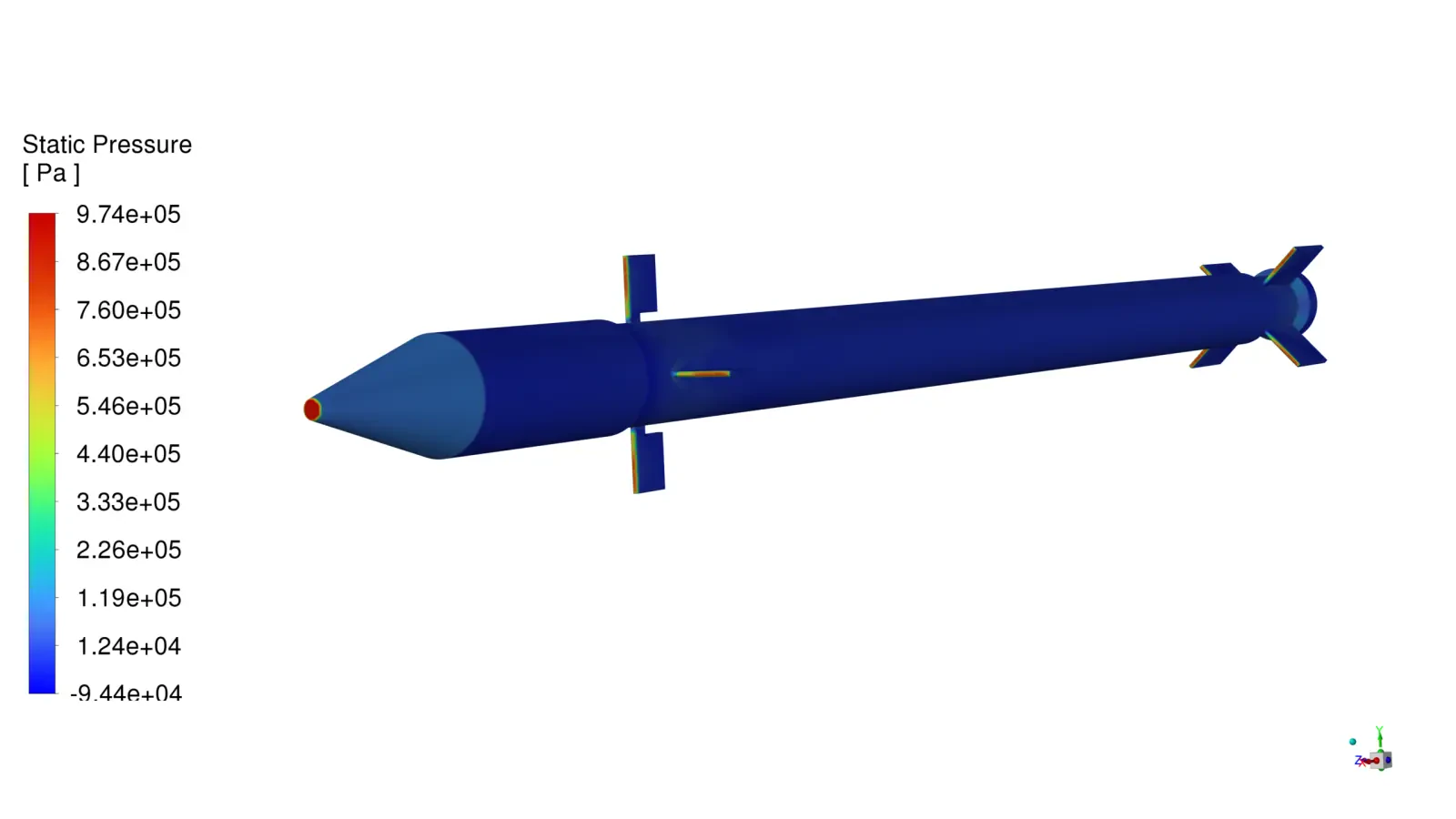
According to the contours below, the velocity and pressure in the areas around the Mistral as well as the pressure on the Mistral wall are clear. As can be seen, the velocity around it is higher, especially in the areas of the cap, and the pressure contours also confirm this.
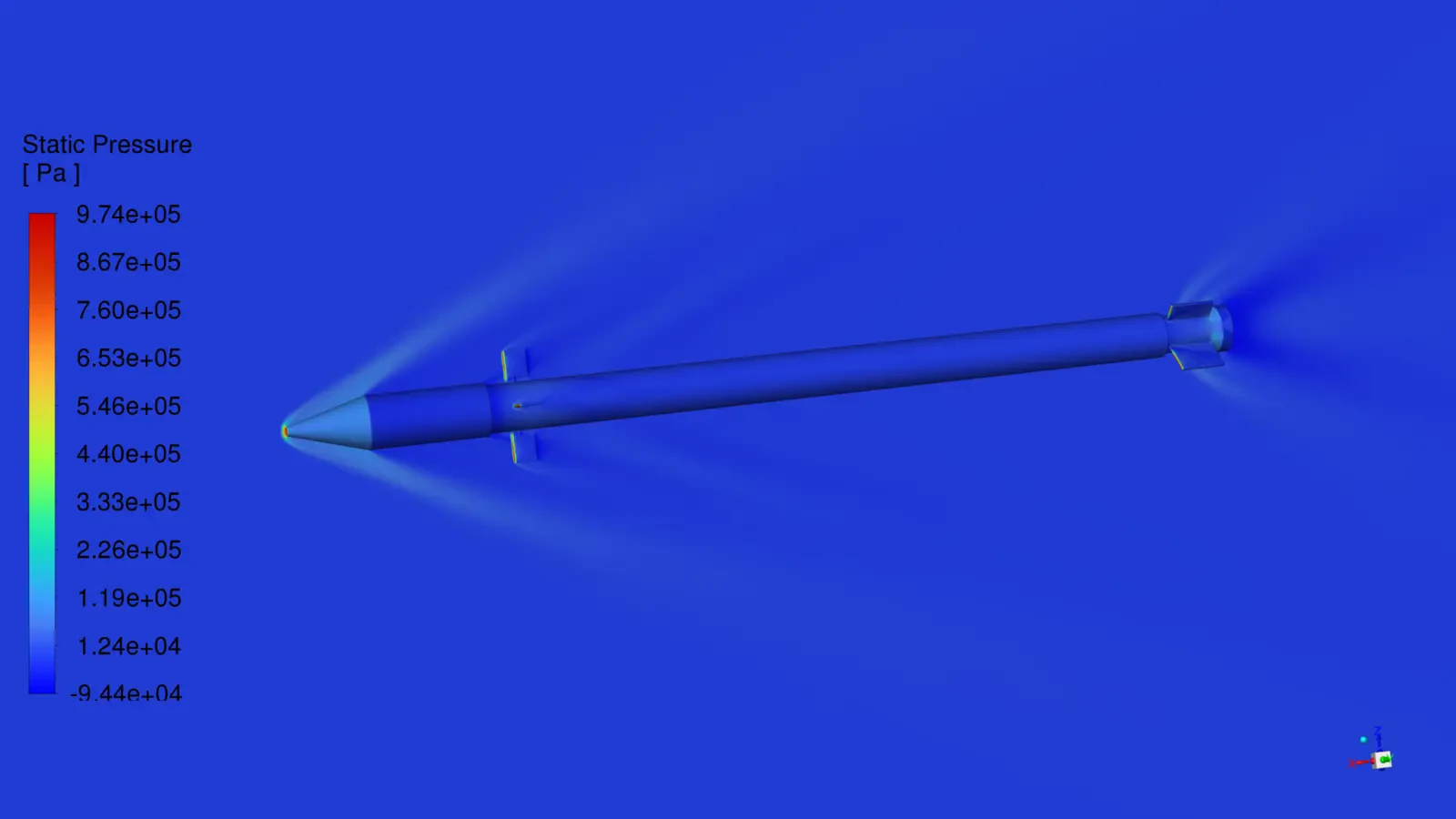
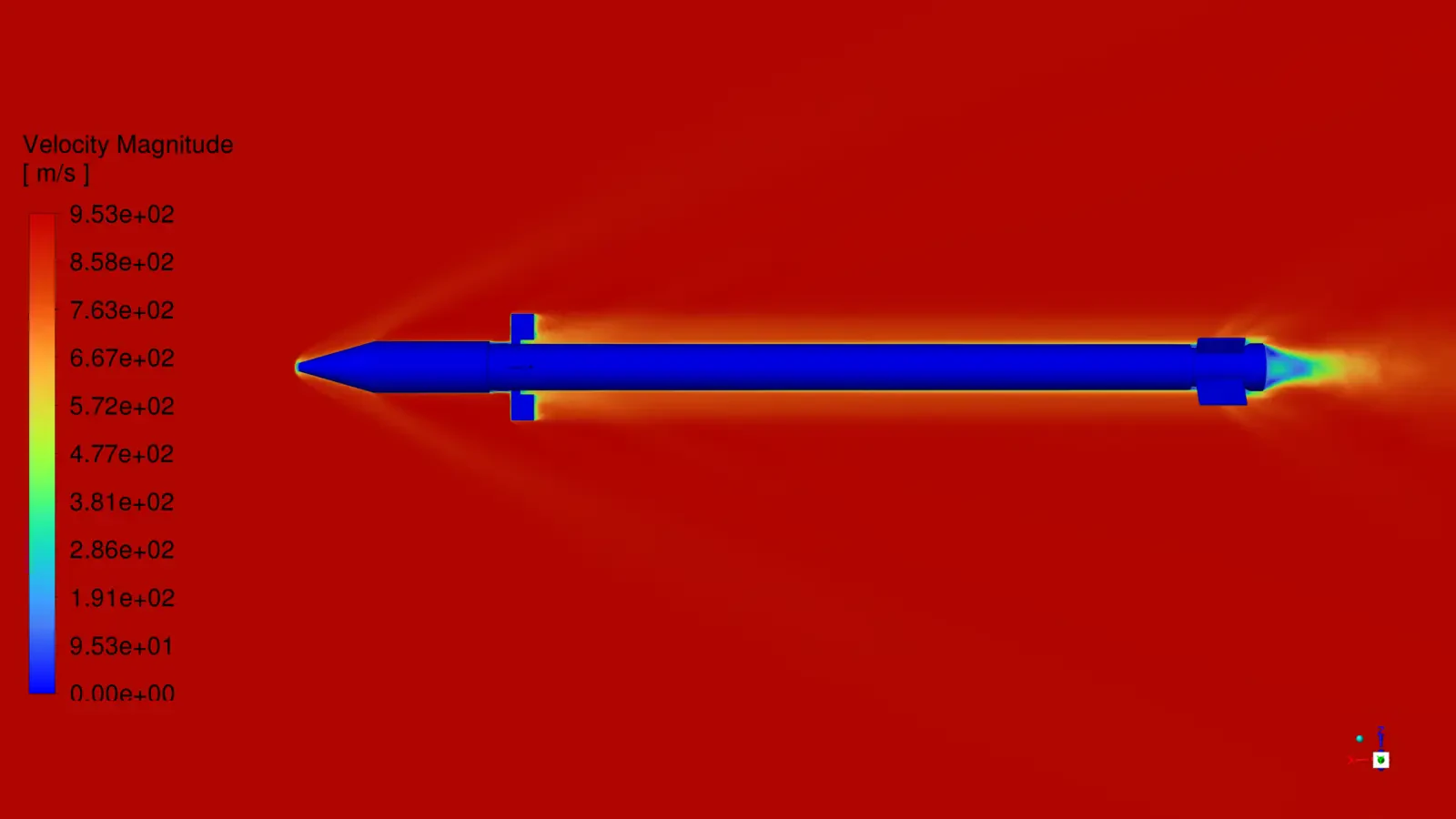
You can also see that the highest pressure is applied to the front of the cap.