

Nanofluid Heat transfer in Double Pipe Heat Exchanger, Paper Validation
Price: $84
The present problem validates the article "Heat transfer enhancement of nanofluids in a double pipe heat exchanger with louvered strip inserts" applying CFD simulation, using ANSYS Fluent software.
Nanofluid Heat transfer in Double Pipe Heat Exchanger, Paper Validation
Price: $84
The present problem validates the article "Heat transfer enhancement of nanofluids in a double pipe heat exchanger with louvered strip inserts" applying CFD simulation, using ANSYS Fluent software.
Nanofluid Heat transfer in Double Pipe Heat Exchanger CFD Simulation, Paper Numerical Validation, ANSYS Fluent training
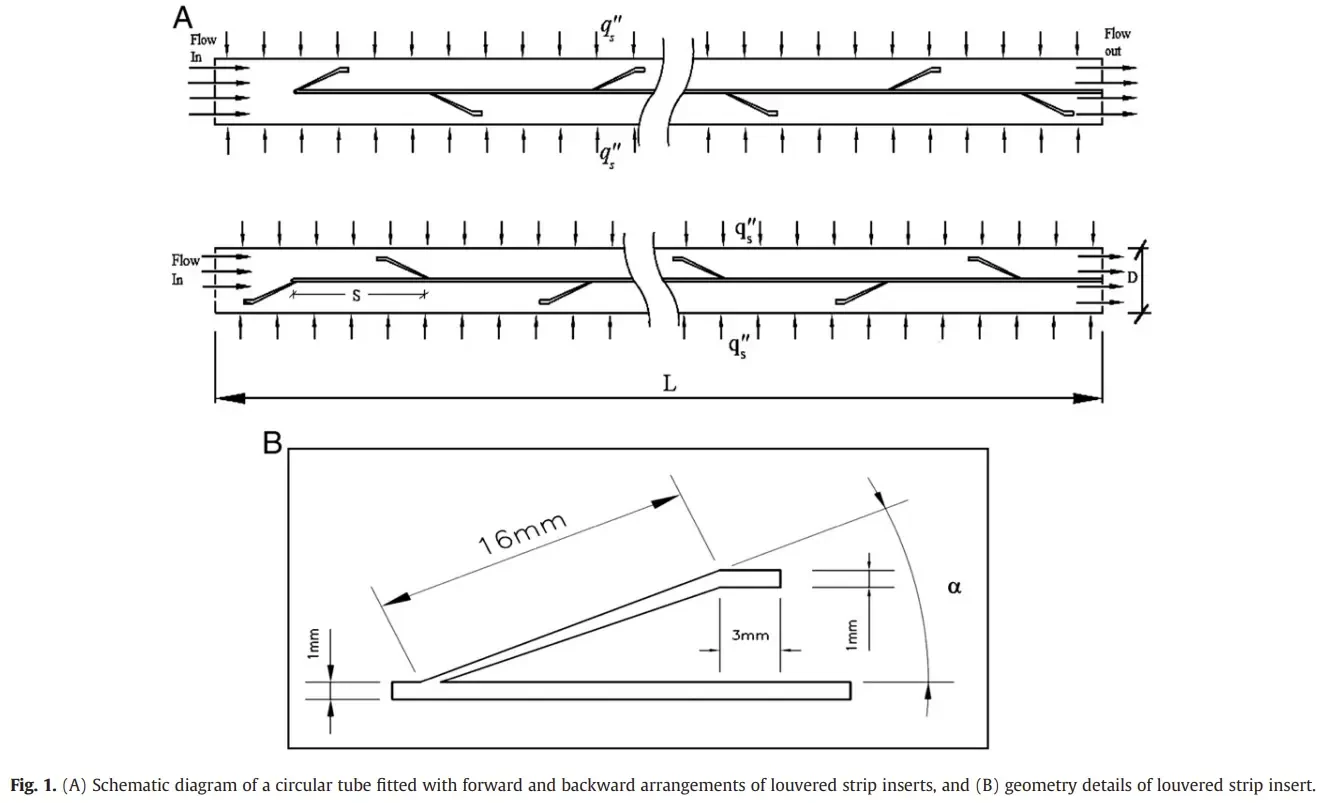
The problem simulates the heat transfer inside a double pipe heat exchanger with a Louver strip, using ANSYS Fluent software. The simulation process is based on the data in the reference article [Heat transfer enhancement of nanofluids in a double pipe heat exchanger with louvered strip inserts]. The results are compared and validated with the results in the article. The model is related to a double pipe heat exchanger, in the interior of which a strip is placed in a louvered manner connected to the inner pipe with specific angles and distances.
In the present model, the angle of each diagonal strip is equal to 30 degrees, and the distance between the two strips is equal to 60 mm, which is connected to the body of the inner tube of the heat exchanger. The fluid flowing inside this pipe is nanofluid with a Reynolds number of 30,000. As a result, according to the Reynolds equation, assuming the diameter of the outer tube as the characteristic length, the inlet nanofluid flow velocity is 1.537279 m.s-1. Also, the inlet nanofluid flow temperature to the pipe is equal to 293 K.
The wall of the heat exchanger consists of three parts, in the middle of which is an inner tube with a Louvre tape attached to it, and also, the outer tube wall is under heat flux. Thus, the wall of the outer tube in the middle part of the heat exchanger under the thermal boundary condition of constant heat flux is equal to 200000 W.m-2; While the Louvre strip connected to the inner tube as well as the outer wall of the tube are thermally insulated at the beginning and end of the heat exchanger.
This work aims to investigate the amount of Nusselt number on the outer tube wall in the middle of the heat exchanger and under constant heat flux.
Geometry & Mesh
The present model is designed in two dimensions using Design Modeler software. The model includes a double-pipe heat exchanger; Thus, the diameter of the inner tube in the middle of the heat exchanger is equal to 0.001 m, and the diameter of the outer tube is equal to 0.0196 m. Also, the length of the outer tube is equal to 1.5 m, and the length of the inner tube is equal to 0.5 m. Louvre strips are attached to the body of the inner tube of the converter, which has an angle of 30 degrees, and the distance between the two strips is 0.06 m.
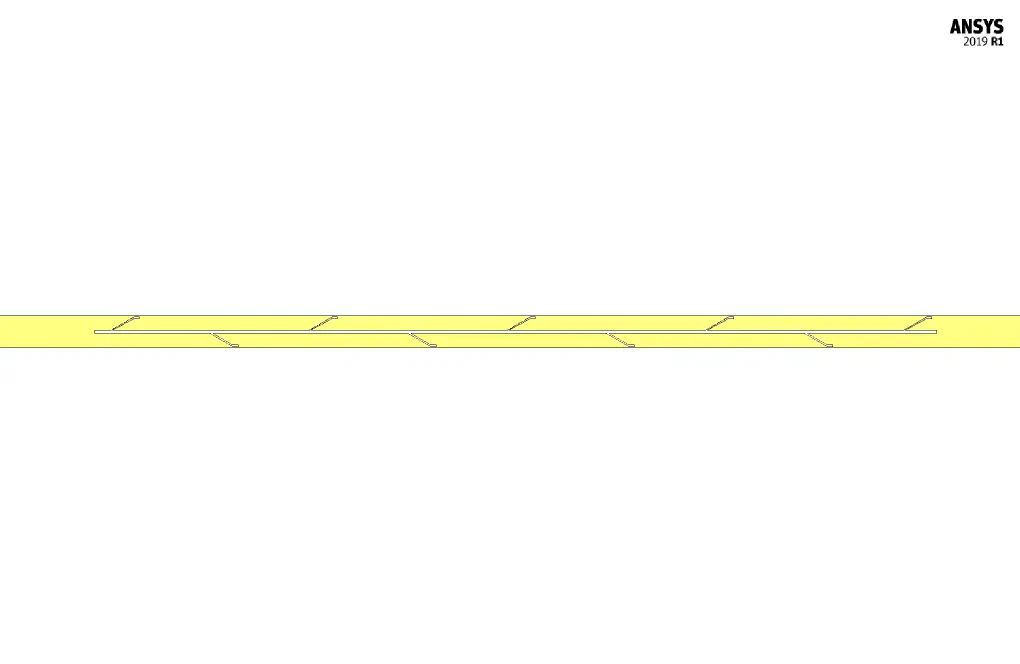
The meshing of the model has been done using ANSYS Meshing software and the mesh type is structured. The element number is 296880. The following figure shows the mesh.

CFD Simulation
To simulate the present model, several assumptions are considered:
- We perform a pressure-based solver.
- The simulation is steady.
- The gravity effect on the fluid is ignored.
The following table represents a summary of the defining steps of the problem and its solution:
| Models | ||
| Viscous | k-epsilon | |
| k-epsilon model | RNG | |
| near wall treatment | standard wall functions | |
| Energy | On | |
| Boundary conditions | ||
| Inlet | Velocity Inlet | |
| velocity magnitude | 1.537972 m.s-1 | |
| temperature | 293 K | |
| Outlet | Pressure Outlet | |
| gauge pressure | 0 Pascal | |
| heat Wall | Wall | |
| wall motion | stationary wall | |
| heat flux | 200000 W.m-2 | |
| louvered strips Wall | Wall | |
| wall motion | stationary wall | |
| heat flux | 0 W.m-2 | |
| Methods | ||
| Pressure-Velocity Coupling | SIMPLE | |
| Pressure | second order | |
| momentum | second-order upwind | |
| turbulent kinetic energy | second-order upwind | |
| turbulent dissipation rate | second-order upwind | |
| energy | second-order upwind | |
| Initialization (nanofluid) | ||
| Initialization methods | Standard | |
| gauge pressure | 0 pascal | |
| x-velocity | 1.537972 m.s-1 | |
| y-velocity | 0 m.s-1 | |
| temperature | 293 K | |
Nanofluid Heat transfer in Double Pipe Heat Exchanger Paper Validation Results
At the end of the solution process, the value of the Nusselt number is obtained on the outer tube wall of the heat exchanger, which is under constant heat flux. This value is obtained when the value of the Reynolds number is equal to 300,000, the Louver strips' angle is 30 degrees, and the distance between the two Louvre strips is 60 mm. Calculating the value of the Nusselt number requires the correct reference values.
So that in the present model, the characteristic length is equal to the diameter of the outer tube of the heat exchanger, i.e., 0.0196 m, and the reference temperature is equal to the temperature of the fluid bulk temperature inside the tube, which is equivalent to 293 K. Comparing the results of the present work with the results of the article and validating the results have been done using the diagram of Figure 6-A of the reference article.
| Re | Nusselt number @ paper | Nusselt number @ present work |
| 30000 | 1102 | 1041.359 |
Finally, two-dimensional contours related to pressure, temperature, velocity, and two-dimensional pathlines are obtained.