

Non-Newtonian Flow Between 2 Concentric Cylinders, Eulerian, ANSYS Fluent
Price: $24
The present problem simulates a non-Newton two-phase flow between two concentric cylinders using ANSYS Fluent software.
Non-Newtonian Flow Between 2 Concentric Cylinders, Eulerian, ANSYS Fluent
Price: $24
The present problem simulates a non-Newton two-phase flow between two concentric cylinders using ANSYS Fluent software.
Non-Newtonian Flow Project Description
The present problem simulates a non-Newton two-phase flow between two concentric cylinders using ANSYS Fluent software. Fluids are divided into two categories in terms of viscosity: Newtonian and non-Newtonian fluids. Viscosity is a parametric fluid that indicates the degree of resistance of that fluid to flow. Newtonian fluids are fluids that follow Newton's law of viscosity (shear stress in a Newtonian fluid changes linearly with strain rate) and also their viscosity depends only on the temperature and pressure of the fluid, and by applying a force to them in a constant temperature and pressure, their viscosity does not change.
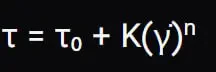
Non-Newtonian fluids, on the other hand, are fluids that do not follow Newton's law of fluids, and their viscosity changes with the application of force. In this simulation, a two-phase flow is defined using the Eulerian model, the base fluid of which is a non-Newtonian fluid with a soluble fluid flowing through it. The base fluid has a density of 998.2 kg.m-3 and its viscosity is defined as non-Newtonian, which is non-Newtonian-power-law. The relation to the non-Newtonian viscosity value is as follows; So that k is equal to the criterion for measuring the average viscosity of the fluid and n is the criterion for the deviation of the fluid from the Newtonian state.
In this simulation, k is defined as 0.021 and n is defined as 0.75, and the minimum and maximum viscosity are 0.0001 kg.m-1.s-1 and 2000 kg.m-1.s-1, respectively. The soluble fluid in non-Newtonian fluid also has a density equal to 2000 kg.m-3 and a viscosity equal to 0.00111 kg.m-1.s-1.
Geometry & Mesh
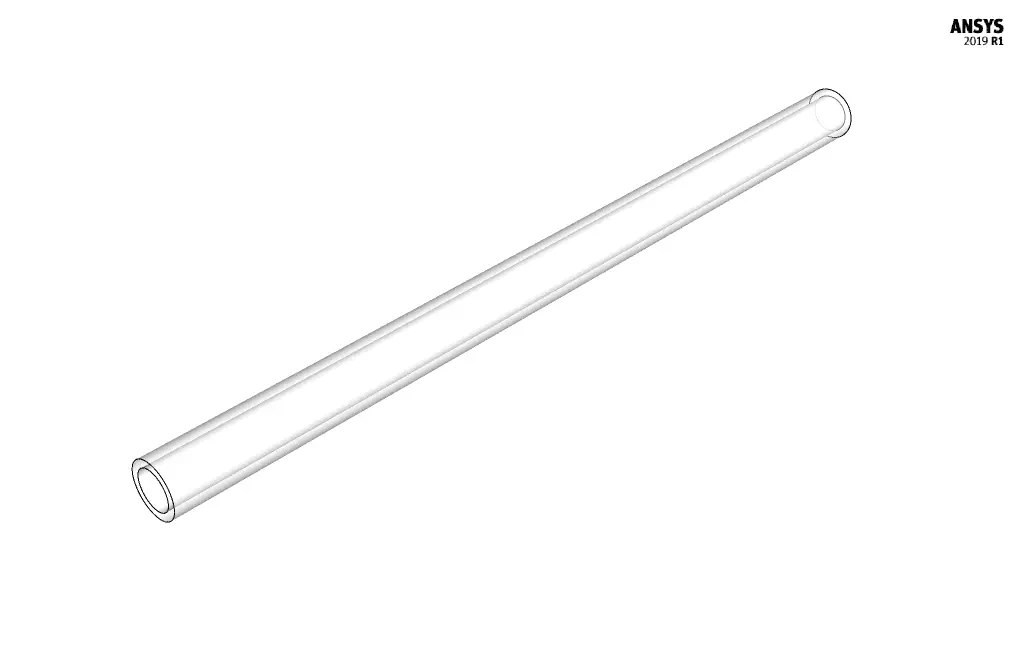
The present model is designed in three dimensions using Design Modeler software. The model is a cylindrical channel with a length of 1 m and an inner diameter of 0.0225 m and an outer diameter of 0.03125 m.
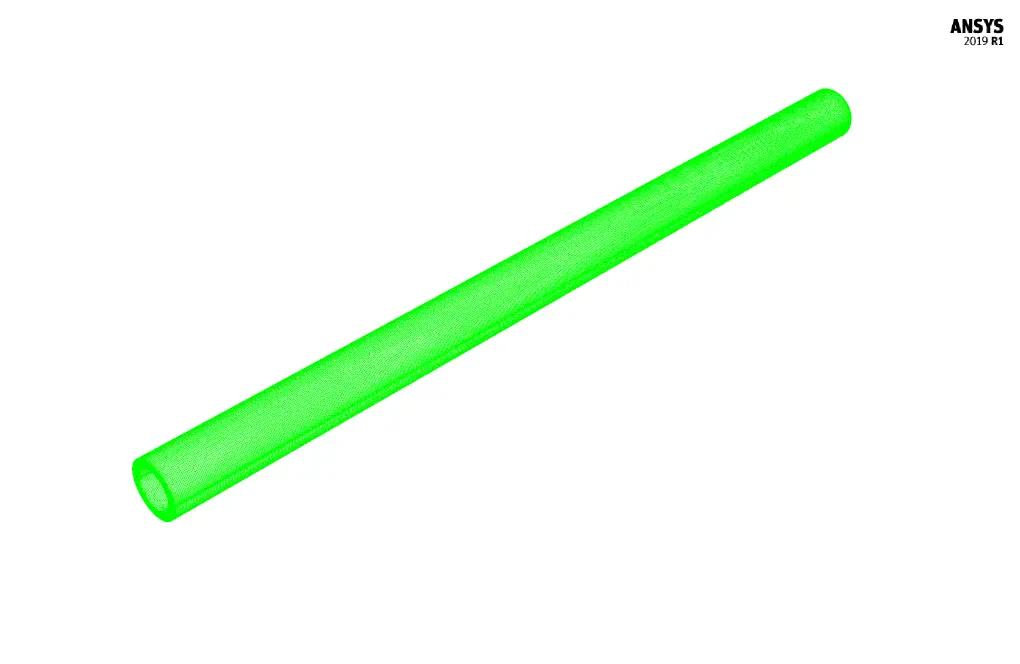
We carry out the model's meshing using ANSYS Meshing software. The mesh type is structured. The element number is 1396224. The following figure shows the mesh.
Non-Newtonian Flow CFD Simulation
We consider several assumptions to simulate the present model:
- We perform a pressure-based solver.
- The simulation is steady.
- The gravity effect on the fluid is ignored.
The following table represents a summary of the defining steps of the problem and its solution:
| Models (Non-Newtonian) | ||
| Viscous | k-epsilon | |
| k-epsilon model | standard | |
| near wall treatment | standard wall functions | |
| Multiphase Model | Eulerian | |
| number of eulerian phases | 2 | |
| formulation | implicit | |
| Boundary conditions (Non-Newtonian) | ||
| Inlet | Velocity Inlet | |
| gauge pressure | 0 Pascal | |
| velocity magnitude | 1.3566 m.s-1 | |
| volume fraction - primary phase | 0.87 | |
| volume fraction - secondary phase | 0.13 | |
| Outlet | Pressure Outlet | |
| gauge pressure | 0 pascal | |
| Inner wall | wall motion | Rotating wall (100 rpm) |
| Outer wall | wall motion | stationary wall |
| Methods (Non-Newtonian) | ||
| Pressure-Velocity Coupling | Coupled | |
| Pressure | PRESTO | |
| momentum | first order upwind | |
| turbulent kinetic energy | first order upwind | |
| turbulent dissipation rate | first order upwind | |
| volume fraction | first order upwind | |
| Initialization (Non-Newtonian) | ||
| Initialization methods | Standard | |
| gauge pressure | 0 Pascal | |
| velocity (x,y,z) | 0 m.s-1 | |
| volume fraction - primary | 1 | |
| volume fraction - secondary | 0 | |
Results & Discussions
At the end of the solution process, two-dimensional and three-dimensional contours related to pressure, velocity, volume fraction of non-Newtonian base fluid and volume fraction of soluble fluid were obtained.