

Non-Return Valve (Dynamic Mesh), CFD Simulation ANSYS Fluent Training
Price: $36
In this project, which has been done by the CFD simulation method with the help of Ansys Fluent software, a non-return valve is simulated.
Non-Return Valve (Dynamic Mesh), CFD Simulation ANSYS Fluent Training
Price: $36
In this project, which has been done by the CFD simulation method with the help of Ansys Fluent software, a non-return valve is simulated.

Non-Return Valve Project Description
A non-return valve is simulated in this project, which has been done by the CFD simulation method with the help of Ansys Fluent software. These valves move the fluid flow in only one direction and prevent it from moving in the opposite direction. In some industrial applications, the pressure at the outlet may increase relative to the inlet and cause the flow to return, and this factor can be harmful to us, so in these cases, we use this type of valve. In this simulation, dynamic mesh and one DOF rotation capability are used. Input speed up to 0.4 seconds 1 m/s and then almost zero (0.000001m/s) is defined using UDF.
Geometry & Mesh
The two-dimensional geometry of this project has been produced with SpaceClaim software.
The length of the calculation area is 26 cm, and the width is 5 cm.
The meshing of this project has been done with Ansys Meshing software, and the type of elements is unstructured. Also, the total number of elements is 61580.
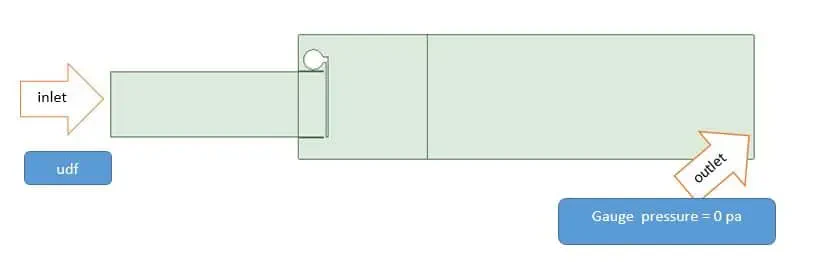
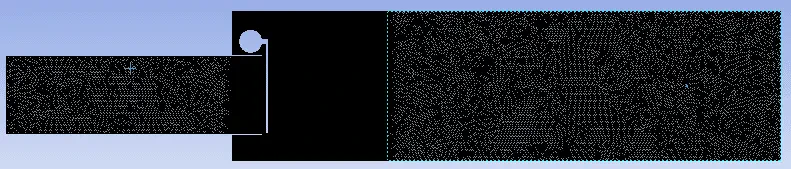
CFD Simulation
- the pressure-based solver method has been selected.
- The simulation is transient.
- The gravity effect is ignored.
The following tables represent a summary of the defining steps of the problem in this project and its solution:
| Models | ||
| Viscous model | k-omega | |
| Model | SST | |
| Dynamic mesh | On | |
| Six DOF | On | one DOF rotation |
| Spring | 1 n-m/rad | |
| Boundary conditions | ||
| Inlet | velocity inlet | |
| Velocity magnitude | UDF | |
| Outlet | Pressure outlet | |
| Gauge pressure | 0 pa | |
| Walls | Stationary wall | |
| Solution Methods | ||
| Pressure-velocity coupling | Simple | |
| Spatial discretization | Pressure | Second-order |
| Momentum | second-order upwind | |
| Turbulent kinetic energy | first-order upwind | |
| Turbulent dissipation rate | first-order upwind | |
| Initialization | ||
| Initialization method | Standard |
Non-Return Valve Results
At the end of the simulation, we see that the valve opens up for 0.4 seconds due to the high speed and kinetic energy of the water. From this moment on, when the flow velocity is also zero, the valve starts to close. The spring force defined for the valve also accelerates the closing of the valve and does not allow the flow to return to the inlet. We can also see the input speed diagram in terms of time defined by UDF. The graph of the force applied to the valve is also drawn over time.