

Open Channel Flow inside a 180-Degree Bend, ANSYS Fluent Simulation Training
Price: $28
The problem simulates a two-phase flow (water and air) inside an open channel with a 180-degree arc using ANSYS Fluent software.
Open Channel Flow inside a 180-Degree Bend, ANSYS Fluent Simulation Training
Price: $28
The problem simulates a two-phase flow (water and air) inside an open channel with a 180-degree arc using ANSYS Fluent software.
Project Description
The present problem simulates two-phase flow (water and air) inside an open channel with a 180-degree arc using ANSYS Fluent software. To simulate the mentioned two-phase flow, the multiphase VOF model (Volume of Fluid) have been used; Because this two-phase flow is considered free surface currents. Therefore, the VOF model is used to define different phases of the flow. In this multiphase model, airflow is defined as the primary phase and water flow as the secondary phase. Also, because the free surface of water flow inside the canal, the open channel flow model has been used; So that the level of water flow is equivalent to 0.2 m. A stream of water with a height of 0.2 m and a mass flow of 94.83 kg.s-1 enters the channel and, after passing through an arc path of 180 degrees, exits the channel's outlet at a pressure equal to atmospheric pressure. Also, for the upper level of the duct, which is for the passage of airflow, the relative pressure limit condition equal to 0 pascals has been used.
Geometry & Mesh
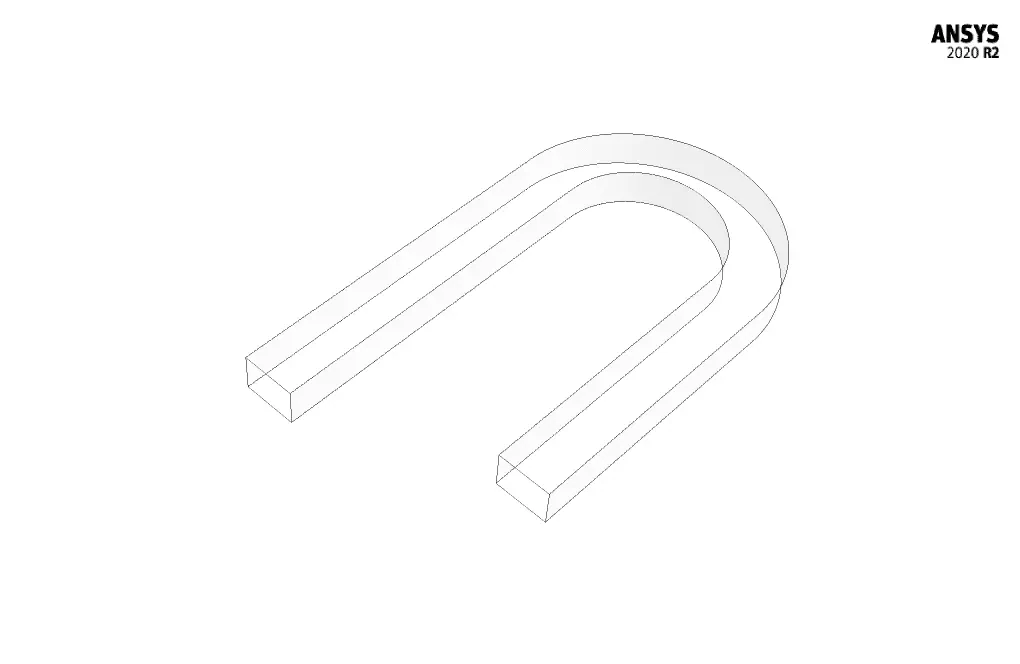
The present model is designed in three dimensions using Design Modeler software. The present model is a channel with a rectangular cross-section that has an arc path of 180 degrees. The rectangular cross-section of the canal has a width of 1 m and a height of 0.7 m.
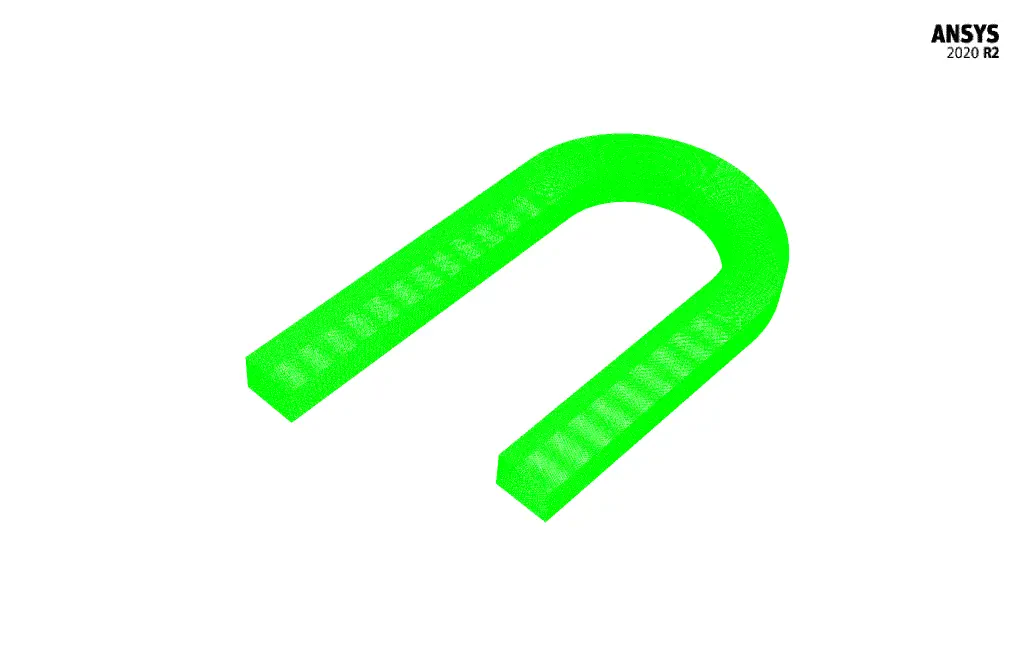
We carry out the model's meshing using ANSYS Meshing software. The mesh type is structured. The element number is 2316480. The following figure shows the mesh.
CFD Simulation
We consider several assumptions to simulate the present model:
- We perform a pressure-based solver.
- The simulation is steady.
- The gravity effect on the fluid is equal to -9.81 m.s-2 along the vertical axis.
The following table represents a summary of the defining steps of the problem and its solution:
| Models | ||
| Viscous | k-epsilon | |
| k-epsilon model | RNG | |
| near wall treatment | standard wall function | |
| Multiphase Model | VOF | |
| number of Eulerian phases | 2 (air & water) | |
| formulation | implicit | |
| VOF sub-models | open channel flow | |
| interface modeling | sharp | |
| Boundary conditions | ||
| Inlet | Mass Flow Inlet | |
| free surface level for water | 0.2 m | |
| bottom level for water | 0 m | |
| mass flow rate of water | 94.83 kg.s-1 | |
| mass flow rate of air | 0 kg.s-1 | |
| Outlet & Up | Pressure Outlet | |
| gauge pressure | 0 pascal | |
| Walls (Inner-Outer-Bottom) | Wall | |
| wall motion | stationary wall | |
| Methods | ||
| Pressure-Velocity Coupling | SIMPLE | |
| pressure | second order | |
| momentum | second order upwind | |
| volume fraction | compressive | |
| turbulent kinetic energy | first order upwind | |
| turbulent dissipation rate | first order upwind | |
| Initialization | ||
| Initialization methods | Standard | |
| gauge pressure | 0 pascal | |
| velocity (x,y,z) | 0 m.s-1 | |
| water volume fraction | 0 | |
| air volume fraction | 1 | |
Results
At the end of the solution process, three-dimensional contours related to pressure, velocity, kinetic turbulence energy, the volume fraction of water, and the volume fraction of air inside the 180-degree arc channel are obtained.