

Optimization of a Compressor Cascade Using MOGA (BBD DOE & GA RSM), ANSYS Fluent
Price: $150
- The problem numerically simulates the Optimization of a Compressor Cascade Using MOGA using ANSYS Fluent software.
- We design the 3-D model with the Spaceclaim software.
- We mesh the model with ANSYS Meshing software, and the element number equals 2655960.
- We use a Design of Experiment (DOE) to perform an Optimization process.
Description
A high-speed compressor cascade wind tunnel is used for investigations of secondary flow phenomena occurring in the region between the corner and sidewalls of axial compressors.
This project is an optimization of a compressor cascade using the MOGA method. In this project, we have simulated a sectional compressor cascade at the first step.
Then we optimized the problem for 3 input parameters and 2 output parameters. v_in (velocity inlet), alpha_degree (angle of attack), and pitch are considered input parameters. Also, drag force and lift force are considered output parameters.
The objective function for this project is defined in such a way that the drag force is minimized and reaches zero, the lift force is maximized and reaches 0.07 and the beta angle reaches -12 degrees.
The present geometry is designed in a 3D model via DesignModeler software and We have created a computational grid on the geometry using ANSYS Meshing software. The mesh type is unstructured (tetrahedrons cells) with 5 boundary layer mesh. Also, the number of cells is 2655960.
Cascade Methodology
All the optimization steps have been done by ANSYS Workbench software. This optimization has been done using Multi-Objective Genetic Aggregation.
Also, the Box-Behnken Design (BBD) method is used as a Design of Experiments step and Genetic Aggregation is used as an RSM step. The limited range of each input parameter is as in the following:
3<velocity-inlet<30m/s
1mm<pitch<7mm
-10°<Angle of Attack<+10°
Cascade Conclusion
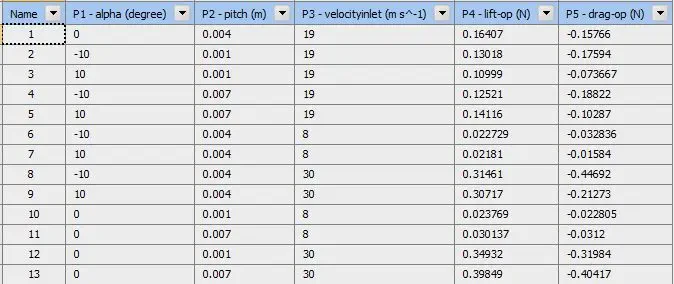
In each of the three main stages of optimization, the results were obtained for analysis and selection of the optimal point. The table below shows the design points along with the execution results for these points.
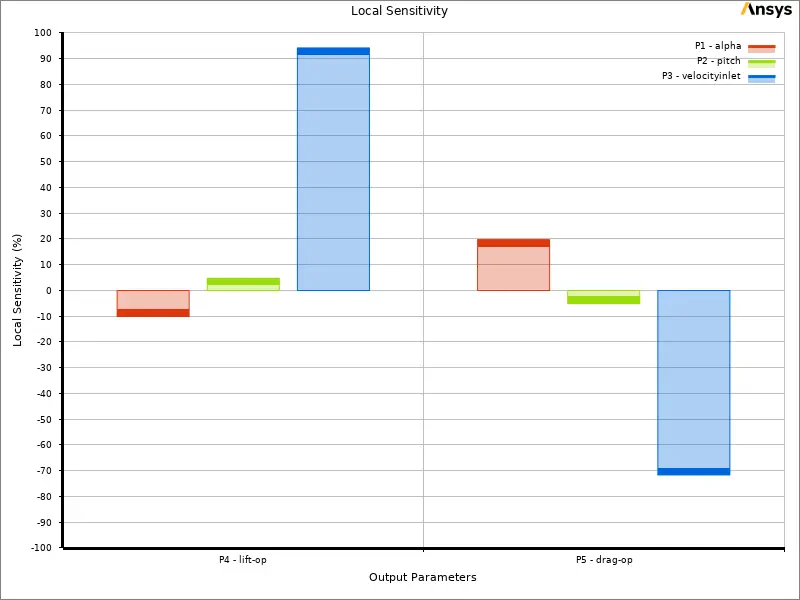
In ANSYS Workbench we can use the DOE results to create a response surface for prediction purposes. The images below show the sensitivity of the output parameters to the input parameters.
As it is known, the parametric changes for all three inputs have a positive effect on the lift force, which is the most effective for the velocity.
Although velocity as an input parameter for lift and drag has a positive effect, this effect is negative for the beta angle, and screw as an input parameter has the most effect on the beta angle.
In the last step, after performing the optimization, ANSYS Worbenched has suggested 3 points as optimal points, and 3 verified points.
