

Packed Bed CFD Simulation by ANSYS Fluent, Training
Price: $10
In this project, which has been done by the CFD simulation method with the help of Ansys Fluent software, and the results of this simulation have been analyzed.
Packed Bed CFD Simulation by ANSYS Fluent, Training
Price: $10
In this project, which has been done by the CFD simulation method with the help of Ansys Fluent software, and the results of this simulation have been analyzed.
Packed Bed Project Description
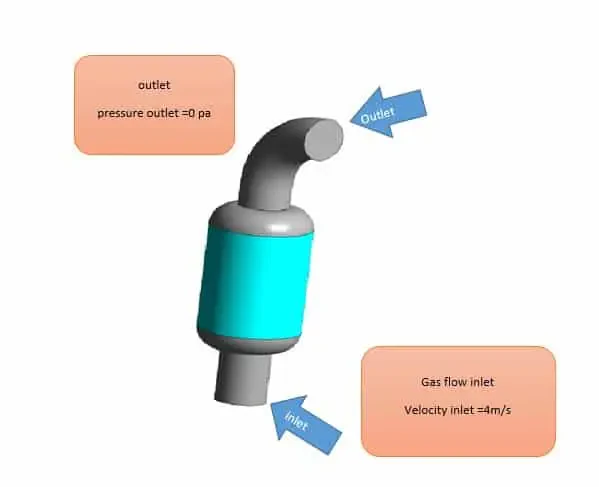
In this project, which has been done by the CFD simulation method with the help of Ansys Fluent software, the gas flow passing through the packed bed is simulated. The gas used is argon monoatomic gas, which enters at a speed of 4 m/s and for the outlet is defined zero Pascal gauge pressure. The packed bed area is a porous medium with an inertial resistance of 45 (1 / m) and viscous resistance of 3e9 (1 /m^2).
Geometry & Mesh
The three-dimensional geometry of this project has been produced with SpaceClaim software.
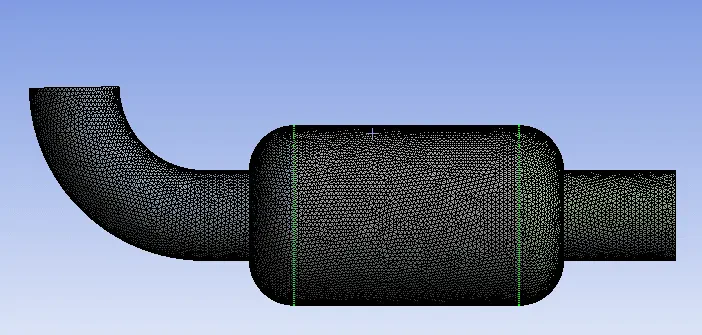
The length of the commutating domain is 80 mm, the width is 97 mm, and its height is 388 mm. meshing of this project has been done with Ansys Meshing software, and the type of elements is unstructured. Also, the total number of elements is 501444.
CFD Simulation
- the pressure-based solver method has been selected.
- The simulation is steady.
- The gravity effect is ignored.
The following tables represent a summary of the defining steps of the problem in this project and its solution:
| Models | ||
| Viscous model | k-epsilon | |
| Model | standard | |
| Cell zone conditions | ||
| Packed bed | Porous zone | on |
| Inertial resistance | 45 (1/m) | |
| Viscous resistance | 3e9 (1/m) | |
| Laminar zone | on | |
| Boundary conditions | ||
| Inlet | velocity inlet | |
| Velocity magnitude | 4m/s | |
| Outlet | Pressure outlet | |
| Gauge pressure | 0 pa | |
| Walls | Stationary wall | |
| Solution Methods | ||
| Pressure-velocity coupling | Coupled | |
| Spatial discretization | Pressure | Second-order |
| Momentum | second-order upwind | |
| Turbulent kinetic energy | first-order upwind | |
| Turbulent dissipation rate | first-order upwind | |
| Initialization | ||
| Initialization method | Hybrid |
Packed Bed Results
At the end of the simulation, we can see that a high-pressure drop has occurred in the porous area. The amount of pressure drop is directly related to the magnitude of the defined viscous and inertial resistances. To overcome this high-pressure drop, we must provide the pressure required to cross this barrier in the path before the gas enters the packed bed area using a pressure-boosting element such as a compressor.