Particle Distribution and Deposition in Indoor Environments; Paper Validation
Price: $210
- The current CFD analysis numerically validates the paper “Modeling particle distribution and deposition in indoor environments with a new drift–flux model” using ANSYS Fluent software.
- We designed and meshed the room geometry in Design Modeler and ANSYS Meshing, generating 128,000 cells.
- A pressure-based solver with k-ε RNG turbulence modeling is employed, and particle dynamics are simulated using the DPM model.
Particle Distribution and Deposition in Indoor Environments; Paper Validation
Price: $210
- The current CFD analysis numerically validates the paper “Modeling particle distribution and deposition in indoor environments with a new drift–flux model” using ANSYS Fluent software.
- We designed and meshed the room geometry in Design Modeler and ANSYS Meshing, generating 128,000 cells.
- A pressure-based solver with k-ε RNG turbulence modeling is employed, and particle dynamics are simulated using the DPM model.
Effect of Particle Distribution and Deposition in Indoor Environments with a New Drift–Flux Model Paper Validation: CFD Simulation By ANSYS Fluent
Project Description:
This project aims to validate the paper named “Modeling particle distribution and deposition in indoor environments with a new drift–flux model.” This validation investigates the ventilation of a room.
Geometry and Mesh:
The room’s geometry for validation was created by the Design Modeler software. The validation case, along with its details, will be presented. The simulation consists of a room with dimensions of 0.4m × 0.4m × 0.8m (width × height × length) that has one inlet and one outlet, both with a size of 4cm × 4cm. Then, the geometry was imported into the Ansys Meshing Software, generating 128,000 cells within this software.
Methodology:
The simulation for validation uses a pressure-based solution. The inlet velocity is 0.225 m/s. Particles have a diameter of 10 micrometers, and the density of the particle material is 1400 kg/m³. For turbulence modeling, we used the k-epsilon RNG model with a standard wall function. Air is treated as an incompressible gas in this simulation.
First, the flow and turbulence are solved under steady-state conditions, and after convergence, these equations are turned off. Then, DPM is activated, and unsteady particles are traced for 360 seconds. The results of the experimental study by Chen et al. will be used to validate the numerical results.
Results:
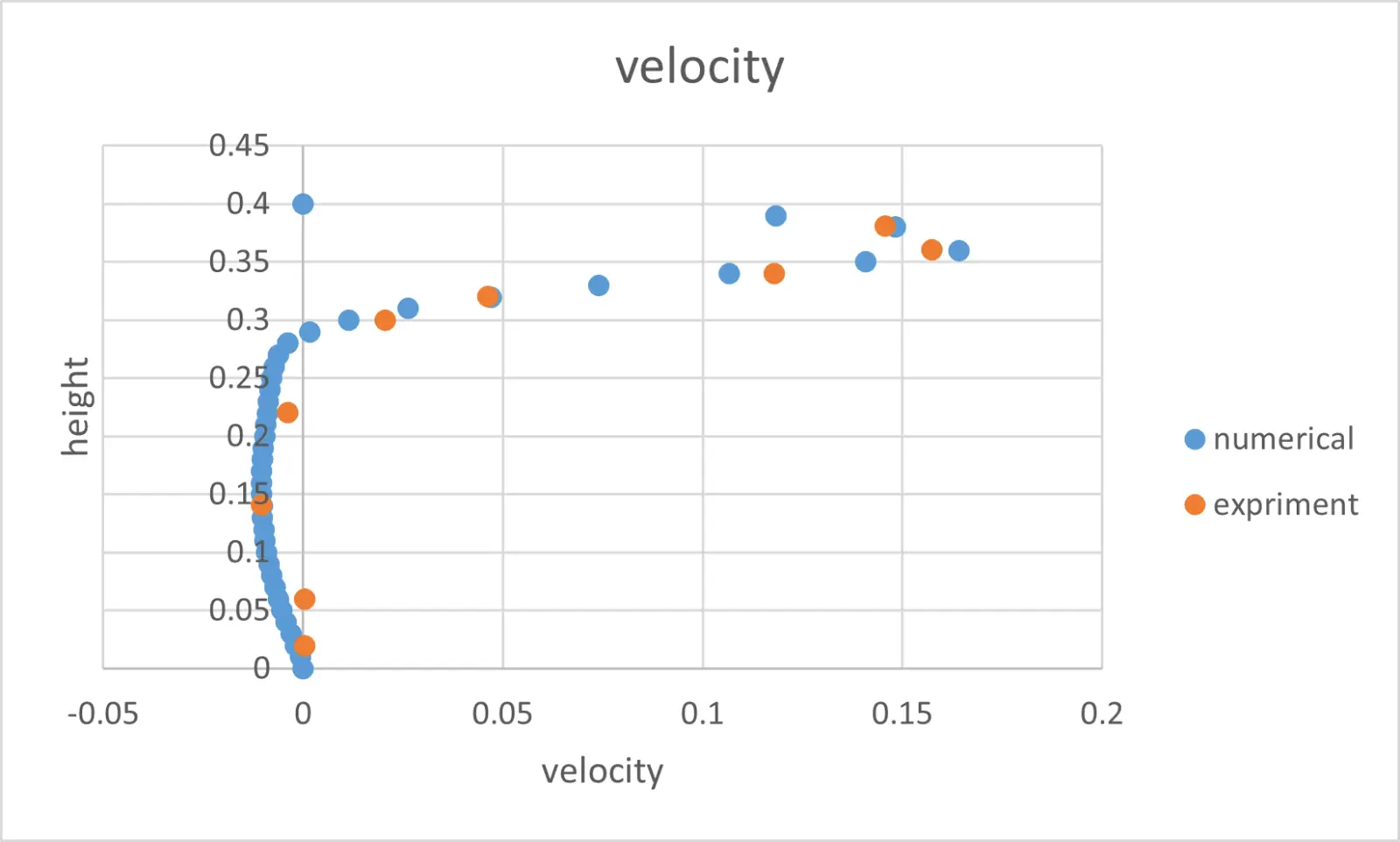
In the following graph, the velocity along the center line, with a length of 0.2 m, is shown for both numerical and experimental results.
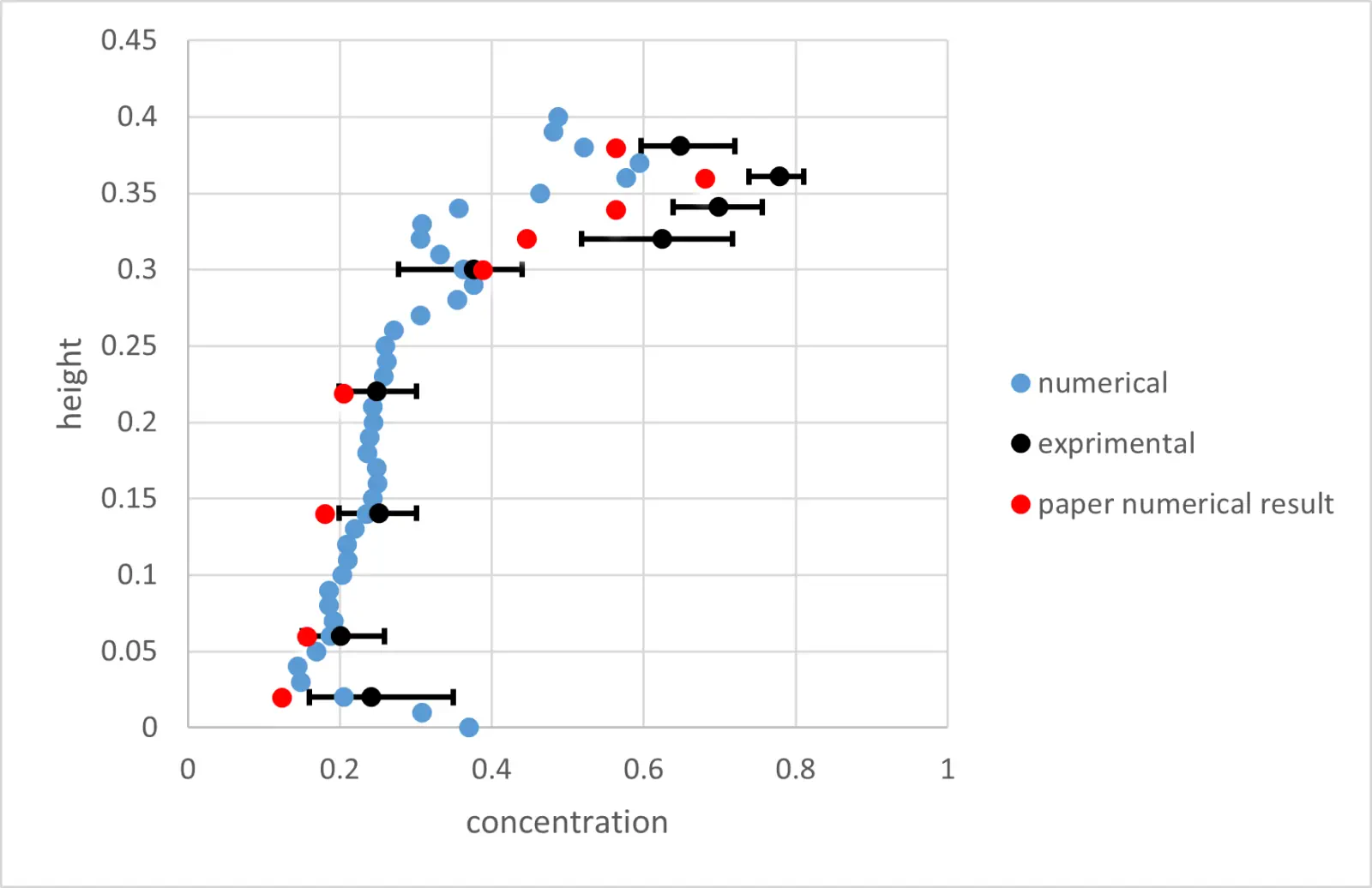
In the following graph, the DPM concentration along the center line with a length of 0.2m is shown for both numerical and experimental results.