

PCM Components in Hot Water Tank Thermal Analysis (Load & Discharge), CFD Simulation Training
Price: $36
In this project, PCM components in a hot water tank are simulated.
PCM Components in Hot Water Tank Thermal Analysis (Load & Discharge), CFD Simulation Training
Price: $36
In this project, PCM components in a hot water tank are simulated.

Phase Change Material (PCM) Project Description
A Phase Change Material (PCM) is a substance that releases/absorbs sufficient energy at phase transition to provide useful heat or cooling. Generally, the transition will be from one of the first two fundamental states of matter - solid and liquid - to the other.
The phase transition may also be between non-classical states of matter, such as the conformity of crystals, where the material goes from conforming to one crystalline structure to conforming to another, which may be a higher or lower energy state.
By melting and solidifying at the Phase Change Temperature (PCT), a PCM is capable of storing and releasing large amounts of energy compared to sensible heat storage.
Heat is absorbed or released when the material changes from solid to liquid and vice versa or when the internal structure of the material changes; PCMs are accordingly referred to as Latent Heat Storage (LHS) materials.
The system consists of 16 PCM capsules placed in the water tank which hot water enters the domain with a speed of 0.5 m/s and a temperature of 335 k. when PCMs are completely turned to liquid, the cold water enters the system and cools down the PCM’s. by cooling down PCM’s start to solidify.
Geometry & Mesh
The 3-D domain of this simulation has been designed in ANSYS Design Modeler. Domain has an inlet and outlet and a wall for PCMs.
The meshing of this present model has been generated by ANSYS Meshing software. The mesh grid is unstructured, and the total cell number is 339466 elements.
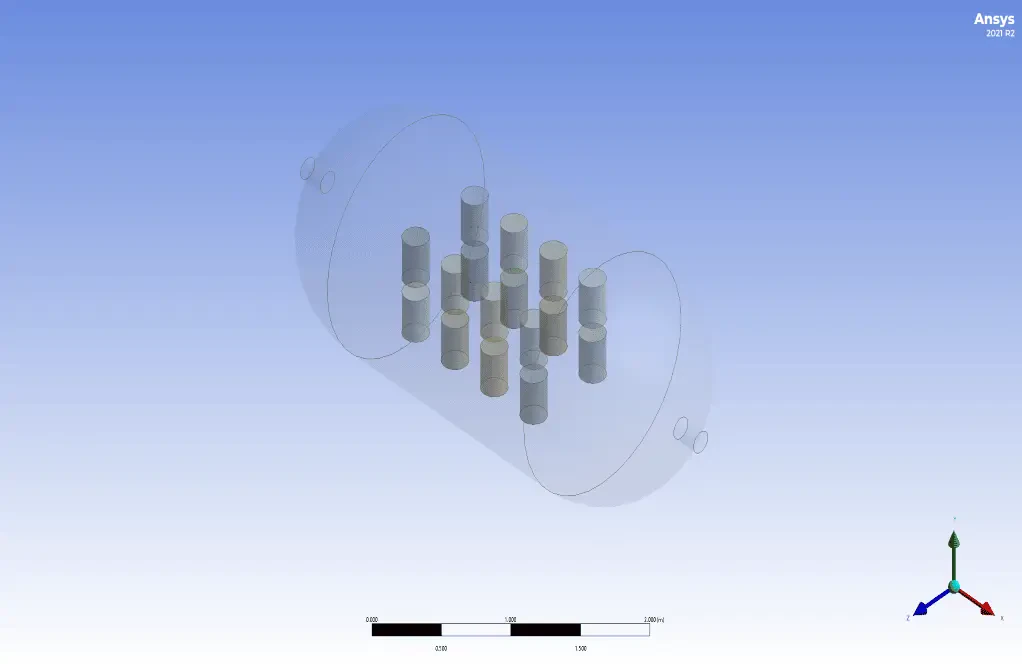
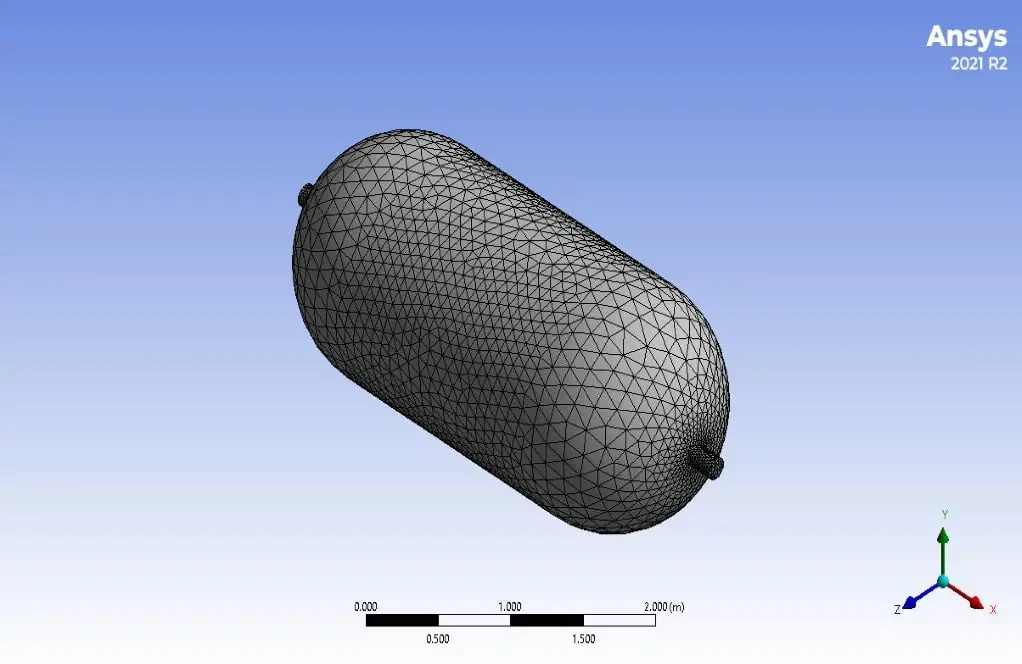
Phase Change Material (PCM) CFD Simulation
To simulate the present model, several assumptions are considered, which are:
- The solver is pressure-based.
- The effect of gravity on the flow has not been considered.
- The present model is unsteady.
The following summarizes the steps for defining the problem and its solution.
| Models | ||
| K-omega | Viscous model | |
| SST | K-omega Model | |
| Pressure based | Solver | |
| unsteady | Timestep | |
| On | Energy | |
| Boundary conditions | ||
| Velocity-inlet | inlet | |
| 0.5 m/s | Fluid inlet velocity | |
| 333 k | Hot water temperature | |
| 272 k | Cold water temperature | |
| Pressure outlet | outlet | |
| 0 | gage pressure | |
| wall | wall | |
| stationary wall | wall motion | |
| Non | Thermal condition | |
| wall | PCM wall | |
| stationary wall | wall motion | |
| Coupled | Thermal condition | |
Phase Change Material (PCM) Results
The first instance, according to the graph of the average temperature of the environment and PCMs, shows that with the entry of hot water, the temperature of the environment increases, which causes the average temperature of the PCMs to increase and shows the process of melting in 343 seconds.
Gives. After 1500 seconds, all the PCMs are completely melted, and cold-water flows into the domain, the effects of which are evident in the average temperature diagram and causes the average temperature of the domain to decrease. PCMs release the stored heat slowly, and their average temperature decreases at a slower rate.
After 500 seconds after entering the cold water, the PCMs start to solidify, and in 4500 seconds, they are completely solidified.