Plate Silencer and Sound Absorption CFD Simulation
Price: $16
The present problem simulates the sound pressure waves a plate silencer absorbs using ANSYS Fluent software.
Plate Silencer and Sound Absorption CFD Simulation
Price: $16
The present problem simulates the sound pressure waves a plate silencer absorbs using ANSYS Fluent software.

Plate Silencer and Sound Absorption CFD Simulation (Acoustic), ANSYS Fluent Training
The present problem simulates the sound pressure waves a plate silencer absorbs using ANSYS Fluent software. An acoustic model has been used in the software to simulate and analyze sound or acoustic waves. In general, mechanical waves within a fluid are caused by the vibrations and reciprocating motions of the fluid layers. For example, when a layer of air moves forward in a specific direction, the next layer of fluid pushes itself forward, and the layer returns to its original position. These reciprocating movements of the air layers must continue until the energy within the airflow is depleted.
Now if this number of reciprocating movements reaches more than 16 times per second, the sound is produced. When we hit the surface of a solid object with our hand, the layers of air between our hand and the surface begin to move back and forth; if the number of these round trips is more than 16 times per second, the sound is produced by our hand hitting a solid surface. But, one of the problems in various industries is the production of very loud and abnormal sounds due to the propagation of sound waves. Therefore, in such cases, the use of silencers seems imperative.
The basis of the working mechanism of these mufflers is that by receiving sound waves from the environment, the silencer starts vibration. Finally, the sound wave and the silencer components (plate silencer) mode shapes equalize, and this causes the ambient sound waves to be absorbed by the muffler. To perform such steps, the plate silencer has some plates inside itself. The plates absorb the sound by adapting their mode shapes due to the vibration caused by the sound waves. These mufflers are used in various industries such as metallurgy, power, mining, subway tunnels, automotive, and interior architecture.
The material and type of design of the silencers are such that they can absorb the sounds produced with different frequencies, and in the range of human hearing from 63 to 800 Hz, they can provide the conditions of environmental comfort in terms of sound. Simulation and analysis of these silencers are of great importance; Because if designed incorrectly, the muffler will not only not be able to absorb sound but also increase the sound problems. In the present project, a plate silencer is modeled with a symmetrical structure with a sinusoidal or wavy plate in the middle of its body.
In this simulation, it is assumed that the desired pressure waves have already been created inside this muffler, and our work aims to investigate the behavior of these waves in the longitudinal direction of this muffler and also the plate silencer efficiency. To define the acoustic model in the present simulation, the Ffowcs-Williams & Hawkings model is used. Definitive density is equivalent to air density, ie 1.225 kg / m3, sound speed is equivalent to sound speed in the air, i.e., 340 m / s, and reference acoustic pressure is equal to 0.00002 pascals. Acoustic sources are also defined near the airflow inlet boundary.
In this modeling, airflow enters the muffler at a speed of 1.461 m.s-1 and a temperature of 403.15 K and exits at a pressure equal to the ambient pressure. The plate of the silencer system consists of three parts, which are smooth in the initial and final parts of the system and have a structure with wavy geometry in the middle part of the system that shows a specific vibration mode shape. These plates of are made of aluminum and have a heat transfer coefficient of 20 W.m-2.K-1. Also, the surrounding environment with a free stream temperature equals 298.15 K.
Geometry & Mesh
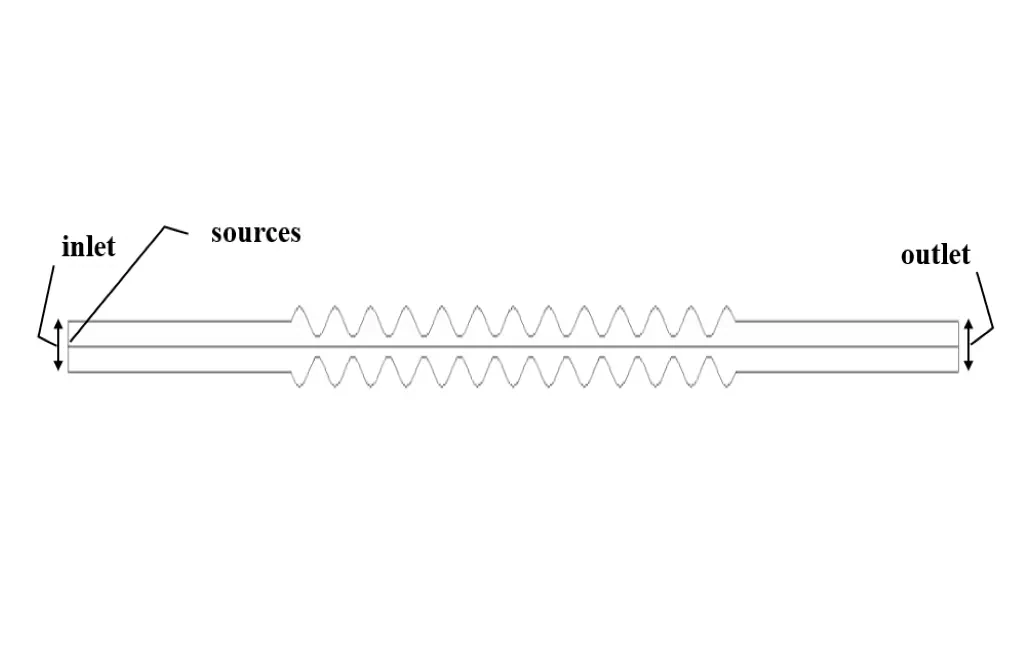
The present model is designed in two dimensions using Design Modeler software. The model has a symmetrical structure whose middle wall has a sinusoidal and wavy structure. Adjacent to the airflow inlet boundary, a section is defined as the source of sound wave propagation. The wavy plate is drawn in such a way that it has a wave amplitude of 0.015 m.
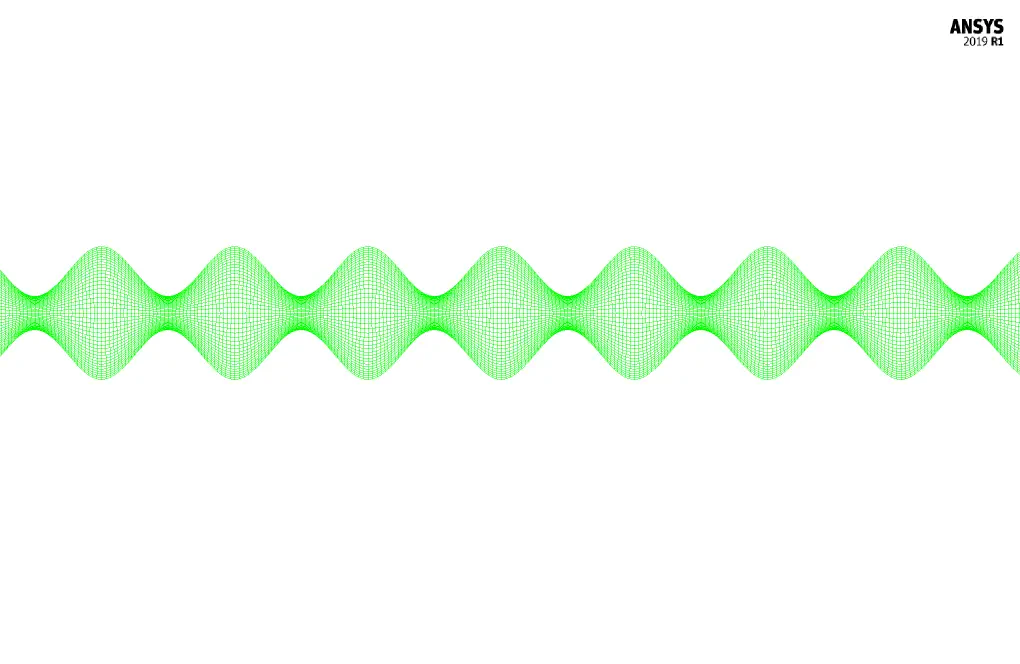
The meshing of the model has been done using ANSYS Meshing software and the mesh type is structured. The element number is 17000. The following figure shows the mesh.
CFD Simulation
To simulate the present model, several assumptions are considered:
- We perform a pressure-based solver.
- The simulation is unsteady because the purpose of this simulation is to investigate the behavior of acoustic waves over time.
- We ignore the gravity effect on the fluid.
The following table represents a summary of the defining steps of the problem and its solution:
| Models | ||
| Viscous | k-epsilon | |
| k-epsilon model | realizable | |
| near wall treatment | enhanced wall treatment | |
| Acoustics Model | Ffowcs-Williams & Hawkings | |
| far-field density | 1.225 kg.m-3 | |
| far-field sound speed | 340 m.s-1 | |
| Reference acoustic pressure | 0.00002 pascal | |
| Energy | On | |
| Boundary conditions | ||
| Inlet | Velocity Inlet | |
| velocity magnitude | 1.461 m.s-1 | |
| temperature | 403.15 K | |
| Outlet | Pressure Outlet | |
| gauge pressure | 0 pascal | |
| Wave Walls | Wall | |
| wall motion | stationary wall | |
| free stream temperature | 298.15 K | |
| heat transfer coefficient | 20 W.m-2.K-1 | |
| Methods | ||
| Pressure-Velocity Coupling | SIMPLE | |
| Pressure | second order | |
| momentum | second-order upwind | |
| turbulent kinetic energy | second-order upwind | |
| turbulent dissipation rate | second-order upwind | |
| energy | second-order upwind | |
| Initialization | ||
| Initialization methods | Standard | |
| gauge pressure | 0 pascal | |
| axial velocity | 1.461 m.s-1 | |
| radial velocity | 0 m.s-1 | |
| temperature | 403.15 K | |
Results
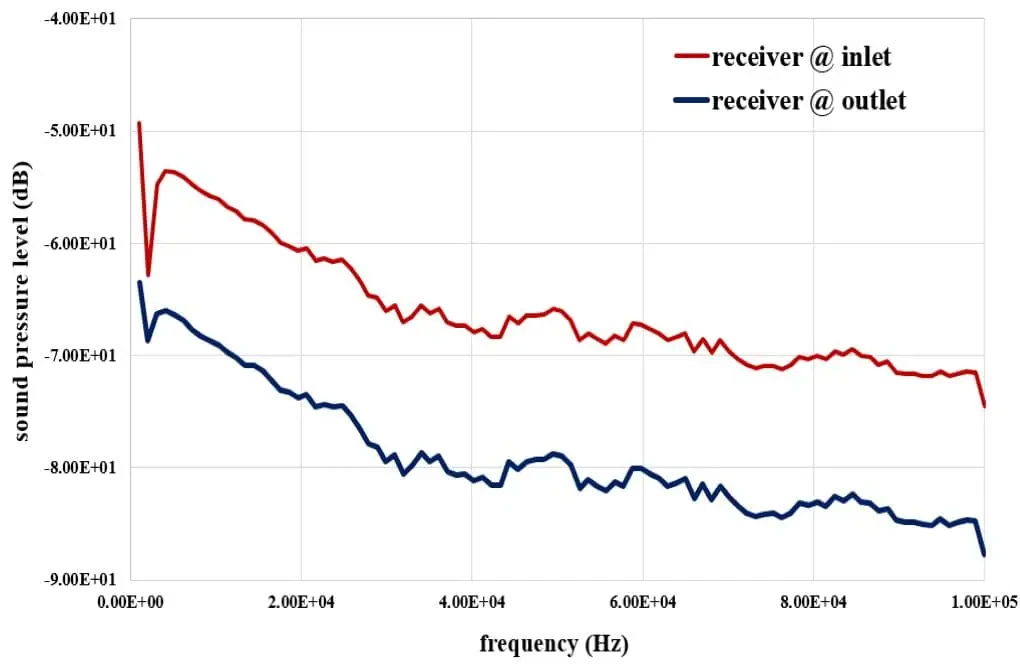
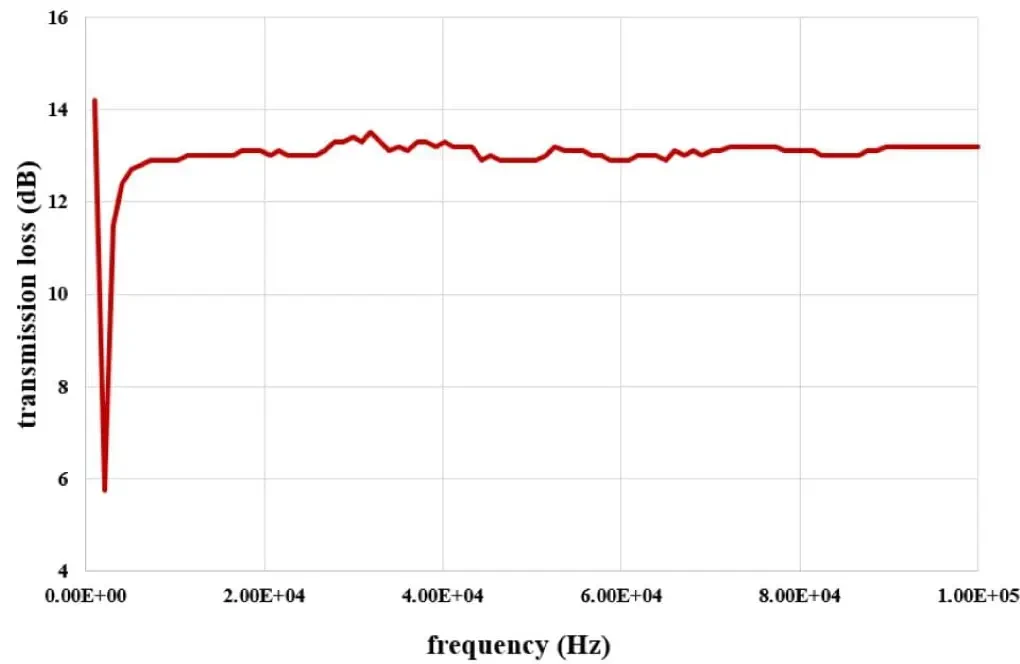
At the end of the solution process, we obtain two-dimensional counters related to pressure, velocity, and temperature, as well as diagrams of velocity changes along the central axis of the system. Also, we present the inlet and outlet receivers' Sound Pressure Levels (dB) in terms of different frequencies. Finally, you can see the Transmission Loss diagram.