Porous Zone Inside 3D Channel ANSYS CFX Tutorial
Price: $60
- The problem numerically simulates a Porous Zone inside 3D cylinder using ANSYS CFX software.
- We modeled the geometry using ANSYS Design Modeler and created the mesh using ANSYS Meshing software.
- The mesh type is Structured and the number of them is 1,308,762.
- Porosity has been used in the simulation.
- Pressure Drop inside the channel due to porosity is investigated.
Description
In this project, a 3-dimensional simulation of a channel with a Perforated Plate is performed using ANSYS CFX software. Ethanol enters the domain with a velocity of 0.25m/s from the inlet and collides with the porous zone located in the middle of the domain. This interaction causes a dramatic drop in pressure.
Design modeler software was used to create the 3D geometry. A 1.2-meter-long in z-direction cylinder with a perforated plate is 55 cm apart from the inlet and outlet. In addition, a Structured mesh grid was produced using ANSYS Meshing software, generating a total of 1,308,762 elements.
Methodology: Porous Zone Inside 3D Channel
The simulation is independent of Time, so it has performed in steady state form. Moreover, the gravitational effects are ignored.
Turbulence model is Shear Stress Transport (SST).
The Advection Scheme and Turbulence Numerics is set to High Resolution.
Also, the Isotropic Porous Model is used inside the cylinder, while the Loss Velocity Type is set to True Velocity.
Conclusion
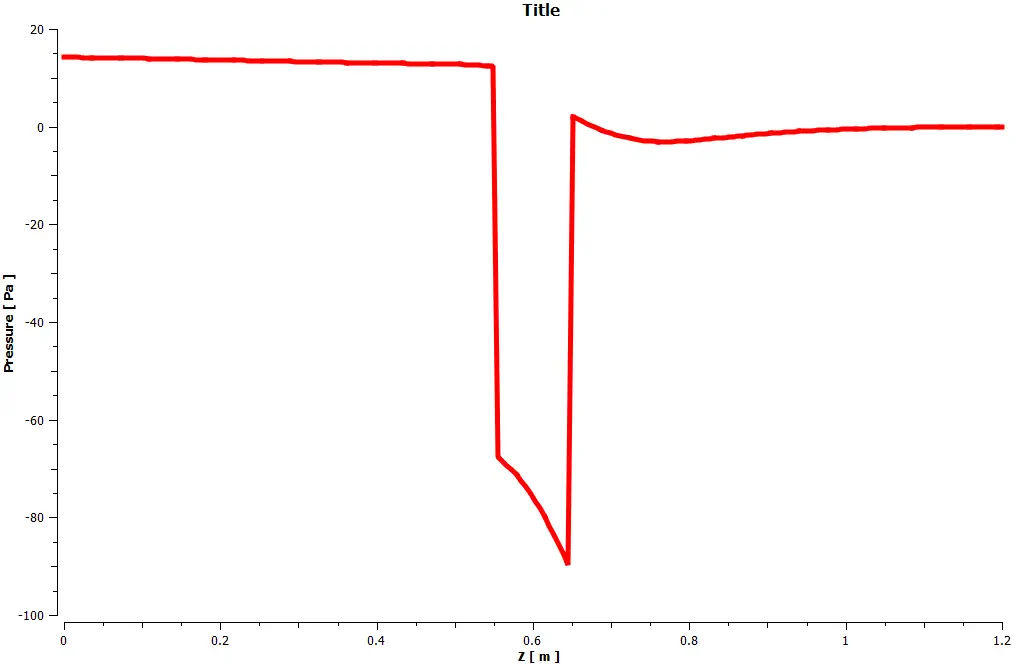
The Ethanol flow enters the channel with a 0.25m/s velocity magnitude. After a while, a collision with a perforated plate with 0.5 porosity causes an extreme pressure drop. As can be seen in the following plot, the amount of pressure decreases suddenly from 16 to zero. Also, this pressure drop is clearly visible in the 2D and 3D contours above.
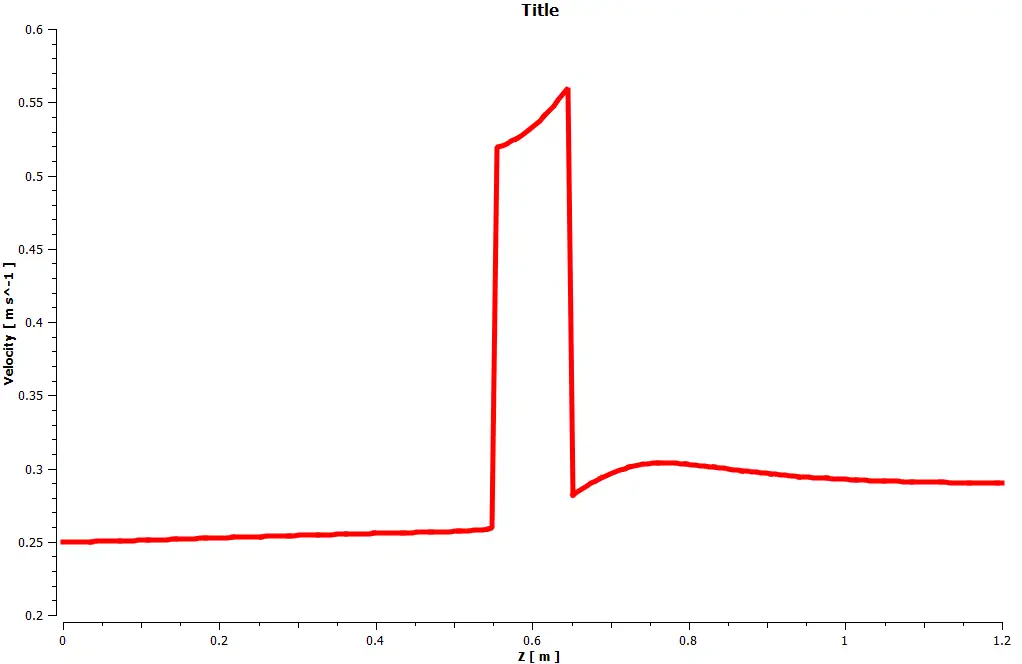
Concerning the velocity magnitude of Ethanol inside the cylinder, it starts to increase from the entrance until it reaches the porous zone. Due to the interactions inside the porosity, the velocity shoots up by about two times and after that decreases suddenly and starts to diminish with the low slope it had at the beginning.