

Premixed Combustion in a Porous Zone CFD Simulation
Price: $54
- The problem numerically simulates the Premixed Combustion in Porous Zone using ANSYS Fluent software.
- We design the 3-D model by the Design Modeler software.
- We Mesh the model by ANSYS Meshing software.
- The mesh type is Structured, and the element number equals 8700.
- We use the Premixed Combustion in Species model to define combustion reactions.
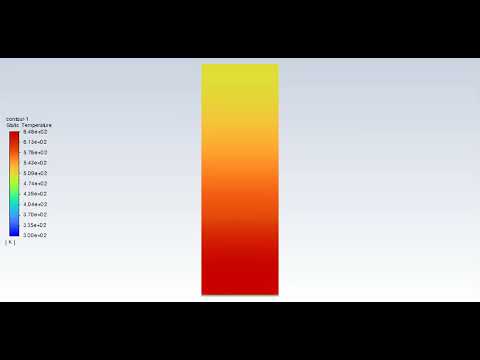
Premixed Combustion in a Porous Zone, CFD Simulation Ansys Fluent Training
In this project, Premixed Combustion in Porous Zone has been simulated, and the simulation results have been investigated using ANSYS Fluent software. We perform this CFD project and investigate it by CFD analysis.
The 3-D geometry of the present model is carried out using Design Modeler software. The geometry consists two-section, the lower section is preheating, and the upper section is a stable burn region.
The meshing of this present model has been generated by Ansys Meshing software. The mesh grid is Structured, and the total cell number is 8700.
Premixed Combustion Methodology
This simulation aims to model Simple Premixed Combustion in a Porous zone by Ansys Fluent Software and see how a porous zone affects combustion temperature and stabilizes it.
This simulation is a matrix-stabilized burner, and the results are compared to the same premixed combustion without porosity. The Species transport model has been used.
The mixture flow enters the domain with a 0.23 methane mass fraction and 0.77 oxygen mass fraction. Then, using the ignition spark sub-model, the combustion process starts.
Also, the gravity is considered as -9.81 m/s-2 on the y-axis. Moreover, the SST k-omega model is used to solve turbulent fluid equations.
Premixed Combustion Conclusion
At the end of the solution process, three-dimensional velocity, air and water volume fraction, and animation are obtained. The result shows that the porous zone affects static temperature by reducing it and making combustion more monotonous and stable than a zone without porosity.