Radiant Solar Collector Applying PCM: Numerical Analysis and Heat Transfer CFD Simulation by ANSYS Fluent
Price: $120
- In this project, the numerical investigation of a radiant solar collector is conducted utilizing ANSYS SpaceClaim software, inspired by advanced modeling techniques.
- The 3D geometry is meticulously crafted and meshed with 647,500 elements, emphasizing an unstructured grid and refinement near the tubes to enhance simulation accuracy.
- The RNG K-epsilon turbulence model serves as the foundation for simulating the flow field, while the solidification and melting module addresses the PCM zone characteristics.
- Momentum, turbulence, and energy equations are tackled using the SIMPLE algorithm with second-order upwind discretization for precision.
- The simulation focuses on fluid dynamics and heat transfer, crucial for understanding the collector's performance under variable environmental conditions, despite the exclusion of radiation effects.
Radiant Solar Collector: Numerical Analysis and Heat Transfer Simulation
Project Description
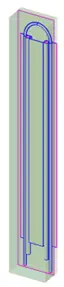
In this project, a radiant solar collector is numerically investigated. The 3D model is designed in ANSYS Spaceclaim software. Then, an unstructured meshgrid is generated. It is worth noting that boundary layer is used near the tubes to increase the accuracy of the simulation. The following figure shows the modeled geometry.
Methodology
The RNG K-epsilon turbulence model is used to simulate the flow field. Also, the solidification and melting module is employed in order to simulate the PCM zone.
Momentum, turbulence, and energy equation are solved with a segregated method called SIMPLE algorithm. Furthermore, pressure, momentum, and energy term are discretized with the second-order upwind method.
Results
After the simulation process, the results were extracted as reported in the following. The fluid flow enters the tube with 3.55 kg/s mass flow and 60°C degree. Its high temperature affects the tube wall, plaster, microcapsules and then PCM, respectively. Moreover, the plaster is in contact with the insulation layer from one side and the environment from the other side. The convective heat transfer between the plaster and the environment was modeled using the convection method. The heat transfer coefficient is 15 W/m^2.K and the free stream temperature varies during the day.
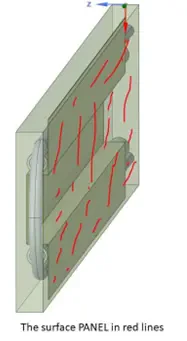
The results were reported on a panel surface as shown below:
The following tables contain the energy obtained by the panel surface and its average temperature and also the liquid fraction of PCM zones:
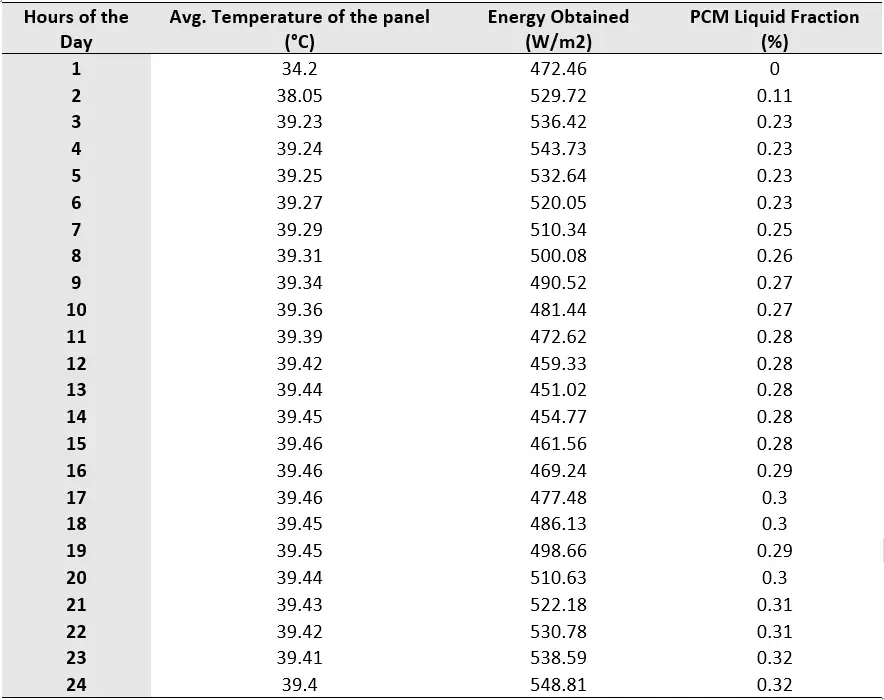
The results show that the water fluid flow is dominant in the computational domain`s condition. In other words, the free stream temperature can barely influence the radiant solar collector condition. It should be noted that the radiation effects were ignored in this simulation although, it is anticipated to be effective.
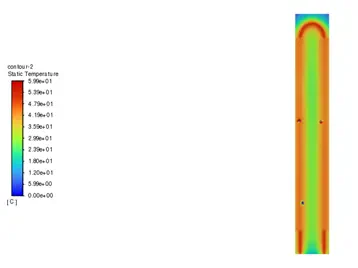
Here is the temperature distribution contour extracted from the simulation: