

Radiator Heat Transfer Simulation by Hot Nanofluid Flow, ANSYS Fluent
Price: $20
The present problem simulates heat transfer inside a radiator with nanofluid flow using ANSYS Fluent software.
Radiator Heat Transfer Simulation by Hot Nanofluid Flow, ANSYS Fluent
Price: $20
The present problem simulates heat transfer inside a radiator with nanofluid flow using ANSYS Fluent software.

Project Description
The present problem simulates heat transfer inside a radiator with nanofluid flow using ANSYS Fluent software. The working mechanism of these radiators is such that the flow of hot fluid passes through the pipes inside the radiator and on the other hand, the air flow also passes through the pipes. In this way, the air flow passes through the pipes carrying the hot flow, receiving their heat, and as a result, the resulting hot air flow is transferred to the outside environment. In this simulation, hot nanofluid flows at a velocity of 0.1 ms-1 and a temperature of 343.15 K flows through three pipes inside the radiator, and cold air flows at a velocity of 3 ms-1 and a temperature of 293.15 K passes over this pipe.
To define the hot fluid inside the pipes inside the radiator, a kind of nanofluid has been used. The nanofluid used in this model is Al2_O3-Water which has a density equal to 1086.287 kg.m-3 and a specific heat capacity equal to 3804.691 j.kg-1.K-1 and a thermal conductivity equal to 0.6672643 Wm-1.K- 1 and the viscosity is equal to 0.00108236 kg.m-1.s-1. The purpose of this work is to investigate the quality of heat transfer inside the radiator in the presence of hot nanofluid.
Radiator Geometry & Mesh
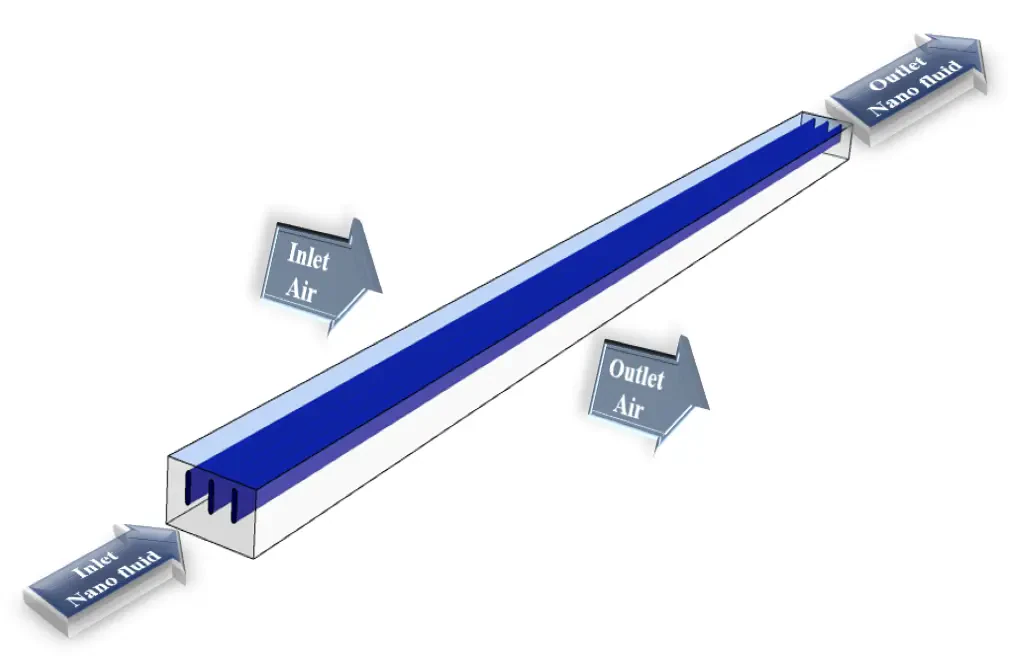
The present model is designed in three dimensions using Spaceclaim software. The model includes a symmetrical radiator, which is semi-drawn due to its symmetrical geometric structure and in order to avoid heavy calculations. This radiator has air inlet and outlet sections on both sides. Also inside this radiator, three pipes have been designed for the passage of nanofluid flow.
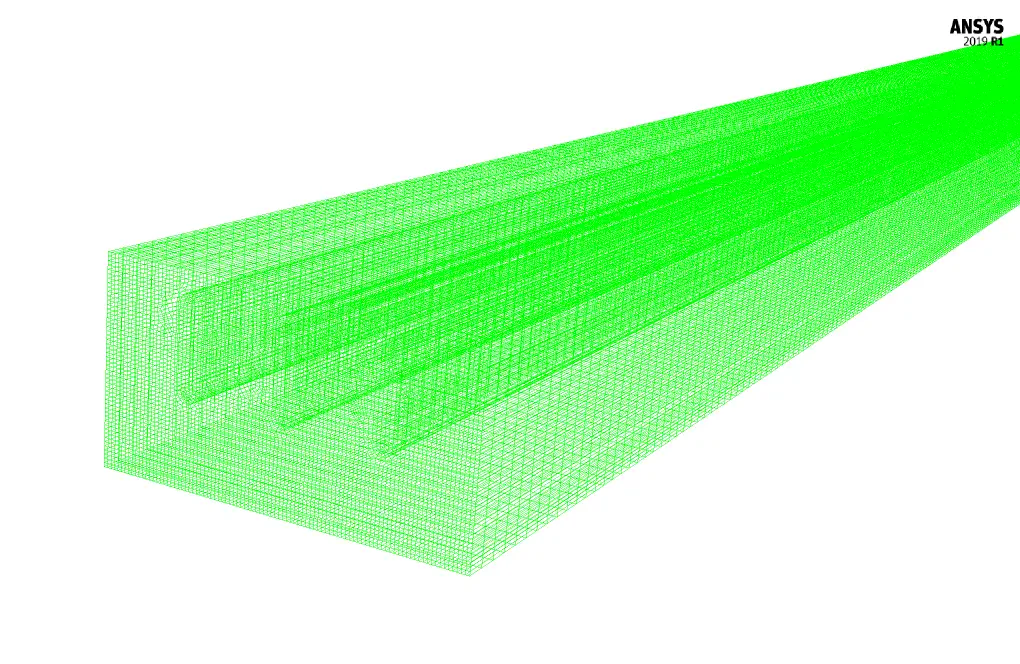
The meshing of the model has been done using ANSYS Meshing software and the mesh type is unstructured. The element number is 1,033,305. The following figure shows the mesh.
Radiator CFD Simulation
To simulate the present model, several assumptions are considered:
- We perform a pressure-based solver.
- The simulation is steady.
- The gravity effect on the fluid is ignored.
The following table represents a summary of the defining steps of the problem and its solution:
| Models (radiator) | ||
| Viscous | k-epsilon | |
| k-epsilon model | standard | |
| near wall treatment | standard wall functions | |
| Energy | On | |
| Boundary conditions (radiator) | ||
| Inlet - Air | Velocity Inlet | |
| velocity magnitude | 3 m.s-1 | |
| temperature | 293.15 K | |
| Inlet - Nanofluid | Velocity Inlet | |
| velocity magnitude | 0.1 m.s-1 | |
| (heat transfer) | temperature | 343.15 K |
| Outlet - Air | Pressure Outlet | |
| gauge pressure | 0 pascal | |
| Outlet - Nanofluid | Pressure Outlet | |
| gauge pressure | 0 pascal | |
| Internal Walls | Wall | |
| wall motion | stationary wall | |
| thermal condition | coupled | |
| Bottom Wall | Wall | |
| wall motion | stationary wall | |
| heat flux | 0 W.m-2 | |
| Methods (heat transfer) | ||
| Pressure-Velocity Coupling | Coupled | |
| Pressure | second order | |
| momentum | second order upwind | |
| energy | second order upwind | |
| turbulent kinetic energy | second order upwind | |
| turbulent dissipation rate | second order upwind | |
| Initialization (heat transfer) | ||
| Initialization methods | Standard | |
| gauge pressure | 0 pascal | |
| x-velocity | 3 m.s-1 | |
| y-velocity , z-velocity | 0 m.s-1 | |
| temperature | 293.15 K | |
Results
At the end of the solving process, two-dimensional and three-dimensional contours related to pressure, velocity, and temperature are obtained.